
What is the Photon Energy Calculator?
This tool computes the energy carried by a single photon of light. A photon's energy depends only on its frequency (or, equivalently, its wavelength). Enter either a wavelength in nanometers or a frequency in terahertz, and the calculator returns the photon energy in joules and electronvolts, along with the matching frequency and wavelength. It works for any part of the electromagnetic spectrum — radio, infrared, visible, ultraviolet, X-rays and gamma rays.
How to use it
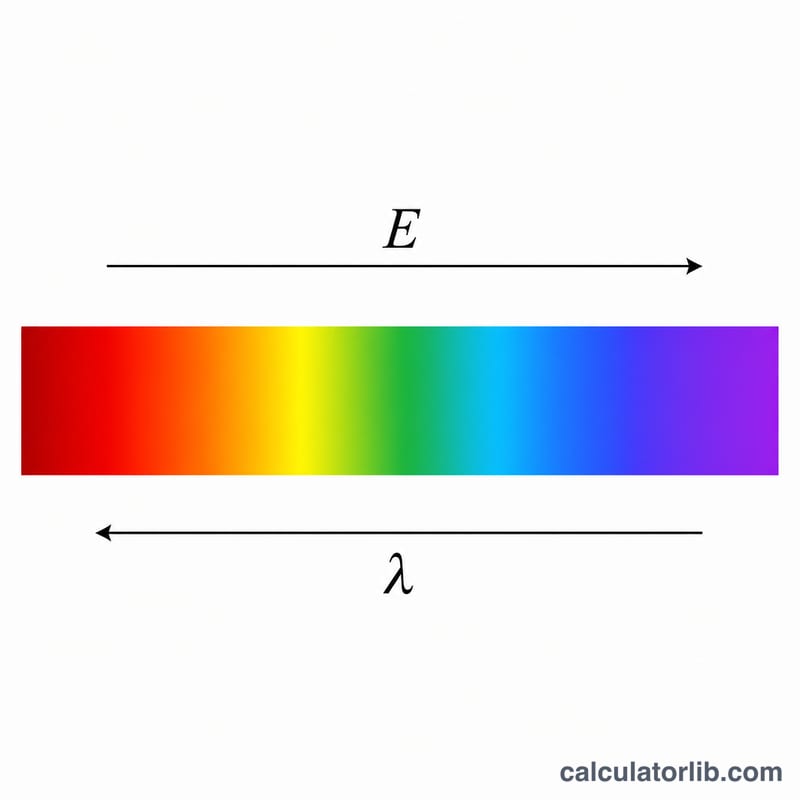
Pick whether you want to enter a wavelength or a frequency. For visible light, wavelengths run roughly from 380 nm (violet) to 700 nm (red). Type your value and read off the photon energy. Switching modes lets you check the inverse relationship: shorter wavelengths and higher frequencies always mean more energetic photons.
The formula explained
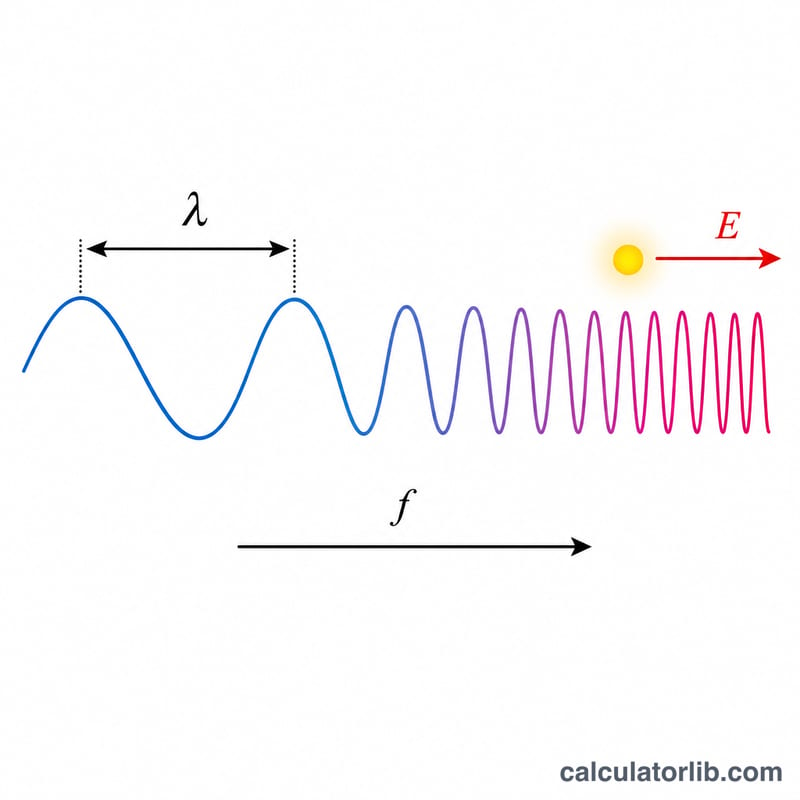
The Planck–Einstein relation states \(E = hf\), where \(h = 6.626 \times 10^{-34}\ \text{J}\cdot\text{s}\) is Planck's constant and \(f\) is frequency in hertz. Because the speed of light links frequency and wavelength as \(c = f\lambda\) (with \(c = 2.998 \times 10^{8}\ \text{m/s}\)), we can also write $$E = \frac{hc}{\lambda}$$ To express the result in electronvolts, we divide the energy in joules by the elementary charge, \(1.602 \times 10^{-19}\ \text{C}\).
Worked example
Consider green light with a wavelength of \(500\ \text{nm} = 5.00 \times 10^{-7}\ \text{m}\). The frequency is $$f = \frac{c}{\lambda} = \frac{2.998 \times 10^{8}}{5.00 \times 10^{-7}} \approx 5.996 \times 10^{14}\ \text{Hz}$$ (about 600 THz). The energy is $$E = hf = 6.626 \times 10^{-34} \times 5.996 \times 10^{14} \approx 3.97 \times 10^{-19}\ \text{J}$$ which is about 2.48 eV — a typical value for visible photons.
FAQ
Why is energy proportional to frequency, not wavelength? Quantum theory says light comes in packets whose energy scales directly with frequency. Since wavelength is inversely related to frequency, shorter wavelengths carry more energy.
What units should I use? Enter wavelength in nanometers (nm) or frequency in terahertz (THz). The calculator converts internally to meters and hertz.
Does this apply to a beam of light? The result is the energy of one photon. To get the energy of many photons, multiply by the number of photons.