
What Is the Vickers Hardness Number?
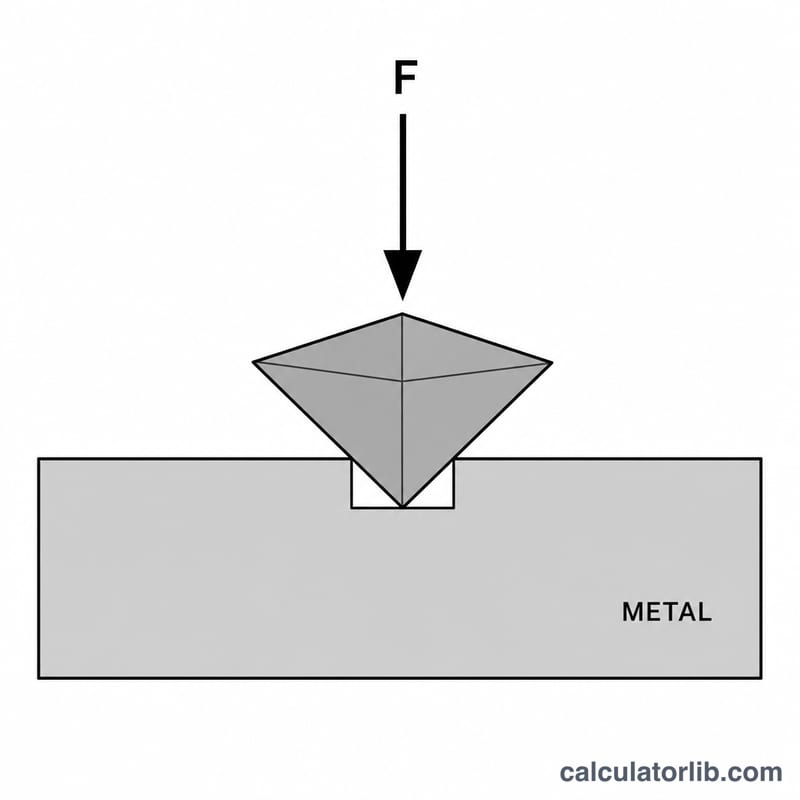
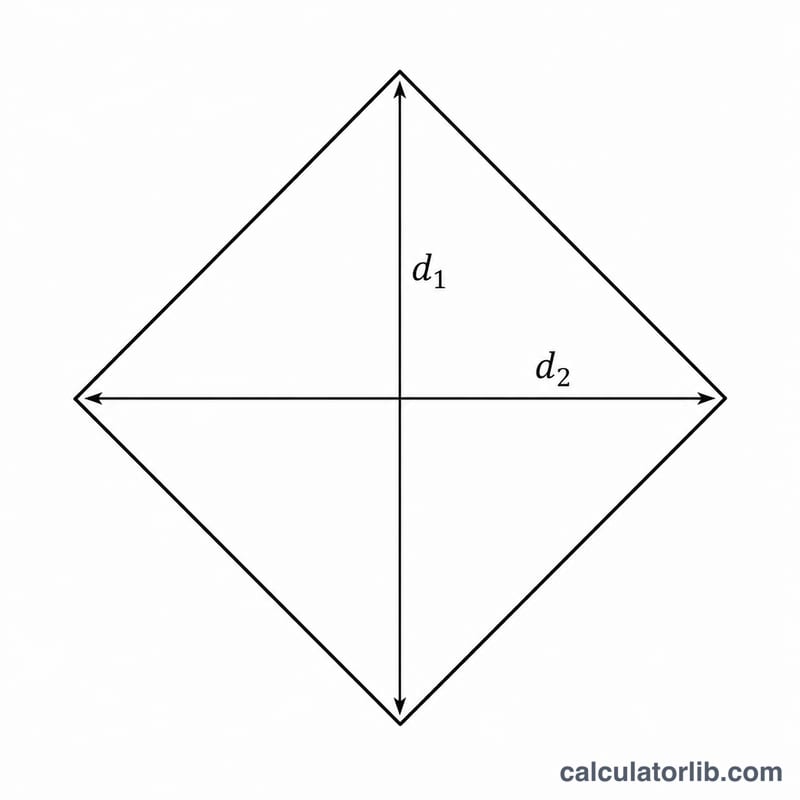
The Vickers Hardness Number (HV) measures a material's resistance to indentation. In a Vickers hardness test, a diamond indenter shaped like a square-based pyramid (with a 136° angle between opposite faces) is pressed into the surface under a known load. The two diagonals of the resulting square impression are measured under a microscope and averaged. The hardness is then computed from the load and this mean diagonal. The Vickers test is widely used because a single continuous scale covers everything from soft metals to hardened steels and ceramics.
How to Use This Calculator
Enter the applied load F in kilogram-force (kgf) and the mean diagonal d in millimeters (mm). The calculator returns the Vickers Hardness Number (HV). Make sure both diagonals were measured and averaged before entering the value, and that the load matches the one applied during testing.
The Formula Explained
The standard formula is:
$$\text{HV} = 1.854 \times \frac{\text{Load }F\text{ (kgf)}}{\text{Diagonal }d\text{ (mm)}^{2}}$$
The constant 1.854 comes from the geometry of the 136° pyramidal indenter: HV equals the load divided by the contact surface area of the indentation. Because area scales with the square of the diagonal, doubling the diagonal for the same load reduces hardness by a factor of four.
Worked Example
Suppose a load of 10 kgf produces a mean diagonal of 0.25 mm. Then:
$$\text{HV} = 1.854 \times \frac{10}{(0.25)^{2}} = \frac{18.54}{0.0625} = \mathbf{296.64\ \text{HV}}$$
FAQ
What units should I use? Use kgf for the load and mm for the diagonal. The result is dimensionless and reported in HV units.
How is HV usually written? Results are commonly written as a number followed by the load, e.g. "300 HV10" means 300 HV measured at a 10 kgf load.
Does load affect the result? For uniform materials HV is nominally independent of load, but very low loads (microhardness) can show an indentation size effect, so always note the test load.