
What is the adjoint (Hermitian conjugate) of a matrix?
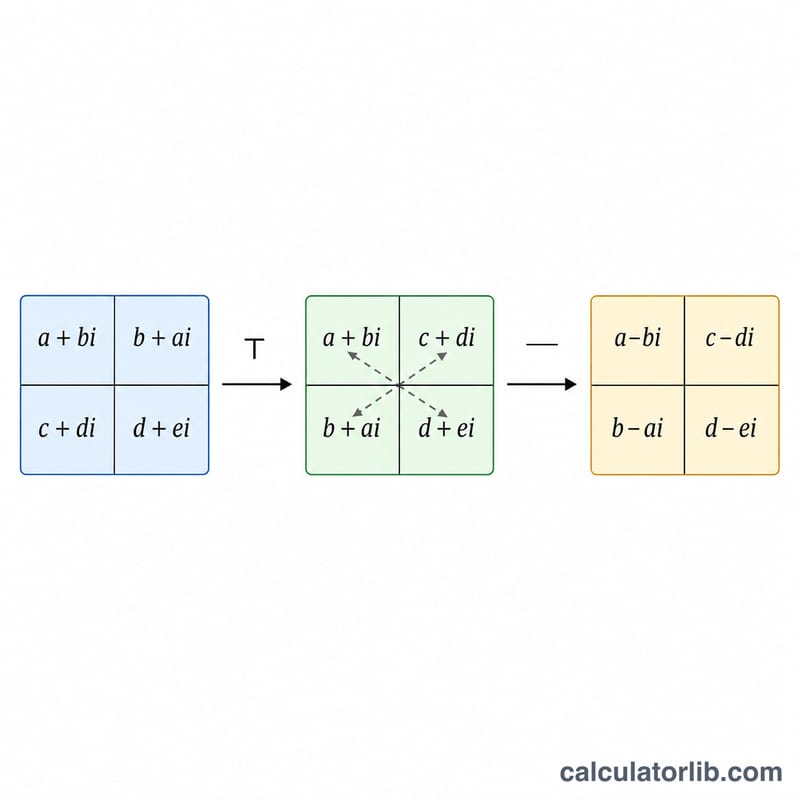
The adjoint matrix, written A*, A† (dagger) or AḤ, is the conjugate transpose of a matrix A. You build it in two steps: transpose A (swap rows and columns), then replace every entry with its complex conjugate (keep the real part, negate the imaginary part). If A is m×n, then A* is n×m. Note this is the Hermitian conjugate used in linear algebra and quantum mechanics — not the "adjugate" (classical adjoint, the transpose of the cofactor matrix) used for matrix inversion.
How to use this calculator
Enter your matrix with one row per line, separating cells with commas or spaces. Real cells are plain numbers like 3 or -2.5. Complex cells use the a+bi form: 2+3i, -1-2i, 4i or just -i. Set the number of rows and columns to match your data, pick a display precision, and the tool returns A* with its dimensions swapped.
The formula explained
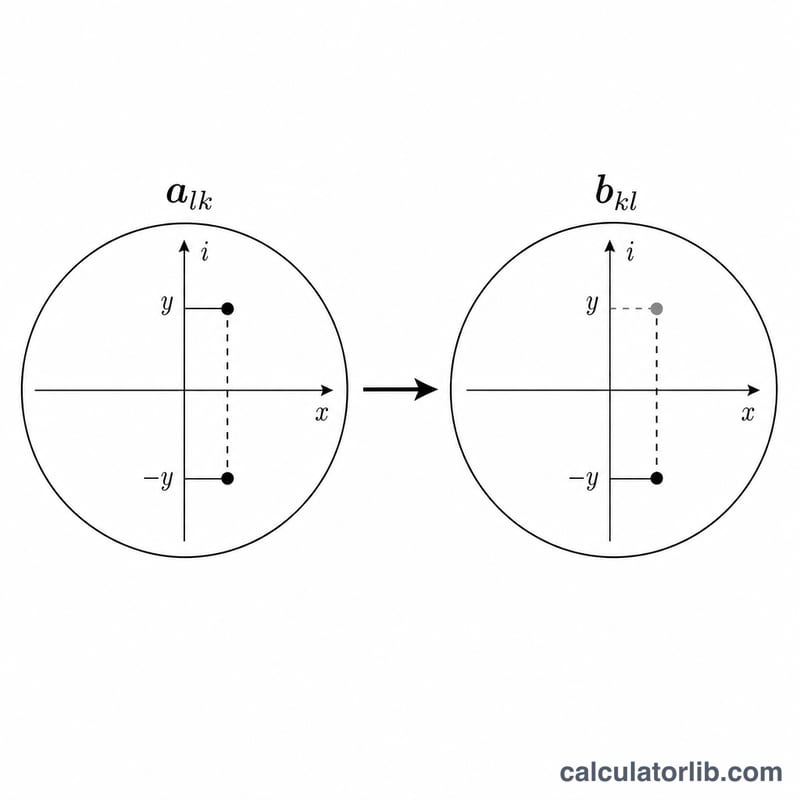
Write each entry as \(a_{kl} = x_{kl} + i\cdot y_{kl}\). The adjoint \(B = A^{*}\) has entries $$b_{kl} = \overline{a_{lk}} = x_{lk} - i\,y_{lk}$$ The first index pair flip is the transpose; the sign flip on \(y\) is the conjugation. In full: $$A^{*} = \overline{A^{\mathsf{T}}} = \left(\overline{A}\right)^{\mathsf{T}}$$ For a purely real matrix the conjugation does nothing, so $$A^{*} = A^{\mathsf{T}} \quad (\text{if all } y_{ij}=0)$$
Worked example
Take the 2×3 matrix \(A = \begin{bmatrix} 1 & 2+3i & -i \\ 4-i & 5 & 6+2i \end{bmatrix}\). Transposing gives a 3×2 layout, and conjugating each entry yields $$A^{*} = \begin{bmatrix} 1 & 4+i \\ 2-3i & 5 \\ i & 6-2i \end{bmatrix}$$ So \(2+3i\) becomes \(2-3i\), \(-i\) becomes \(+i\), and the real \(5\) is unchanged.
Properties of the Adjoint (Conjugate Transpose)
The adjoint (Hermitian conjugate) of a matrix is obtained by transposing and then taking the complex conjugate of every entry: \(\left(A^{*}\right)_{ij} = \overline{A_{ji}}\). The notations \(A^{*}\), \(A^{H}\) and \(A^{\dagger}\) all denote the same operation. The identities below hold for any complex matrices of compatible size (and any complex scalar \(c\)).
| Property | Identity | Notes |
|---|---|---|
| Involution | \((A^{*})^{*} = A\) | Applying the adjoint twice returns the original matrix. |
| Additivity | \((A+B)^{*} = A^{*} + B^{*}\) | Requires \(A\) and \(B\) of the same size. |
| Conjugate homogeneity | \((cA)^{*} = \overline{c}\,A^{*}\) | The scalar comes out conjugated, e.g. \((iA)^{*} = -iA^{*}\). |
| Reverse-order product | \((AB)^{*} = B^{*}A^{*}\) | Factor order is reversed (anti-homomorphism). |
| Inverse | \((A^{*})^{-1} = (A^{-1})^{*}\) | Holds when \(A\) is invertible; adjoint and inverse commute. |
| Determinant | \(\det(A^{*}) = \overline{\det(A)}\) | Square \(A\) only; the determinant is conjugated. |
Because conjugation leaves real numbers unchanged, every identity above reduces to its real-matrix counterpart (with \(A^{*}=A^{\mathsf{T}}\)) when all entries are real.
Key Terms
- Conjugate transpose / adjoint \(A^{*}\)
- The matrix obtained by transposing \(A\) and conjugating every entry: \((A^{*})_{ij} = \overline{A_{ji}}\). Also called the Hermitian conjugate or Hermitian adjoint.
- Complex conjugate
- For \(z = a + bi\), the conjugate is \(\overline{z} = a - bi\): the sign of the imaginary part is flipped while the real part stays the same.
- Transpose \(A^{\mathsf{T}}\)
- Reflection across the main diagonal, swapping rows and columns: \((A^{\mathsf{T}})_{ij} = A_{ji}\). No conjugation is applied.
- Hermitian matrix
- A square matrix equal to its own adjoint, \(A^{*} = A\). Its diagonal entries are real and its eigenvalues are real.
- Skew-Hermitian matrix
- A square matrix satisfying \(A^{*} = -A\). Its diagonal entries are purely imaginary (or zero) and its eigenvalues are purely imaginary.
- Unitary matrix
- A square matrix whose adjoint is its inverse, \(A^{*}A = AA^{*} = I\). Unitary matrices preserve the complex inner product and have eigenvalues of modulus 1.
- Adjugate (classical adjoint)
- A different concept despite the similar name: the transpose of the cofactor matrix, used in \(A^{-1} = \frac{1}{\det A}\,\operatorname{adj}(A)\). It is unrelated to the conjugate transpose \(A^{*}\).
- Dagger notation \(A^{\dagger}\)
- The symbol commonly used in physics (especially quantum mechanics) for the conjugate transpose; \(A^{\dagger}\), \(A^{H}\) and \(A^{*}\) all mean the same operation.
FAQ
Is the adjoint the same as the transpose? Only for real matrices. With complex entries you must also conjugate, so they differ.
What is a Hermitian matrix? A square matrix that equals its own adjoint, \(A^{*} = A\). You can verify this by comparing the output with the input.
Is this the adjugate used in inverses? No. The adjugate (classical adjoint) is the transpose of the cofactor matrix; this tool computes the conjugate transpose instead.