
What is a matrix determinant?
The determinant is a single number computed from the entries of a square matrix. It tells you whether the matrix is invertible (a non-zero determinant means it is), how a linear transformation scales area or volume, and whether a system of equations has a unique solution. This calculator handles the two most common cases in linear algebra courses: 2×2 and 3×3 matrices.
How to use this calculator
Choose the matrix size (2×2 or 3×3). Type each entry into its labelled cell — \(a_{11}\) is the top-left element, \(a_{33}\) is the bottom-right. For a 2×2 matrix only the top-left block (\(a_{11}\), \(a_{12}\), \(a_{21}\), \(a_{22}\)) is read; the other fields are ignored. Click calculate and the determinant appears instantly, along with the intermediate 2×2 minors used in the 3×3 cofactor expansion.
The formula explained
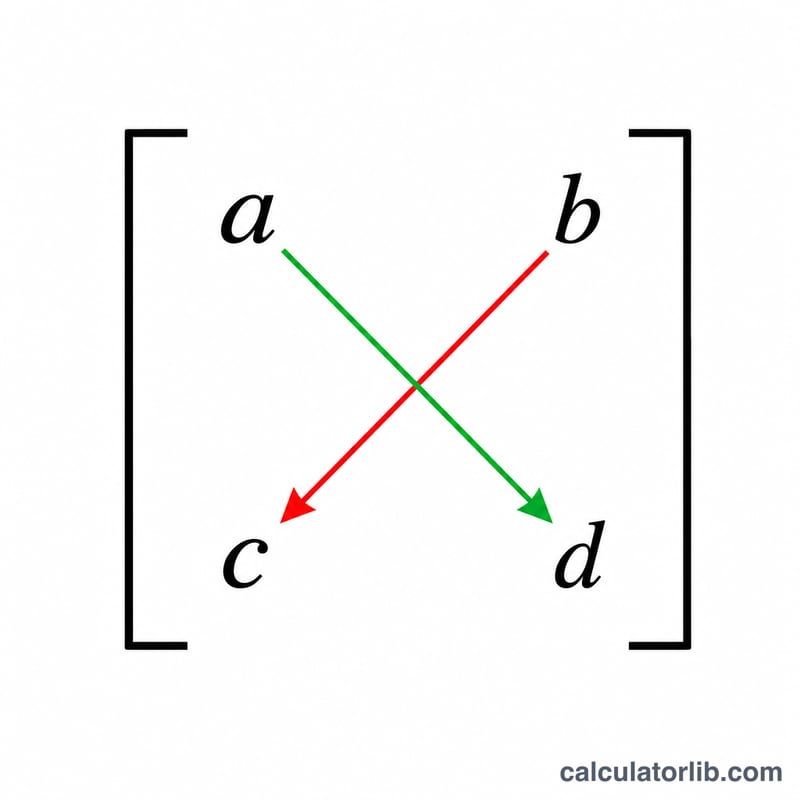
For a 2×2 matrix with entries \(a\), \(b\) on the top row and \(c\), \(d\) on the bottom row, the determinant is simply $$\det A = ad - bc$$ For a 3×3 matrix we use cofactor expansion along the first row: each first-row entry is multiplied by the determinant of the 2×2 matrix that remains when you delete that entry's row and column (its minor), with alternating signs (+, −, +).
$$\det A = a_{11}M_{11} - a_{12}M_{12} + a_{13}M_{13}$$ $$\det A = a_{11}(a_{22}a_{33}-a_{23}a_{32}) - a_{12}(a_{21}a_{33}-a_{23}a_{31}) + a_{13}(a_{21}a_{32}-a_{22}a_{31})$$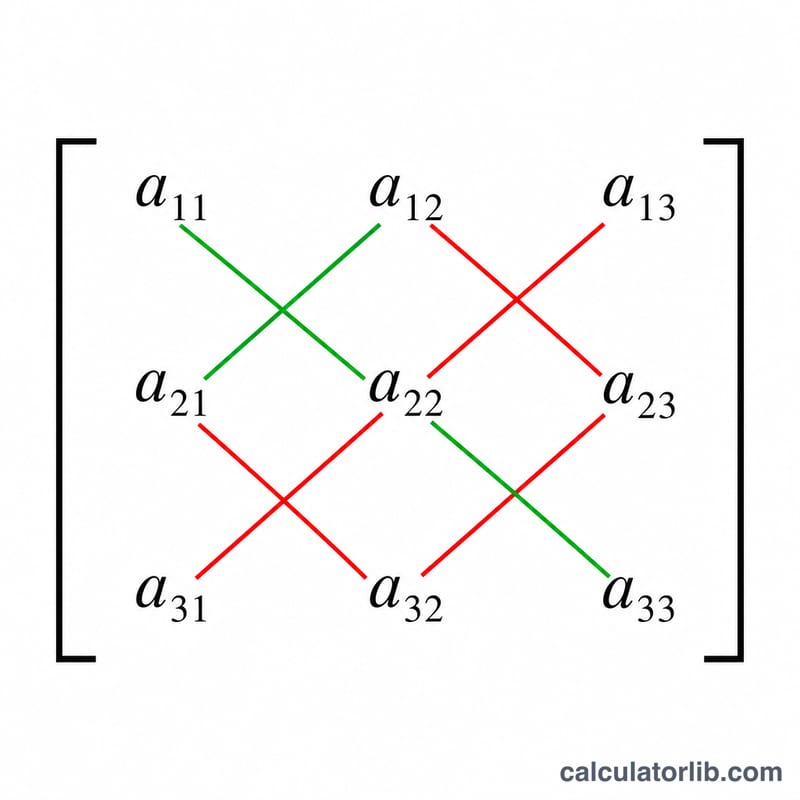
Worked example
Take the matrix with rows (1, 2, 3), (0, 1, 4), (5, 6, 0). The minors are \(M_{11} = 1\cdot 0 - 4\cdot 6 = -24\), \(M_{12} = 0\cdot 0 - 4\cdot 5 = -20\), \(M_{13} = 0\cdot 6 - 1\cdot 5 = -5\). Then $$\det A = 1\cdot(-24) - 2\cdot(-20) + 3\cdot(-5) = -24 + 40 - 15 = 1$$
FAQ
What does a determinant of zero mean? The matrix is singular — it has no inverse, and a related system of equations has no unique solution.
Can the determinant be negative? Yes. A negative determinant indicates the linear transformation reverses orientation; its absolute value still represents the area or volume scaling factor.
Does the calculator handle larger matrices? This tool covers 2×2 and 3×3 matrices, which are the most frequently needed sizes. Larger determinants are typically computed by row reduction.