
What this calculator does
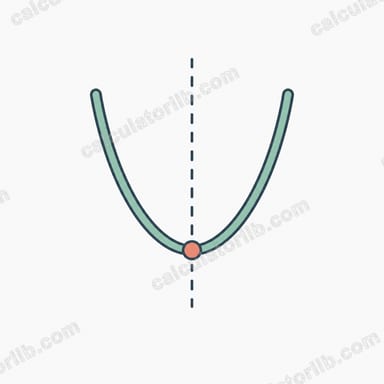
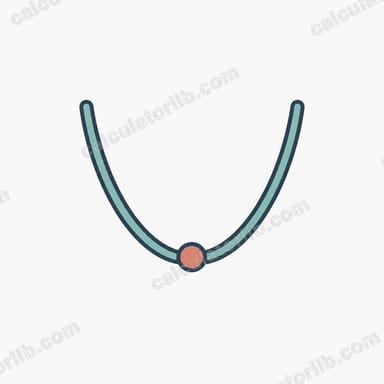
This tool analyzes a parabola written in standard form, \(y = ax^2 + bx + c\), and returns its key geometric features: the vertex (turning point), the focus, and the directrix. These three pieces fully describe the shape and position of a vertical parabola, which is useful in algebra, conic-sections study, optics, and projectile problems.
How to use it
Enter the three coefficients a, b and c exactly as they appear in your equation. The coefficient a must not be zero (otherwise the curve is a straight line). The calculator instantly reports the vertex coordinates, the focus point, and the equation of the directrix line.
The formula explained
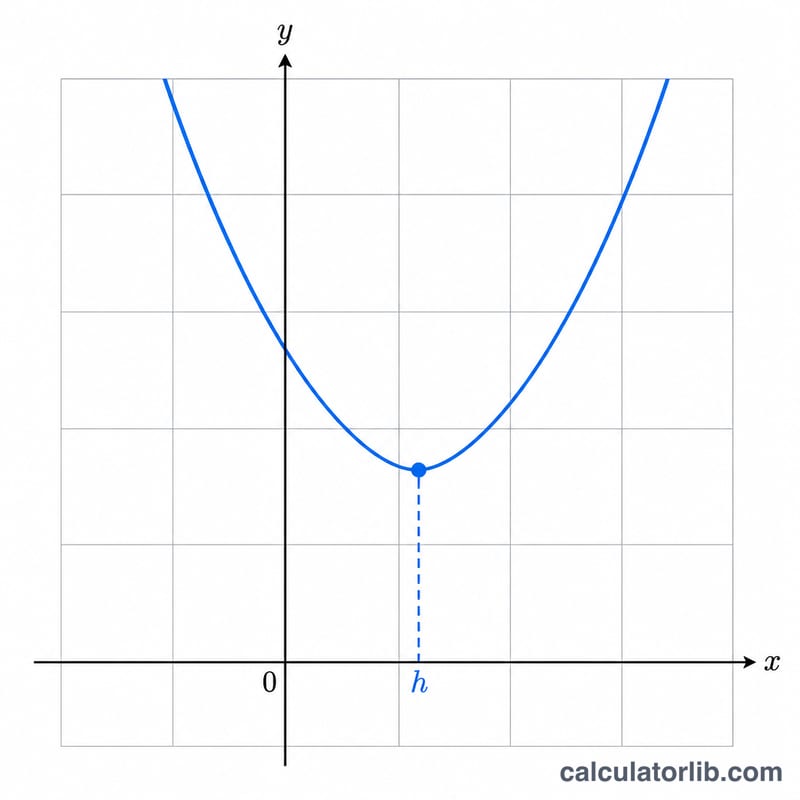
The vertex x-coordinate is \(h = -\frac{b}{2a}\). Substituting back gives the y-coordinate \(k = c - \frac{b^2}{4a}\). The focal distance is \(p = \frac{1}{4a}\). When \(a > 0\) the parabola opens upward and the focus lies above the vertex at \((h,\, k + p)\), with the directrix the horizontal line \(y = k - p\). When \(a < 0\) it opens downward and the signs flip naturally because p becomes negative.
$$\left(-\frac{b}{2a},\; c-\frac{b^2}{4a}\right)$$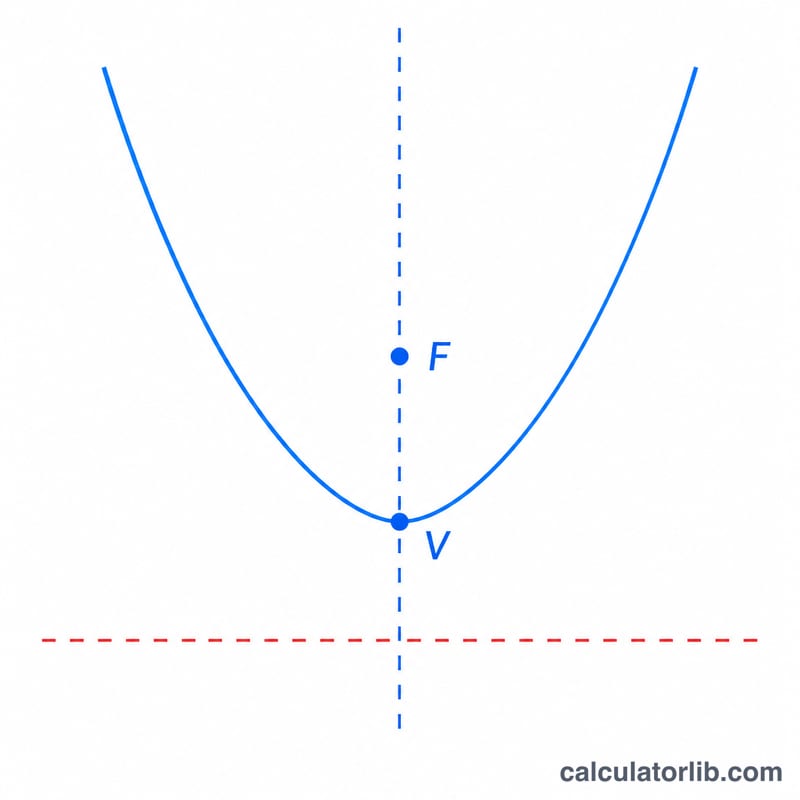
Worked example
Take \(y = x^2 - 4x + 3\), so \(a = 1\), \(b = -4\), \(c = 3\). Then \(h = \frac{4}{2} = 2\) and \(k = 3 - \frac{16}{4} = -1\), giving vertex \((2,\, -1)\). With \(p = \frac{1}{4} = 0.25\), the focus is \((2,\, -0.75)\) and the directrix is \(y = -1.25\).
FAQ
What if a is negative? The parabola opens downward; the focus is below the vertex and the directrix above it. The formulas handle this automatically.
Why must a \(\neq\) 0? If \(a = 0\) there is no \(x^2\) term, so the graph is a line and has no vertex or focus.
Does this work for sideways parabolas? No — this calculator assumes a vertical parabola of the form \(y = ax^2 + bx + c\).