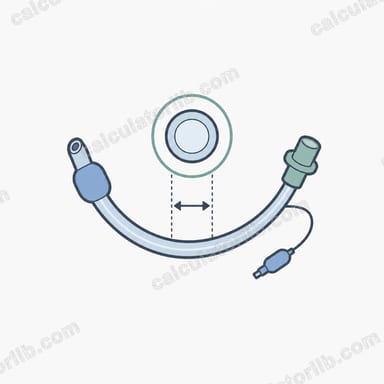

What is the Endotracheal Tube Size Calculator?
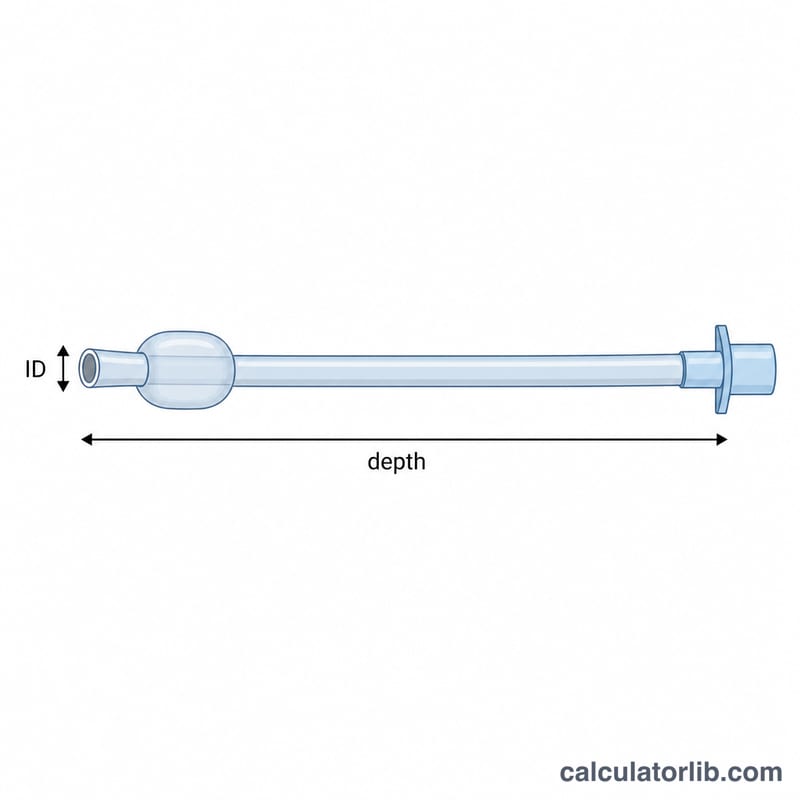
This calculator estimates the appropriate endotracheal tube (ETT) internal diameter and oral insertion depth for a pediatric patient based on age. It uses the classic age-based formulas commonly taught in pediatric airway management and PALS courses. These estimates are clinical starting points only and must always be confirmed with direct visualization, capnography, auscultation, and chest imaging. This is a general clinical reference tool and is not a substitute for professional judgment.
How to Use It
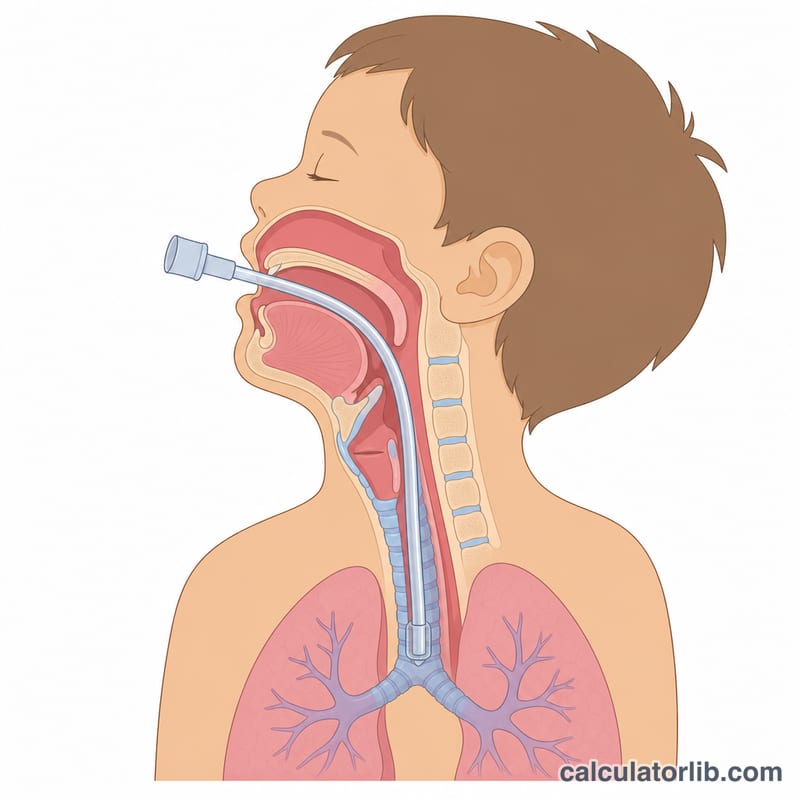
Enter the child's age in years (you may use half-years, e.g. 4.5) and select whether you are using a cuffed or uncuffed tube. The calculator returns the estimated internal diameter in millimeters and the suggested oral insertion depth in centimeters measured from the lips to mid-trachea.
The Formula Explained
The widely used Cole formula estimates an uncuffed tube size as $$\text{ETT Size} = \frac{\text{Age (years)}}{4} + 4.0$$ For modern cuffed tubes a smaller internal diameter is used, so the constant is reduced to 3.5: $$\text{ETT Size} = \frac{\text{Age (years)}}{4} + 3.5$$ Insertion depth is then approximated as the tube size multiplied by 3.
Worked Example
For a 4-year-old child needing an uncuffed tube: $$\text{ETT} = \frac{4}{4} + 4 = 1 + 4 = 5.0 \text{ mm}$$ Insertion depth = \(5.0 \times 3 = 15\text{ cm}\). If a cuffed tube is chosen instead: $$\text{ETT} = \frac{4}{4} + 3.5 = 4.5 \text{ mm}$$ depth = \(4.5 \times 3 = 13.5\text{ cm}\).
FAQ
Does this apply to newborns and infants? The age-based formula is intended for children roughly over 1–2 years. Neonates and small infants use weight- and length-based sizing instead.
Should I have other tube sizes ready? Yes — always prepare tubes 0.5 mm larger and 0.5 mm smaller than the estimate, since anatomy varies.
Why is the cuffed tube smaller? The inflatable cuff seals the airway, so a slightly smaller internal diameter still provides an adequate seal while reducing mucosal trauma.