
What Is the Physiologic Dead Space Calculator?
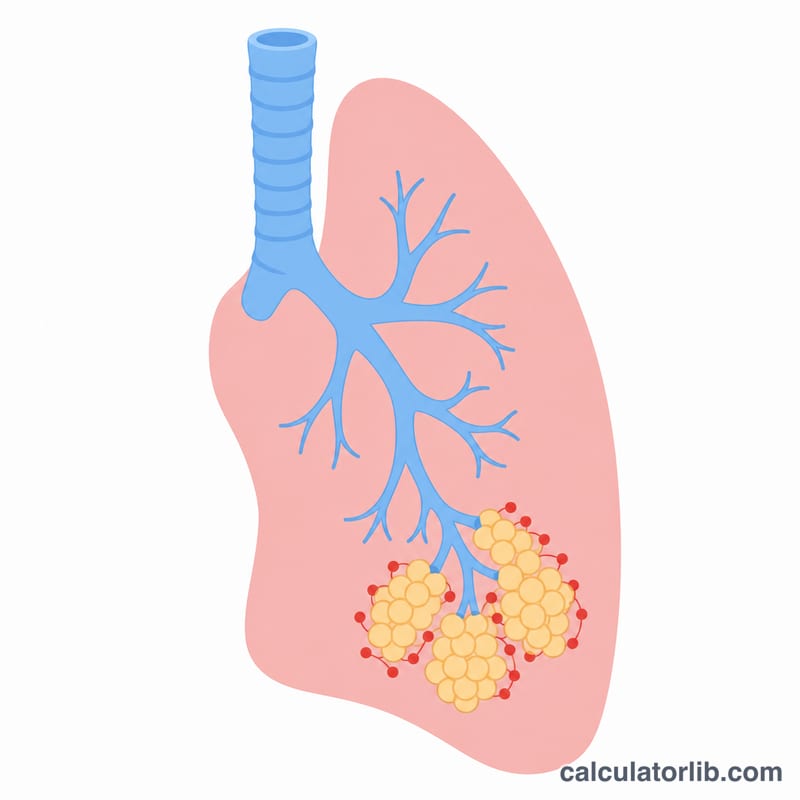
Physiologic dead space is the portion of each breath that does not take part in gas exchange — it includes both anatomic dead space (conducting airways) and alveolar dead space (alveoli that are ventilated but poorly perfused). The Bohr equation, modified by Enghoff to use arterial CO₂ (PaCO₂) in place of alveolar CO₂, expresses this as the ratio Vd/Vt. A normal value is roughly 0.20–0.40; markedly elevated values are seen in pulmonary embolism, ARDS, and severe COPD.
How to Use It
Enter the arterial CO₂ tension (PaCO₂) from a blood gas and the mixed expired CO₂ (PeCO₂) measured from collected exhaled gas (volumetric capnography). Optionally enter the tidal volume (Vt) to obtain the absolute dead space volume in milliliters. The calculator returns the Vd/Vt fraction, its percentage, and the estimated dead space volume.
The Formula Explained
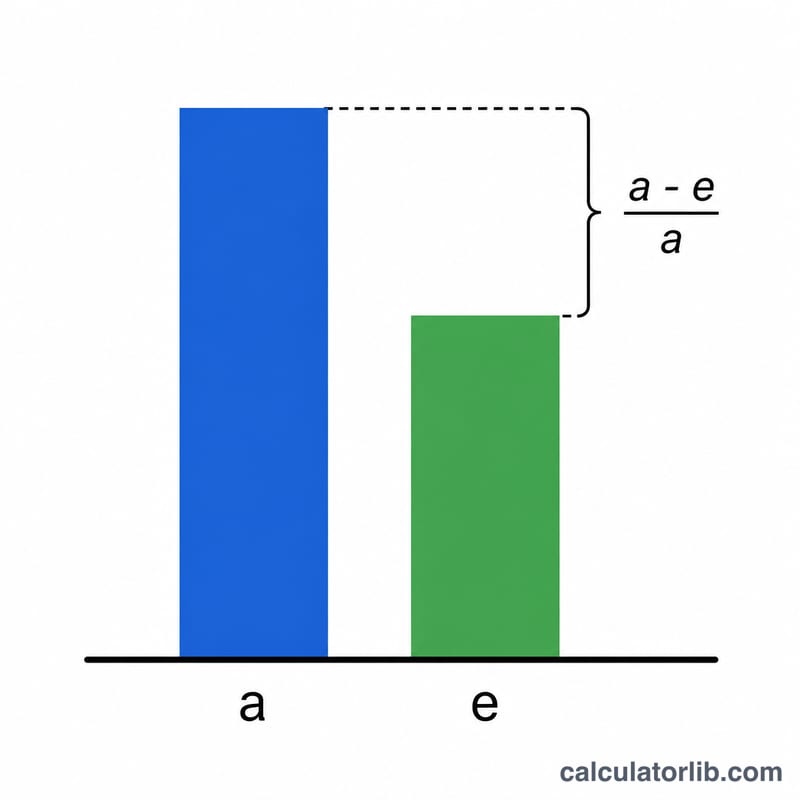
$$\frac{V_d}{V_t} = \frac{\text{PaCO}_2 - \text{PeCO}_2}{\text{PaCO}_2}$$ Because arterial blood equilibrates with alveolar gas, PaCO₂ represents ideal alveolar CO₂. Mixed expired gas is diluted by CO₂-free dead space air, so the gap between PaCO₂ and PeCO₂ reflects the dead-space fraction. Multiplying the fraction by tidal volume gives Vd.
Worked Example
With PaCO₂ = 40 mmHg, PeCO₂ = 28 mmHg, and Vt = 500 mL: $$\frac{V_d}{V_t} = \frac{40 - 28}{40} = \frac{12}{40} = 0.30$$ i.e. 30%. Dead space volume = \(0.30 \times 500 = 150\) mL — a normal result.
FAQ
Is PetCO₂ the same as PeCO₂? No. PetCO₂ is end-tidal CO₂; PeCO₂ is the average (mixed) CO₂ of the entire exhaled breath and is the correct input here.
What if Vt is left blank? The fraction and percentage are still calculated; dead space volume simply uses the default tidal volume.
What is a normal Vd/Vt? About 0.20–0.40 in healthy adults; higher in disease states that increase wasted ventilation.