What Is the Tylenol (Acetaminophen) Overdose Calculator?
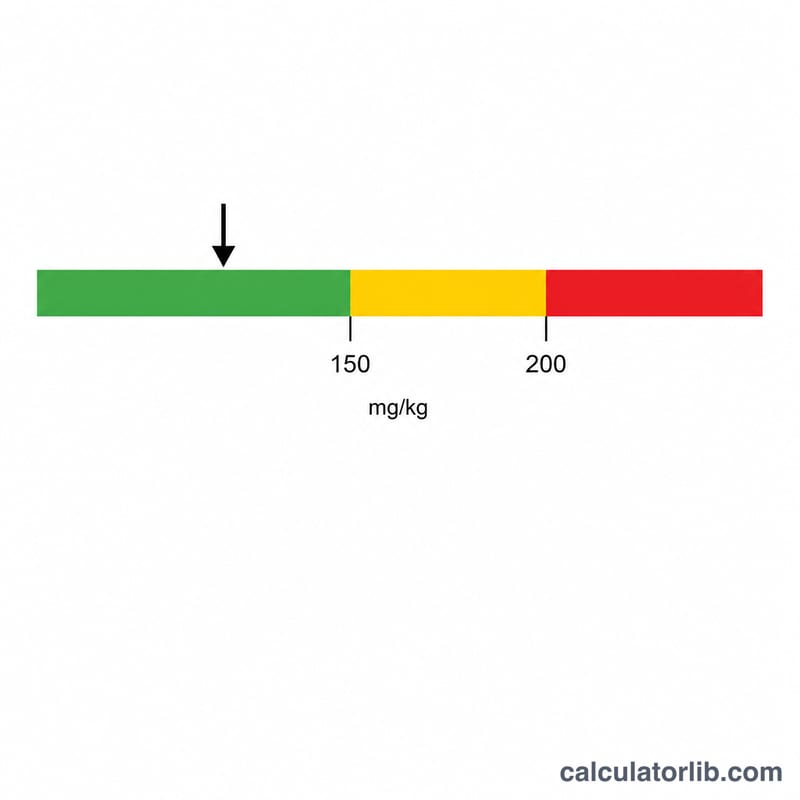
This educational tool estimates the ingested dose of acetaminophen (paracetamol) in milligrams per kilogram of body weight and compares it against a commonly cited toxicity threshold. Acute single-ingestion toxicity is often considered possible at roughly 150 mg/kg, with 200 mg/kg used as another reference point in some protocols. It is not a diagnostic device.
How to Use It
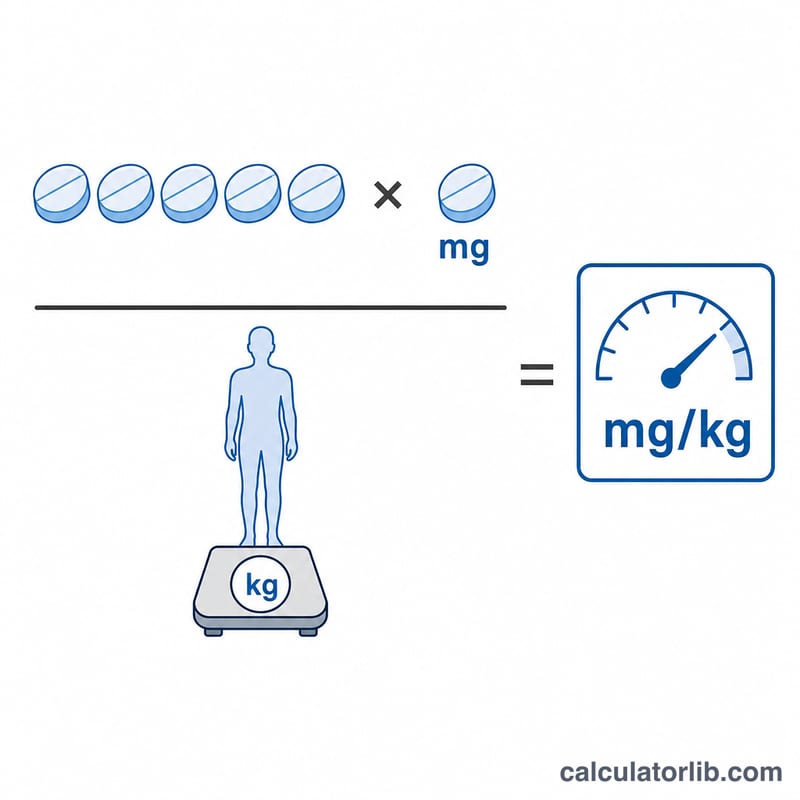
Enter the patient's body weight in kilograms, the number of tablets or doses taken, the strength of each tablet in milligrams, and choose the toxic threshold you want to compare against. The calculator multiplies tablets by strength to get the total milligrams ingested, then divides by weight to get the dose per kilogram.
The Formula
Ingested Dose (mg/kg) = (Number of Tablets × Strength per Tablet in mg) ÷ Body Weight in kg. The result flags a potential risk when either the dose is greater than or equal to the chosen threshold (150 or 200 mg/kg) or the total amount is 7.5 g (7,500 mg) or more, whatever the body weight.
$$\text{Dose}_{\text{mg/kg}} = \frac{\text{Tablets} \times \text{Strength (mg)}}{\text{Weight (kg)}}$$$$\text{Risk if } \text{Dose}_{\text{mg/kg}} \ge \text{Threshold} \;\text{ or }\; \text{Total (mg)} \ge 7{,}500$$
Why an absolute limit: in heavier adults the mg/kg figure can stay below 150 mg/kg even after a dangerous amount. Toxicity is expected from about 150 mg/kg, roughly 7.5–10 g in adults (MSD Manual Professional, Acetaminophen Poisoning), and the US poison-center consensus guideline refers anyone aged 6 or older who took 10 g or 200 mg/kg, whichever is lower, to an emergency department (Dart et al., Clinical Toxicology, 2006). This calculator uses the more cautious 7.5 g.
Worked Example
A 70 kg adult takes twenty 500 mg tablets: total = \(20 \times 500 = 10{,}000\) mg.
$$\text{Dose} = \frac{10{,}000}{70} \approx 142.86 \text{ mg/kg}$$That is about 95% of the 150 mg/kg threshold, but the total of 10 g is above the 7.5 g absolute limit, so risk is flagged as 1. A 100 kg adult who takes the same 10 g reaches only 100 mg/kg and is flagged as 1 for the same reason. A 50 kg person taking thirty 500 mg tablets ingests 15,000 mg, or 300 mg/kg — well above the 200 mg/kg threshold (150% of it), flagging risk as 1. A 70 kg adult who took ten 500 mg tablets (5 g, 71.43 mg/kg) is below both limits and is flagged as 0, which still does not rule out harm.
$$\text{Dose} = \frac{30 \times 500}{50} = \frac{15{,}000}{50} = 300 \text{ mg/kg}$$Interpreting Your Result
This calculator divides the estimated total acetaminophen (paracetamol) ingested by body weight: \(\text{Dose (mg/kg)} = \frac{ \text{Tablets} \times \text{Strength (mg)} }{ \text{Weight (kg)} }\). It then compares the result with a threshold you choose, 150 or 200 mg/kg.
What the 150 and 200 mg/kg thresholds mean
- 150 mg/kg is the lower, more cautious reference point. It is widely cited as the single acute ingestion above which toxicity is possible and evaluation is usually advised.
- 200 mg/kg is a higher reference point used in some protocols and guidelines for a single acute ingestion.
Different poison centers, hospitals and countries use slightly different cut-offs and rules. These numbers are screening reference points, not exact lines between safe and unsafe.
Reading the result
- Below the threshold does not guarantee safety. The tablet count or time of ingestion may be wrong, other acetaminophen-containing products may have been taken, or the person may carry extra risk factors.
- At or above the threshold points to a possible risk of liver toxicity. It is not a diagnosis, and many people with such an estimate do not develop serious injury, especially when treated promptly.
How clinicians actually assess risk
Clinicians rely on the time of ingestion and a serum acetaminophen level, not on the mg/kg estimate alone. For a single acute ingestion with a known time, the level is typically plotted on the Rumack-Matthew nomogram, which is generally interpreted from 4 hours after ingestion. The nomogram is not designed for ingestions spread over several hours, repeated doses, or an unknown time of ingestion. Those cases need clinical judgment, repeat levels and liver tests.
Factors that change risk
Repeated supratherapeutic dosing over hours or days can cause harm at total amounts lower than a single-dose threshold. Chronic heavy alcohol use, malnutrition or fasting, and some other conditions may lower the margin of safety. A simple mg/kg figure cannot capture these factors.
Educational purpose only. This tool does not give personal medical advice. If an overdose is suspected, do not wait for symptoms, which can be delayed. Contact your local poison control center or emergency services immediately. In the United States, Poison Control is 1-800-222-1222. Other countries have their own numbers.
Scenario Comparison by Weight and Tablet Count
The table assumes 500 mg tablets taken as a single ingestion. The mg/kg values are total mg divided by body weight. A result "meets" a threshold if it is equal to or greater than it. Example: 20 tablets × 500 mg = 10,000 mg, and 10,000 ÷ 70 kg = 142.86 mg/kg.
| Tablets (500 mg) | Total mg | Body weight | Dose (mg/kg) | Meets 150 mg/kg? | Meets 200 mg/kg? |
|---|---|---|---|---|---|
| 10 | 5,000 | 20 kg | 250.00 | Yes | Yes |
| 10 | 5,000 | 50 kg | 100.00 | No | No |
| 10 | 5,000 | 70 kg | 71.43 | No | No |
| 10 | 5,000 | 90 kg | 55.56 | No | No |
| 20 | 10,000 | 20 kg | 500.00 | Yes | Yes |
| 20 | 10,000 | 50 kg | 200.00 | Yes | Yes (equal) |
| 20 | 10,000 | 70 kg | 142.86 | No | No |
| 20 | 10,000 | 90 kg | 111.11 | No | No |
| 30 | 15,000 | 20 kg | 750.00 | Yes | Yes |
| 30 | 15,000 | 50 kg | 300.00 | Yes | Yes |
| 30 | 15,000 | 70 kg | 214.29 | Yes | Yes |
| 30 | 15,000 | 90 kg | 166.67 | Yes | No |
The same number of tablets gives a very different mg/kg dose depending on body weight. Small children reach the thresholds with far fewer tablets. A result below a threshold, such as 142.86 mg/kg, is not proof of safety. Contact Poison Control or emergency services for any suspected overdose. This is general educational information, not medical advice.
FAQ
Is this a substitute for medical care? No. In any suspected overdose, contact emergency services or Poison Control immediately regardless of this estimate.
Which threshold should I use? 150 mg/kg is more conservative; some references use 200 mg/kg. Clinicians rely on serum levels and the Rumack-Matthew nomogram, not weight-based estimates alone.
Does timing matter? Yes — risk assessment depends heavily on time since ingestion and serum acetaminophen levels, which this simple calculator does not model.