
What is Omori's Formula?
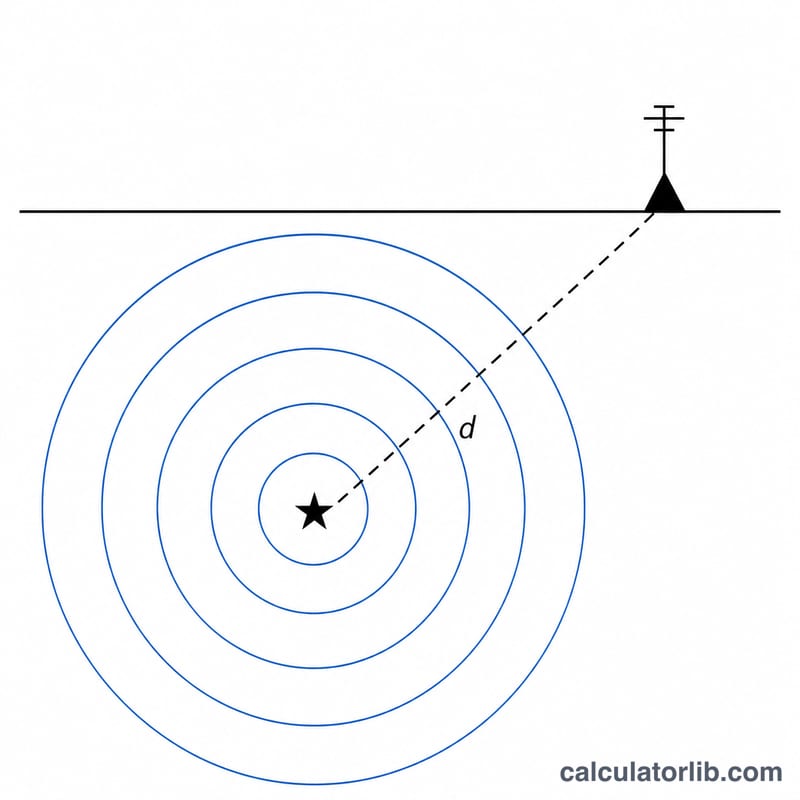
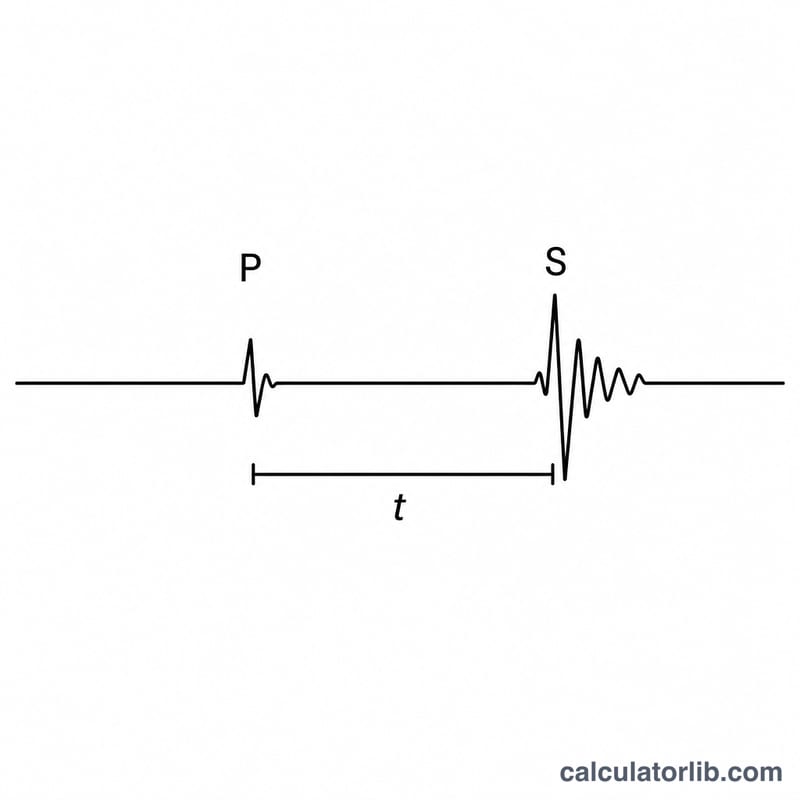
When an earthquake occurs, two main body waves travel outward from the hypocenter. The faster P-wave (Primary wave) arrives first, followed by the slower S-wave (Secondary wave), which brings the strong main shaking. The time gap between their arrivals is the initial preliminary tremor time, written as t. Omori's formula uses this gap to estimate the distance d from the observation point to the source: \(d = k \times t\). This is a universal piece of seismology physics, taught in earth-science classes worldwide; it is not specific to any country.
How to Use the Calculator
First pick an earthquake type, which seeds a typical value for the Omori constant k (about 8 km/s for shallow nearby quakes, around 6 to 7 km/s for more distant ones). You can then override k directly within its plausible 4 to 10 km/s range. Enter the tremor time t in seconds, the measured gap between the P-wave and S-wave arrivals. The tool returns the epicenter distance d in kilometers.
The Formula Explained
Both waves travel the same distance d. The P-wave takes \(d/V_p\) seconds and the S-wave takes \(d/V_s\) seconds, so the gap is $$t = \frac{d}{V_s} - \frac{d}{V_p} = \frac{d(V_p - V_s)}{V_p V_s}.$$ Solving for d gives $$d = \frac{V_p V_s}{V_p - V_s} \times t.$$ The leading fraction is exactly the Omori constant \(k = \frac{V_p V_s}{V_p - V_s}\), so the working form simplifies to $$d = k \times t.$$ Because k is in km/s and t in seconds, d comes out directly in kilometers with no unit scaling.
Worked Example
Suppose \(k = 8\) km/s and \(t = 3\) s. Then $$d = 8 \times 3 = 24 \text{ km}.$$ Cross-checking with explicit speeds \(V_p = 8\) km/s and \(V_s = 4\) km/s: $$k = \frac{8 \times 4}{8 - 4} = \frac{32}{4} = 8 \text{ km/s}.$$ The P-wave arrives at \(24/8 = 3\) s and the S-wave at \(24/4 = 6\) s, a 3 s difference matching t. The epicenter is about 24 km away.
FAQ
Why does k vary? Wave speeds depend on the rock the waves travel through, so the average k changes with depth and distance, which is why typical values span 4 to 10 km/s.
What if t = 0? The P and S waves arrive together, giving \(d = 0\) km, meaning essentially no measurable separation.
Is this exact? No. It assumes constant average wave speeds along a straight ray through a uniform medium, so it is a good textbook approximation rather than a precise locator.