

What Is Buying Power?
Buying power is the total dollar amount you have available to purchase securities in a brokerage account. In a cash account it simply equals your cash balance, but in a margin account your broker lets you borrow against eligible (marginable) securities, which can multiply how much you can invest. This calculator combines your settled cash with the leverage you apply to your marginable securities so you can instantly see your full purchasing power.
How to Use It
Enter three values: your available Cash Balance, the market value of your Marginable Securities, and a Margin Multiplier. A multiplier of 1 represents a cash (no leverage) account, while 2 reflects the common Reg-T initial margin that allows 2:1 leverage for many equities. Some accounts permit higher multipliers for portfolio margin or lower ones for volatile names. Press calculate and the tool returns your total buying power plus a breakdown.
The Formula Explained
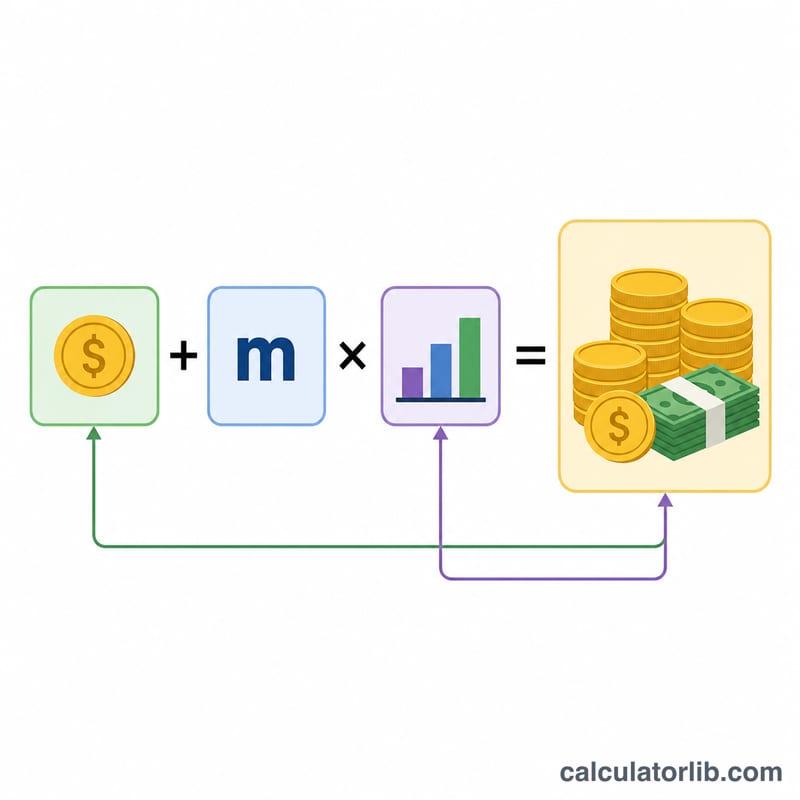
The calculation is: $$\text{Buying Power} = \text{Cash Balance} + (\text{Margin} \times \text{Marginable Securities})$$ The cash contributes dollar-for-dollar, while each dollar of marginable securities contributes according to the multiplier. A multiplier of 2 means every $1 of marginable equity supports $2 of purchases.
Worked Example
Suppose you hold $10,000 in cash and $5,000 in marginable securities with a 2× Reg-T multiplier. Your buying power is $$\$10{,}000 + (2 \times \$5{,}000) = \$10{,}000 + \$10{,}000 = \$20{,}000$$ You could purchase up to $20,000 of stock.
Interpreting Your Buying Power
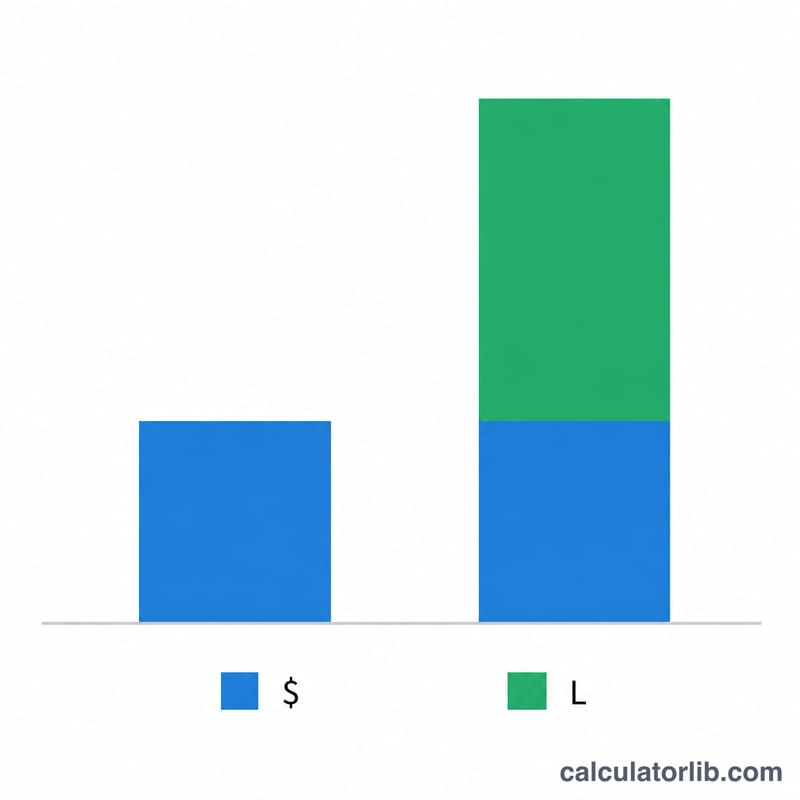
Buying power represents the maximum dollar amount of securities you are permitted to purchase — it is a borrowing limit, not equity you own. In a margin account, any amount above your cash balance is money borrowed from the broker, which accrues interest and must eventually be repaid. A buying power of $50,000 built from $25,000 of cash means up to $25,000 of that total would be a margin loan.
Using the full extent of your margin reduces the equity cushion that protects you from a maintenance margin call. Equity is the market value of your positions minus the loan balance. As prices fall, the loan stays fixed while market value drops, so your equity percentage shrinks. When equity falls below the maintenance requirement (commonly 25%–30%), the broker can issue a margin call requiring additional cash or the liquidation of positions. The more of your buying power you deploy, the smaller the price decline needed to reach that threshold.
The calculated figure also assumes the securities you hold and buy remain marginable. Some securities — such as certain low-priced stocks, recently issued shares, or highly concentrated positions — may carry a reduced margin value or none at all, which lowers your actual buying power below the formula's estimate. Marginability and requirements can change at the broker's discretion, so the result is an estimate based on the multiplier you enter rather than a guaranteed amount.
This is general educational information about how margin buying power is calculated, not financial or investment advice.
FAQ
Is buying power the same as account value? No. Account value is what you own; buying power is what you can spend, which can exceed your value when margin is enabled.
Why use margin carefully? Leverage amplifies both gains and losses, and a falling portfolio can trigger a margin call requiring you to add cash or sell positions.
What multiplier should I use? Use 1 for cash accounts, 2 for standard Reg-T margin, and check your broker's terms for portfolio-margin or special requirements.