
What this calculator does
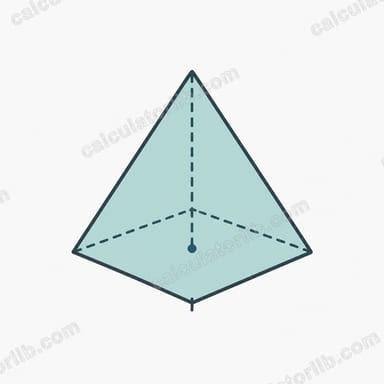
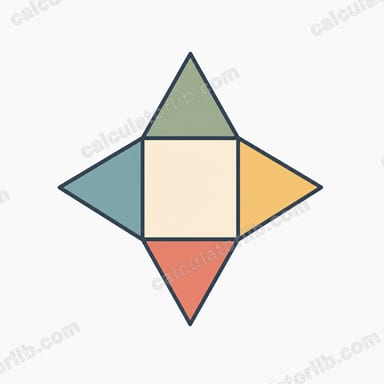
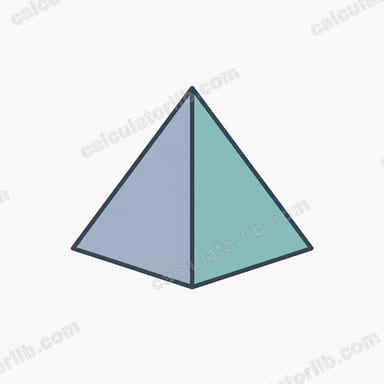
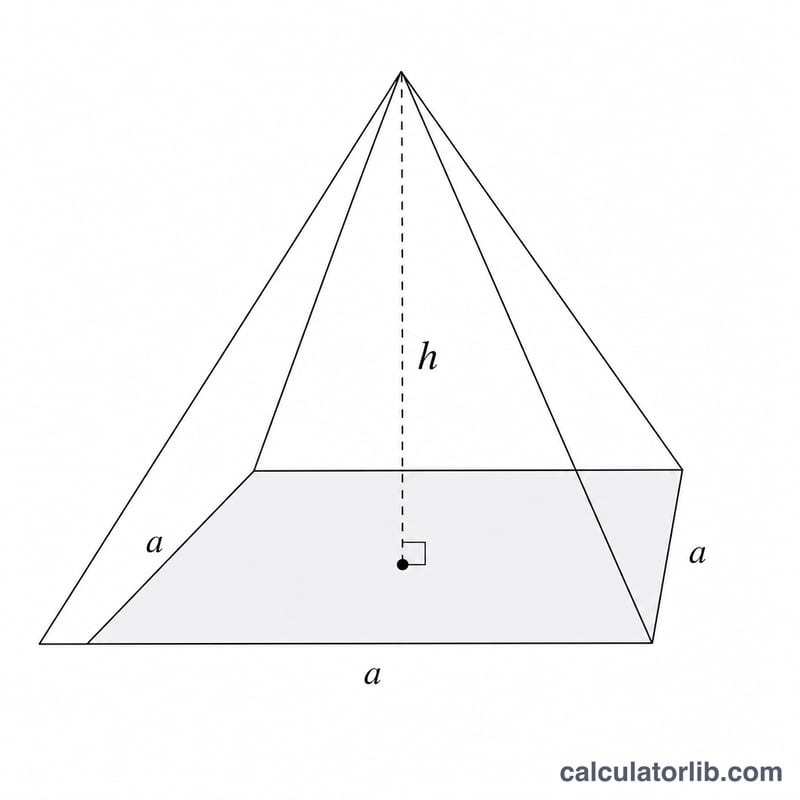
This tool finds the vertical height (h) of a square pyramid when you know its volume (V) and the length of one base edge (a). A square pyramid has a square base and four triangular faces meeting at an apex directly above the center of the base. Rearranging the standard volume formula gives a direct way to solve for height.
The formula
The volume of a square pyramid is \(V = \frac{1}{3} \times a^{2} \times h\), where \(a^{2}\) is the area of the square base and \(h\) is the perpendicular height. Solving for \(h\) gives:
$$h = \frac{3V}{a^{2}}$$
Make sure your volume and base edge use consistent units. If V is in cubic centimeters and a is in centimeters, the resulting height is in centimeters.
How to use it
Enter the pyramid's volume and the base edge length, then read off the computed height. Both inputs accept decimals. The base edge must be greater than zero, since the formula divides by \(a^{2}\).
Worked example
Suppose a square pyramid has a volume of 100 and a base edge of 5. Then \(a^{2} = 25\), so $$h = \frac{3 \times 100}{25} = \frac{300}{25} = 12.$$ The pyramid is 12 units tall.
FAQ
Is this the slant height or the vertical height? It is the vertical (perpendicular) height from the base to the apex, not the slant height along a face.
What units does the answer use? The same length unit as your base edge, as long as the volume uses the cubed version of that unit.
Why must the base edge be positive? The formula divides by \(a^{2}\). A zero base would mean no base area and an undefined height.