
What this converter does
This tool takes a duration written in the common hours:minutes:seconds (HH:MM:SS) format and converts it into a single unit: total hours, total minutes, or total seconds. It also echoes back the normalized HH:MM:SS form with the chosen sign applied. It is a pure time-arithmetic tool with no calendar logic, so it works anywhere in the world without region-specific rules.
How to use it
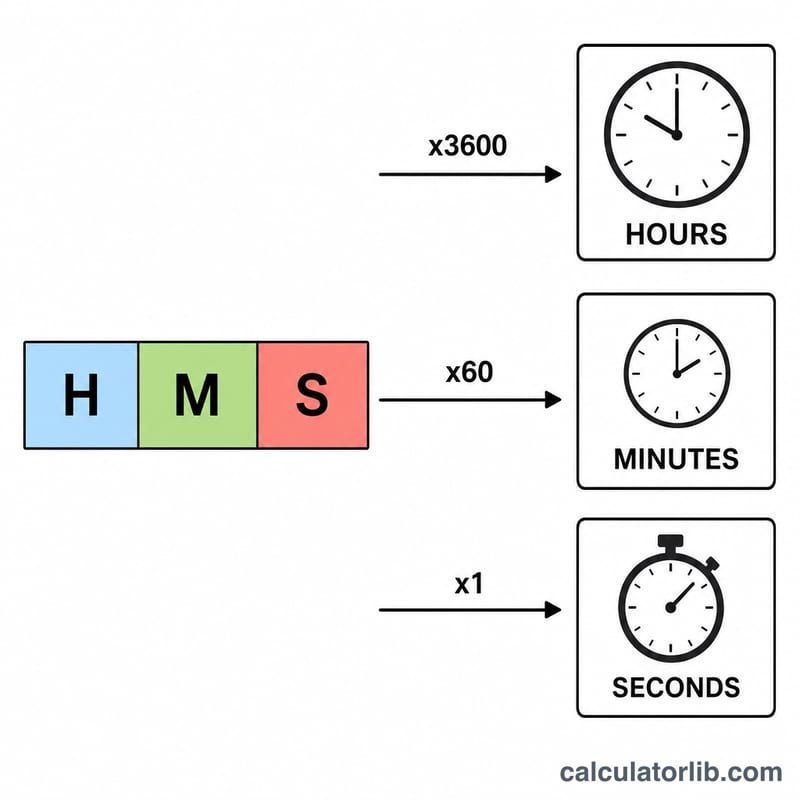
Pick the sign (+ or −), then enter the number of hours, minutes, and seconds. Values may be decimals (for example 1.5 hours), and minutes or seconds are not required to be below 60 — the tool simply adds them up. Blank fields are treated as zero. The result panel shows the same duration expressed three ways plus the tidy HH:MM:SS string.
The formula explained
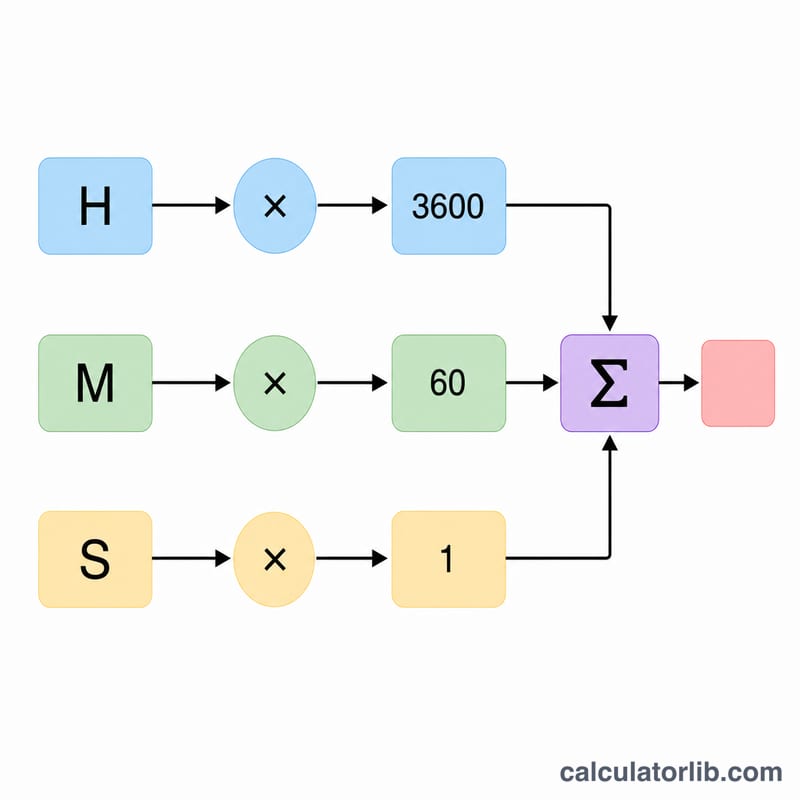
Let s be the sign factor (+1 or −1), and H, M, S the entered components. The base quantity is total seconds: $$t_{\text{sec}} = s \times (H \times 3600 + M \times 60 + S)$$ Because one minute is 60 seconds and one hour is 3600 seconds, the other units follow directly by division: total minutes = \(t_{\text{sec}} / 60\) and total hours = \(t_{\text{sec}} / 3600\). The sign only flips the final value; the magnitude logic is identical.
Worked example
For 12:34:56 with a positive sign: $$\text{total seconds} = 12 \times 3600 + 34 \times 60 + 56 = 43200 + 2040 + 56 = 45296 \text{ s}$$ Dividing gives \(45296 / 60 = 754.9333\ldots\) minutes and \(45296 / 3600 = 12.5822\ldots\) hours. The normalized string is 12:34:56.
FAQ
Can minutes or seconds be more than 59? Yes. The tool just sums them, so 0:90:00 equals 1.5 hours.
Why do I see a repeating decimal? Many conversions, like 754.9333… minutes, do not divide evenly. The result shows several decimal places without forcing a round number.
How is a negative duration handled? Choosing the − sign multiplies every output by −1, so 1:30:00 becomes −5400 seconds, −90 minutes, and −1.5 hours.