
What it does
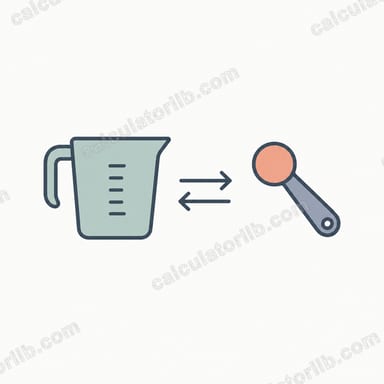
This calculator converts cooking volume measurements between common kitchen units: teaspoons, tablespoons, fluid ounces, cups, pints, quarts, gallons, milliliters, and liters. It uses US customary measures, which differ slightly from UK/imperial measures, so use US recipes for best accuracy.
How to use it
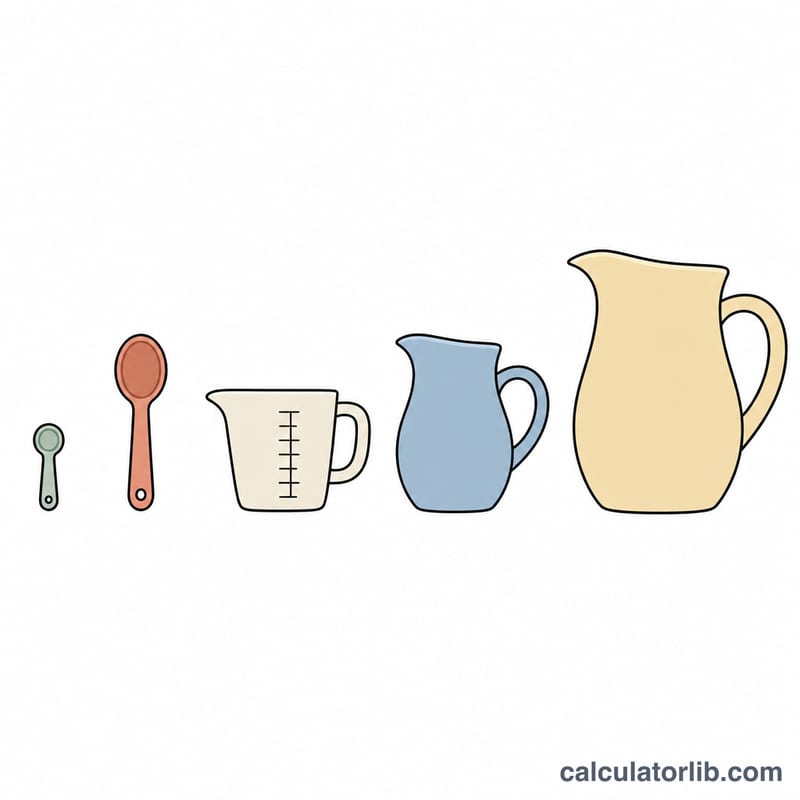
Enter the amount you have, choose the unit you are converting from, then choose the unit you want to convert to. The result appears instantly, along with the equivalent volume in milliliters as a handy metric reference.
The formula explained
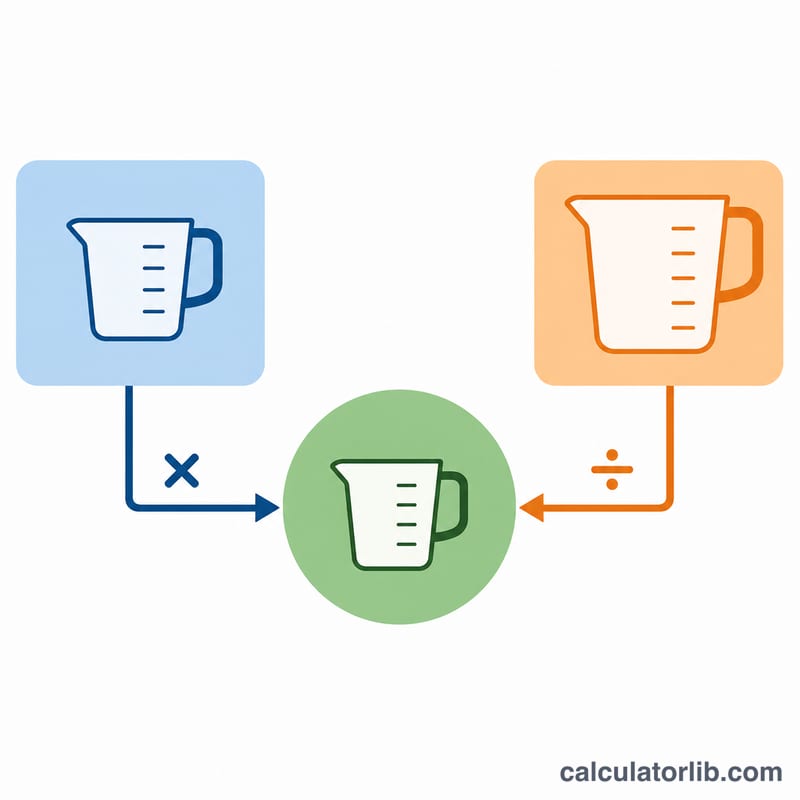
Every unit is stored as a factor — its size in milliliters. To convert, the amount is multiplied by the source factor (turning it into milliliters) and then divided by the target factor: $$\text{value\_out} = \text{value\_in} \times \frac{f_{\text{in}}}{f_{\text{out}}}$$ For example, a US cup is \(236.5882365\) mL and a tablespoon is \(14.78676478\) mL, so $$1 \text{ cup} = \frac{236.5882365}{14.78676478} = 16 \text{ tablespoons exactly.}$$
Worked example
Convert 2 cups to tablespoons. Each cup equals 16 tablespoons, so $$2 \times 16 = 32 \text{ tablespoons}.$$ In milliliters that is $$2 \times 236.5882365 = 473.176 \text{ mL.}$$
FAQ
Are these US or UK measures? US customary. A US cup is 236.6 mL, while a UK/metric cup is 250 mL, so results will differ for UK recipes.
Does a cup equal 16 tablespoons? Yes — in US measures \(1 \text{ cup} = 16 \text{ tbsp} = 48 \text{ tsp} = 8\) fluid ounces.
Can I convert weight units like grams? No. This tool handles volume only, because weight-to-volume depends on the ingredient's density.