

What Is a Lumpsum Investment Calculator?
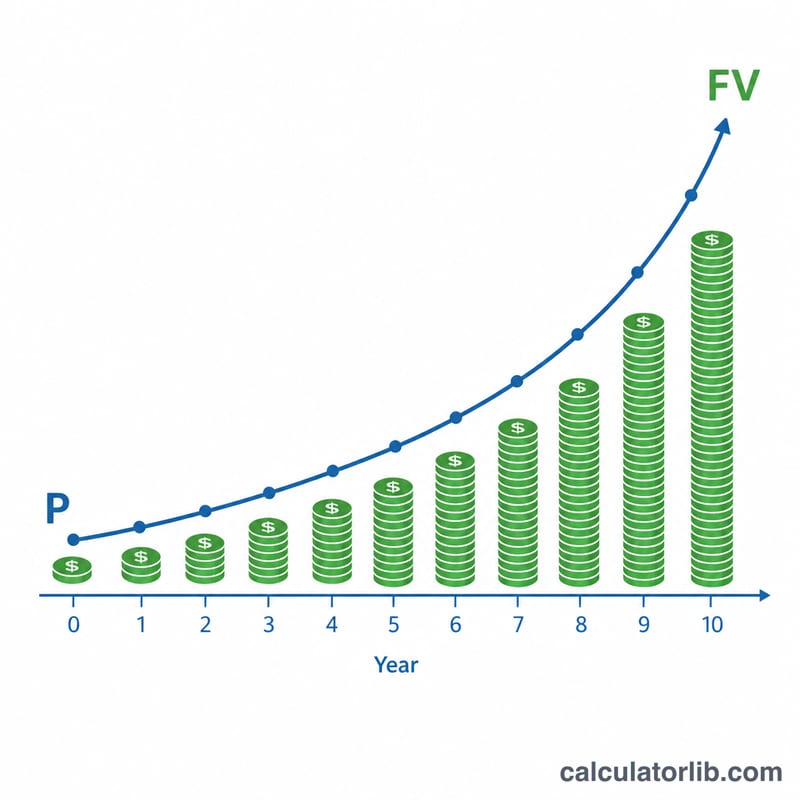
A lumpsum investment is a single, one-time deposit into an investment such as a mutual fund, fixed deposit, or stock portfolio, which is then left to grow over time. This calculator shows how that single investment compounds year after year, giving you the estimated maturity value and the total returns earned. Unlike a SIP (where you invest small amounts regularly), here all your money works for the full duration from day one.
How to Use It
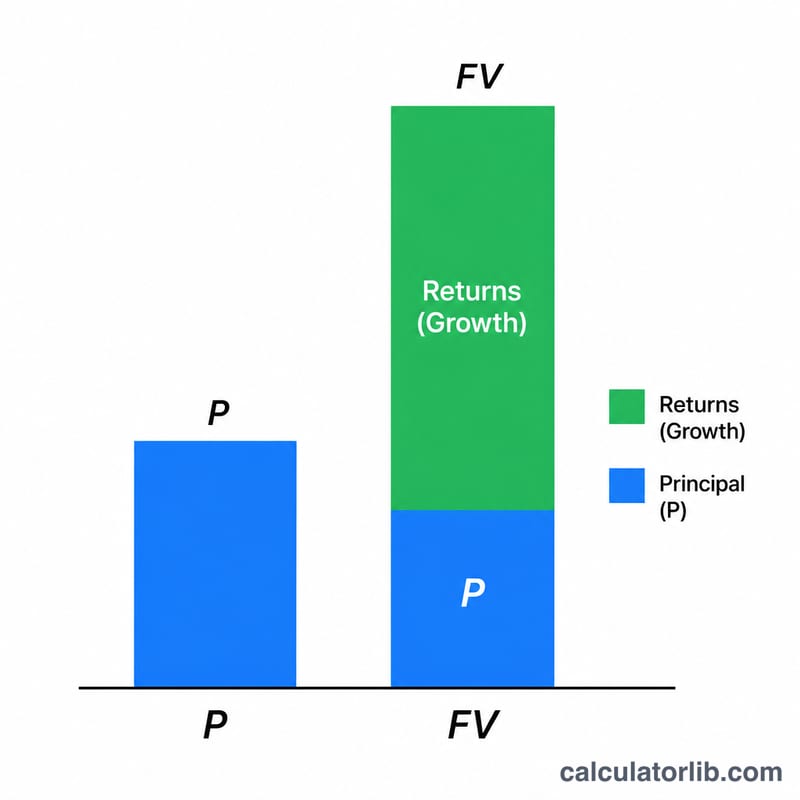
Enter three values: the investment amount (the lumpsum you deposit today), the expected annual return as a percentage, and the investment period in years. The calculator instantly returns the future value, the original amount invested, and the estimated returns (profit) generated by compounding.
The Formula Explained
The future value uses the compound interest formula:
$$\text{FV} = P \times \left(1 + \frac{r}{100}\right)^{n}$$
Here P is the principal (your lumpsum), r is the annual rate of return in percent, and n is the number of years. Each year the balance grows by the rate, and the next year that growth itself earns returns — this is the power of compounding.
Worked Example
Suppose you invest 100,000 at an expected 12% annual return for 10 years. Then $$\text{FV} = 100{,}000 \times (1 + 0.12)^{10} = 100{,}000 \times 3.10585 \approx 310{,}585.$$ Your estimated returns are \(310{,}585 - 100{,}000 = 210{,}585\) — more than double the amount invested, purely from compounding.
FAQ
Is the return rate guaranteed? No. The rate you enter is an assumed average; actual market returns vary year to year. Use a conservative estimate for planning.
Lumpsum vs SIP — which is better? Lumpsum benefits when you have a large sum ready and markets are favorable. SIP averages out market timing. Both can be valuable depending on your situation.
Does this account for inflation or taxes? No. The figures are nominal, before inflation and any applicable taxes. Subtract those to estimate real purchasing power.