
What is an AAS triangle?
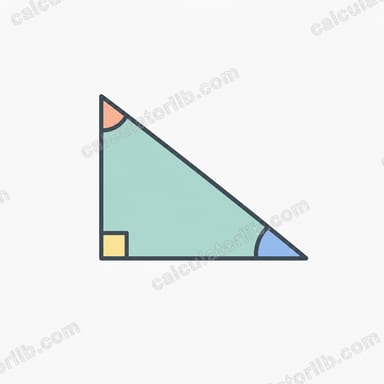
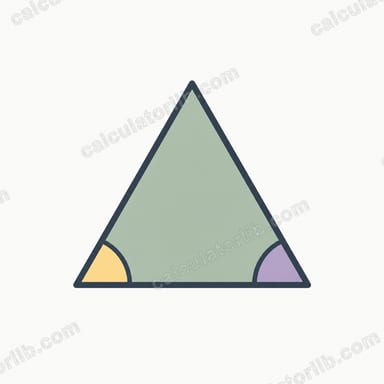
An AAS (Angle-Angle-Side) triangle is one where you know two of its angles and the length of a side that is not between those two angles. Because the three interior angles of any triangle always add up to 180°, knowing two angles instantly gives you the third. From there, the law of sines lets you find every remaining side, so the triangle is completely determined.
How to use this calculator
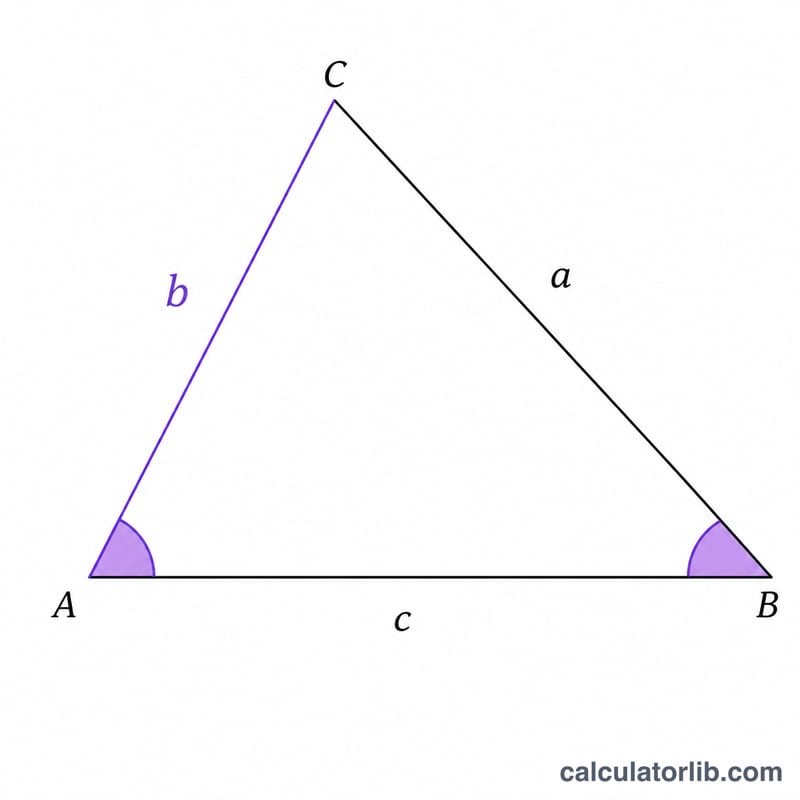
Enter angle A and angle B in degrees, and the length of side b — the side opposite angle B. The calculator returns the third angle C, the two unknown sides a and c, the perimeter, and the area. Make sure your two angles add to less than 180°, otherwise no valid triangle exists.
The formula explained
First find the missing angle: $$C = 180^\circ - A - B$$. Then apply the law of sines, which states that the ratio of each side to the sine of its opposite angle is the same for all three sides. Rearranging gives $$a = \frac{b\,\sin A}{\sin B}$$ and $$c = \frac{b\,\sin C}{\sin B}$$. The area is computed with \(\tfrac{1}{2}\cdot a\cdot b\cdot \sin C\).
Worked example
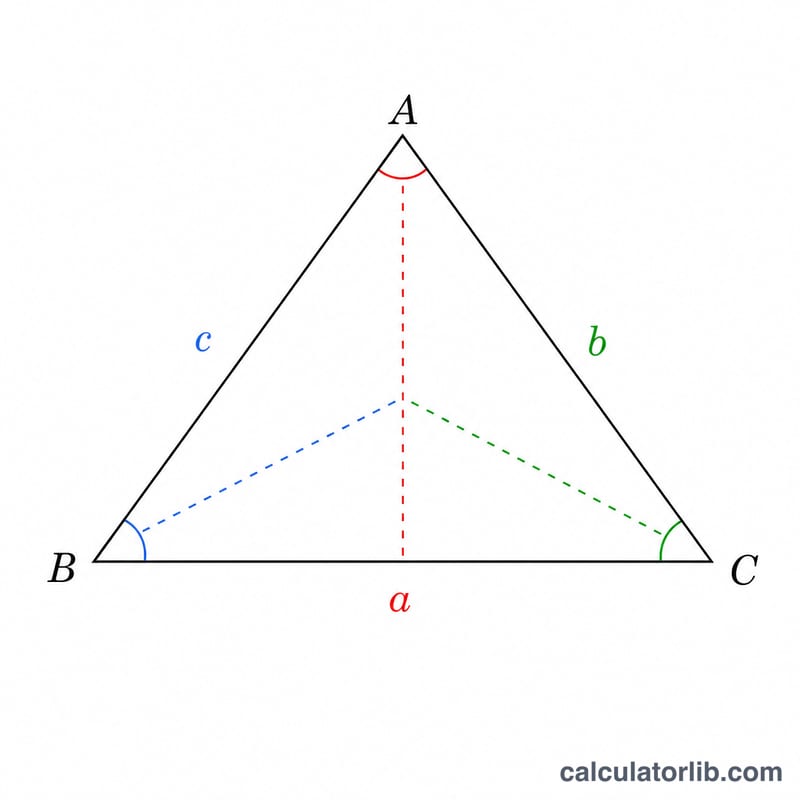
Suppose A = 40°, B = 60°, and side b = 10. Then \(C = 180 - 40 - 60 = 80^\circ\). Using the law of sines, $$a = \frac{10\cdot\sin 40^\circ}{\sin 60^\circ} \approx \frac{10\cdot 0.6428}{0.8660} \approx 7.422$$ and $$c = \frac{10\cdot\sin 80^\circ}{\sin 60^\circ} \approx \frac{10\cdot 0.9848}{0.8660} \approx 11.372.$$ The perimeter is about 28.79 and the area is \(\tfrac{1}{2}\cdot 7.422\cdot 10\cdot \sin 80^\circ \approx 36.55\).
Key Terms & Variables
- AAS (Angle-Angle-Side)
- A triangle case where two angles and a non-included side (a side that is not between the two given angles) are known. AAS always determines a unique triangle.
- ASA (Angle-Side-Angle)
- A related case where the known side is between the two known angles. ASA and AAS use the same law of sines but differ in which side is supplied.
- Angle A, B, C
- The three interior angles of the triangle. They always sum to \(180^\circ\), which is why \(C = 180^\circ - A - B\).
- Side a, b, c
- The side lengths, each labelled to match the opposite angle: side \(a\) is opposite angle \(A\), side \(b\) opposite \(B\), and side \(c\) opposite \(C\). This pairing is what makes the law of sines work.
- Vertex angle vs. side
- A vertex angle is the angle formed at a corner where two sides meet; a side is the straight segment joining two vertices. In AAS you are given two vertex angles and one side.
- Law of sines
- The relationship \(\dfrac{a}{\sin A} = \dfrac{b}{\sin B} = \dfrac{c}{\sin C}\). It lets you find an unknown side from a known side and the angles opposite both.
- Included vs. non-included side
- An included side lies between two given angles (as in ASA); a non-included side does not (as in AAS, where the given side is opposite one of the angles).
- Perimeter
- The total distance around the triangle, \(P = a + b + c\).
- Area
- The region enclosed by the triangle. With two sides and their included angle it is \(\text{Area} = \tfrac{1}{2}\,ab\sin C\); any pair of sides and the angle between them gives the same value.
FAQ
What is the difference between AAS and ASA? In ASA the known side sits between the two known angles; in AAS the known side is opposite one of them. Both are uniquely solvable using the law of sines.
Why must the angles be less than 180° combined? The three angles of a triangle must total exactly 180°, so two angles already summing to 180° or more leaves no room for a third positive angle.
Can I enter the side in any unit? Yes. The result sides share whatever unit you use for side b; the area is in that unit squared.