
What This Calculator Does
This tool converts an amount of substance measured in moles into the actual number of atoms, molecules, ions, or other particles. It uses the Avogadro constant, the fundamental link between the microscopic world of individual particles and the macroscopic world of grams and moles we work with in the lab.
The Formula
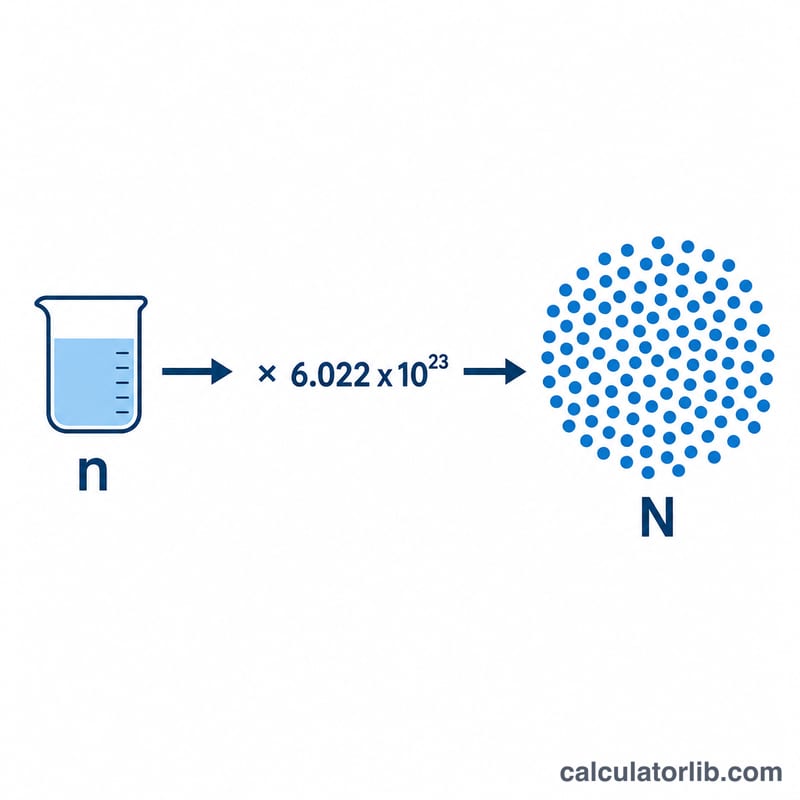
The relationship is a simple multiplication:
$$N = n \times N_A$$
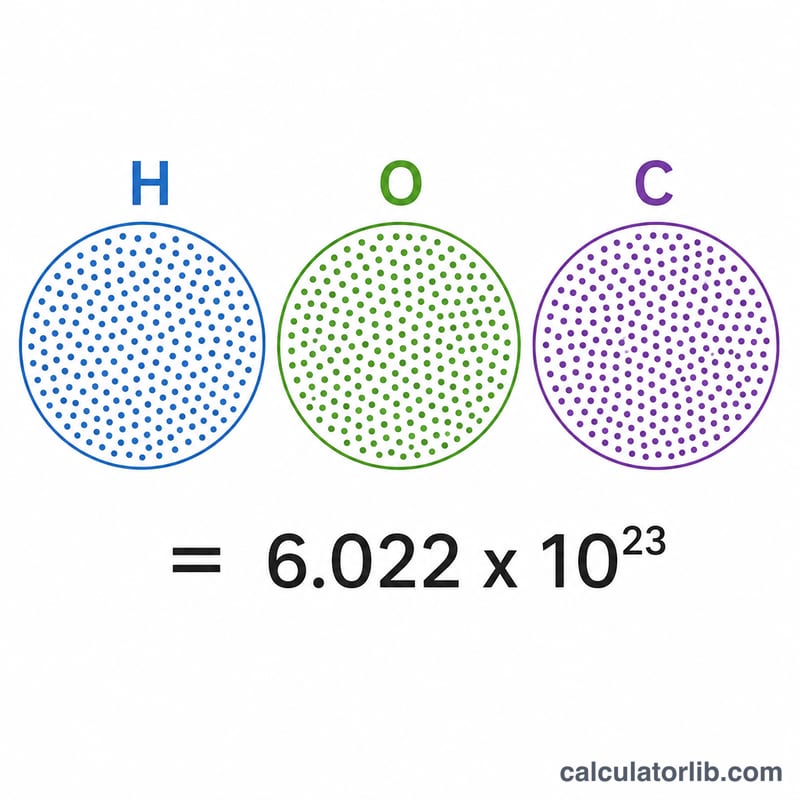
where N is the number of particles, n is the amount of substance in moles, and NA is the Avogadro constant. Since the 2019 redefinition of the SI base units, NA has an exact fixed value of \(6.02214076 \times 10^{23} \ \text{mol}^{-1}\), often rounded to \(6.022 \times 10^{23}\).
How to Use It
Enter the number of moles of your substance. The calculator returns the total number of representative particles. Remember that "particles" depends on the substance: for a monatomic element it is atoms, for a compound it is molecules or formula units, and for an ionic species it can be ions.
Worked Example
How many molecules are in 2 moles of water? $$N = 2 \times 6.02214076 \times 10^{23} = 1.2044 \times 10^{24} \ \text{molecules}$$ To count individual atoms instead, note each water molecule (H₂O) has 3 atoms, giving \(3.613 \times 10^{24}\) atoms.
Atoms Across Common Mole Amounts
The number of representative particles \(N\) in a sample is found by multiplying the amount of substance in moles by the Avogadro constant:
$$N = n \times 6.02214076 \times 10^{23}$$The table below lists the number of particles produced by several common mole amounts. Each value is rounded to four significant figures.
| Moles (n) | Number of particles (N) |
|---|---|
| 0.001 | 6.022 × 10²⁰ |
| 0.1 | 6.022 × 10²² |
| 0.5 | 3.011 × 10²³ |
| 1 | 6.022 × 10²³ |
| 2 | 1.204 × 1024 |
| 10 | 6.022 × 1024 |
Atoms per molecule matters. The formula above counts representative particles — whatever the mole refers to. If the particle is a molecule, you must multiply again by the number of atoms in that molecule to get the total atom count. For example, 1 mol of water (H₂O) contains \(6.022 \times 10^{23}\) molecules, but each molecule has 3 atoms (2 H + 1 O), so the sample contains \(3 \times 6.022 \times 10^{23} = 1.807 \times 10^{24}\) atoms. Likewise, 2 mol of CO₂ contains \(1.204 \times 10^{24}\) molecules and \(3 \times 1.204 \times 10^{24} = 3.613 \times 10^{24}\) atoms.
Key Terms Defined
- Mole (mol)
- The SI base unit for amount of substance. One mole contains exactly \(6.02214076 \times 10^{23}\) elementary entities (the Avogadro number), as fixed by the 2019 SI redefinition.
- Avogadro constant (N₀)
- The number of elementary entities per mole, \(N_A = 6.02214076 \times 10^{23}\ \text{mol}^{-1}\). It converts an amount in moles into a count of particles.
- Representative particle
- The specific entity being counted in a given context — an atom, molecule, ion, formula unit, or electron. The mole always refers to a stated representative particle.
- Atom
- The smallest unit of a chemical element that retains the element's identity, consisting of a nucleus of protons and neutrons surrounded by electrons.
- Molecule
- Two or more atoms held together by covalent bonds, acting as the representative particle of a molecular substance (e.g. H₂O, O₂, CO₂).
- Formula unit
- The lowest whole-number ratio of ions in an ionic compound, used as its representative particle (e.g. NaCl represents one Na⁺ and one Cl⁻).
- Ion
- An atom or group of atoms carrying a net electric charge from gaining or losing electrons, such as Na⁺ (cation) or Cl⁻ (anion).
- Amount of substance (n)
- The physical quantity, measured in moles, that expresses how many representative particles a sample contains; the symbol \(n\) is used in the equation \(N = n \times N_A\).
FAQ
What is a mole? A mole is the SI unit for amount of substance; one mole contains exactly Avogadro number of entities.
Does this give atoms or molecules? It gives the number of whatever entity the mole refers to. For elemental atoms it gives atoms; for molecular compounds it gives molecules.
Can I enter a fraction of a mole? Yes. Decimal and very small mole values (such as 0.001) work fine and give proportionally smaller particle counts.