
What Is Solution Density?
Density is a measure of how much mass is packed into a given volume. For a solution—a homogeneous mixture such as salt water or a sugar syrup—the density is found by dividing the total mass of the solution (solvent plus dissolved solute) by the total volume the solution occupies. It is one of the most fundamental physical properties used in chemistry, biology, and engineering.
How to Use This Calculator
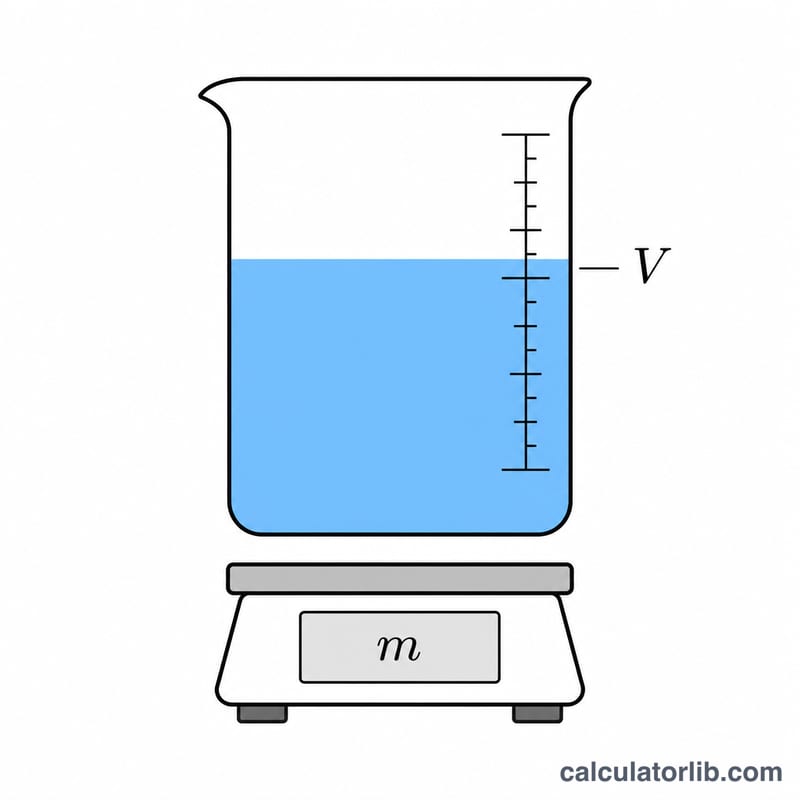
Enter the total mass of your solution in grams and the total volume in milliliters. The calculator instantly returns the density in g/mL (which equals g/cm³) and also converts it to kg/m³ for SI applications. Make sure both measurements describe the same sample.
The Formula Explained
The density formula is \(\rho = \frac{m}{V}\), where \(\rho\) (rho) is density, \(m\) is mass, and \(V\) is volume. When mass is in grams and volume in milliliters, density comes out in g/mL. Because 1 mL = 1 cm³ and 1 g/mL = 1000 kg/m³, the same number can be expressed in SI units by multiplying by 1000.
$$\rho = \frac{\text{Total Mass (g)}}{\text{Total Volume (mL)}}$$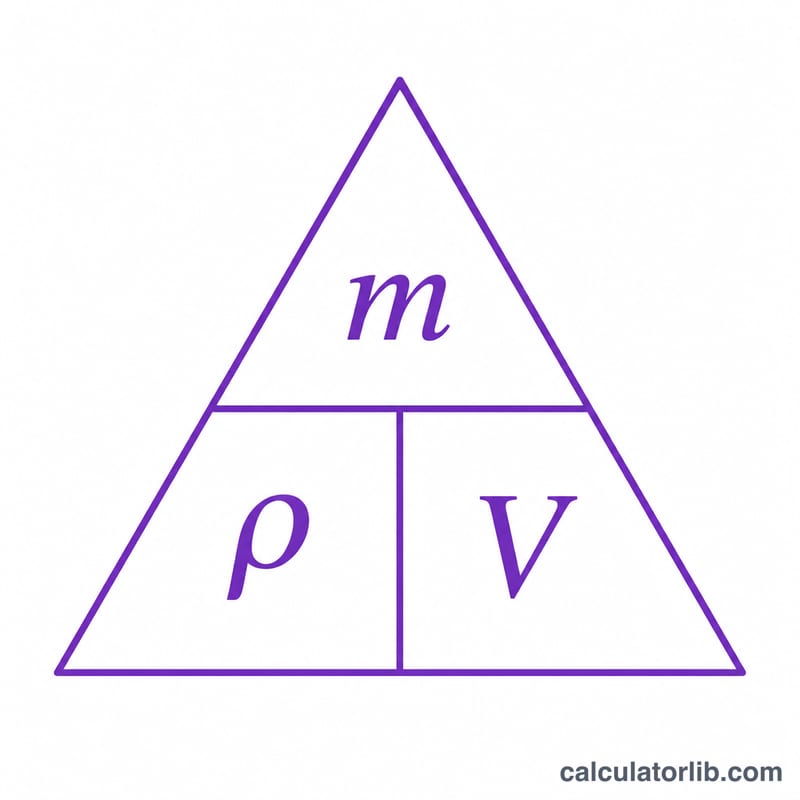
Worked Example
Suppose you prepare a saltwater solution with a total mass of 110 g that fills 100 mL. The density is \(110 \div 100 = 1.1\) g/mL, equivalent to 1100 kg/m³. This is denser than pure water (1.0 g/mL), confirming that dissolving salt increases the density.
$$\rho = \frac{110 \text{ g}}{100 \text{ mL}} = 1.1 \text{ g/mL}$$FAQ
Is g/mL the same as g/cm³? Yes. One milliliter equals exactly one cubic centimeter, so the values are identical.
Why is solution density usually greater than water? Dissolving a solute adds mass while changing volume only slightly, so most solutions are denser than the pure solvent.
Can I use kilograms and liters? Yes—kg/L gives the same numerical value as g/mL, so you can enter consistent units as long as mass and volume match.