
What Is Cumulative Frequency?
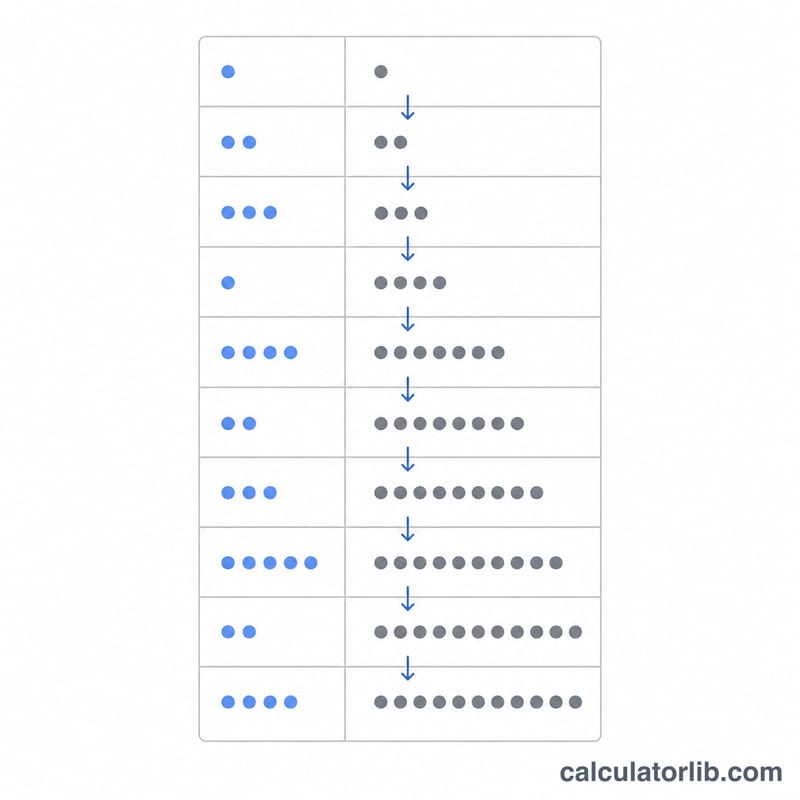
Cumulative frequency is a running total of frequencies. For an ordered set of classes, the cumulative frequency at any class is the sum of that class's frequency plus all the frequencies before it. It answers questions like "how many observations fall at or below this point?" and is the foundation for cumulative frequency graphs (ogives), medians, quartiles, and percentiles.
How to Use This Calculator
Type your class frequencies into the box in order, separated by commas or spaces (for example 5, 8, 12, 4, 6). The calculator adds each frequency to the running total and displays a full table showing every class, its frequency, and its cumulative frequency. The final row gives the grand total, which equals the last cumulative value.
The Formula Explained
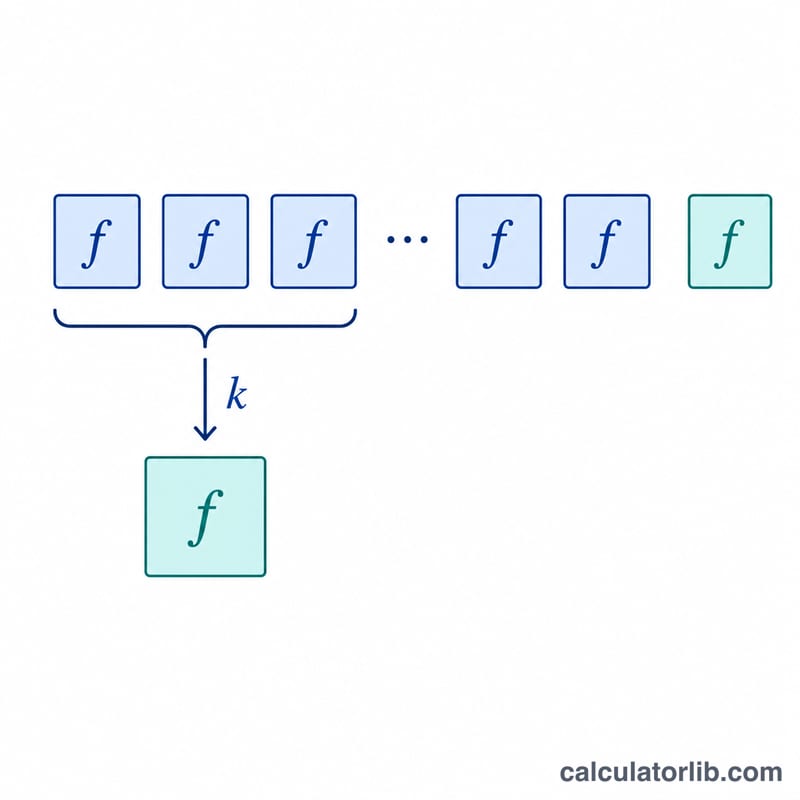
The cumulative frequency of the k-th class is written $$CF_k = \sum_{i=1}^{k} f_i \quad \text{where } f_i \in \text{Frequencies}$$ In plain terms, start with the first frequency, then keep adding each subsequent frequency to the previous total. The last cumulative frequency, \(CF_n\), always equals the sum of every frequency in the data set.
Worked Example
Suppose the frequencies are 5, 8, 12, 4, 6. The cumulative values are: 5, then \(5+8=13\), then \(13+12=25\), then \(25+4=29\), then \(29+6=35\). So the cumulative frequency column reads 5, 13, 25, 29, 35, and the total number of observations is 35.
FAQ
Can I enter decimal frequencies? Yes — weighted or relative frequencies with decimals are supported, though raw counts are typically whole numbers.
Does order matter? Yes. Cumulative frequency depends on the order of the classes, so enter them from the lowest class to the highest.
What is the last cumulative frequency? It is always equal to the total of all frequencies — the size of your data set.