
What is joint probability?
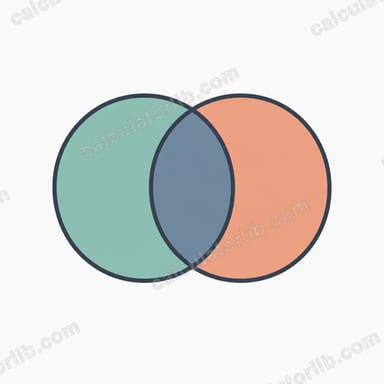
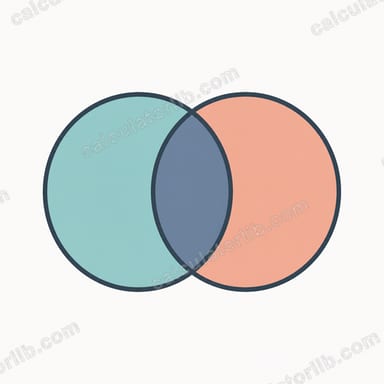
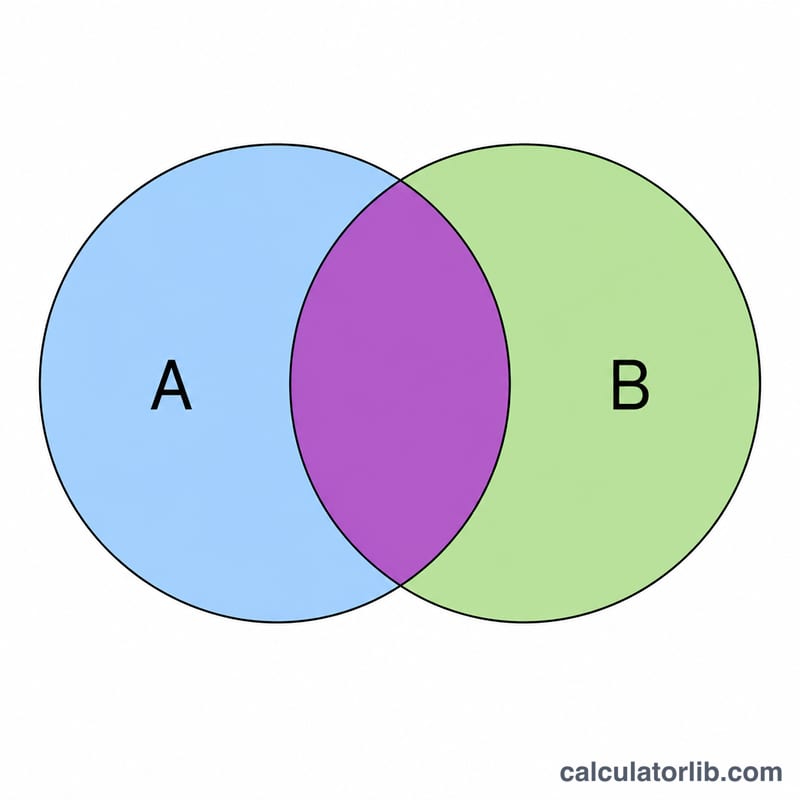
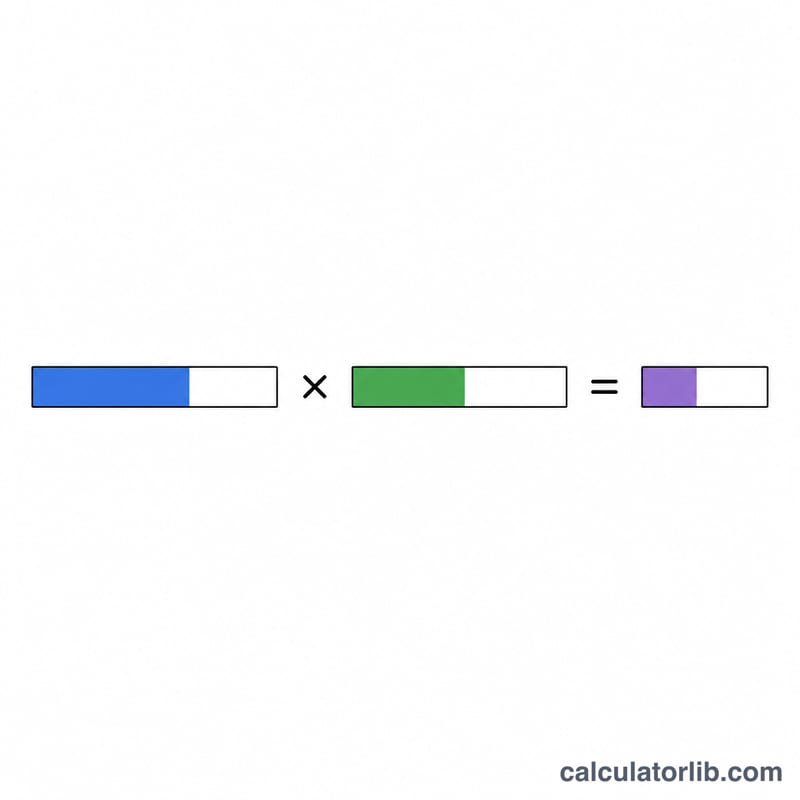
Joint probability is the likelihood that two events both happen. When the two events are independent — meaning the outcome of one has no effect on the other — the joint probability equals the product of their individual probabilities. This calculator uses that rule, written as \(P(A \text{ and } B) = P(A) \times P(B)\).
How to use this calculator
Enter the probability of event A and the probability of event B, each as a value between 0 and 1 (for example, 0.5 means a 50% chance). Click calculate to see the joint probability as both a decimal and a percentage. If you only know percentages, divide by 100 first — 25% becomes 0.25.
The formula explained
For independent events the multiplication rule applies:
$$P(A \cap B) = P(A) \times P(B)$$Because each probability is at most 1, the joint probability is always less than or equal to either input — two requirements are harder to satisfy than one. Note this formula assumes independence; if events influence each other you must use the conditional form \(P(A) \times P(B|A)\).
Worked example
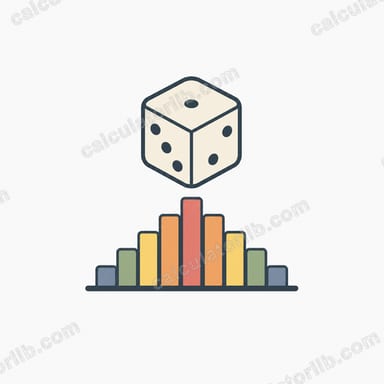
Suppose you flip a fair coin and roll a fair six-sided die. The chance of heads is \(P(A) = 0.5\) and the chance of rolling a 3 is \(P(B) = 1/6 \approx 0.1667\). The joint probability of getting heads and a 3 is
$$0.5 \times 0.1667 = 0.0833$$or about an 8.33% chance.
FAQ
What if the events are not independent? Then this simple multiplication is incorrect; use \(P(A \text{ and } B) = P(A) \times P(B|A)\), where \(P(B|A)\) is the conditional probability of B given A.
Can the inputs be percentages? Convert them to decimals first (50% → 0.5). The calculator expects values from 0 to 1.
Why is the result smaller than each input? Requiring both events to occur is more restrictive, so the combined chance shrinks toward zero as more conditions are added.