
What Is the Lead Conversion Rate?
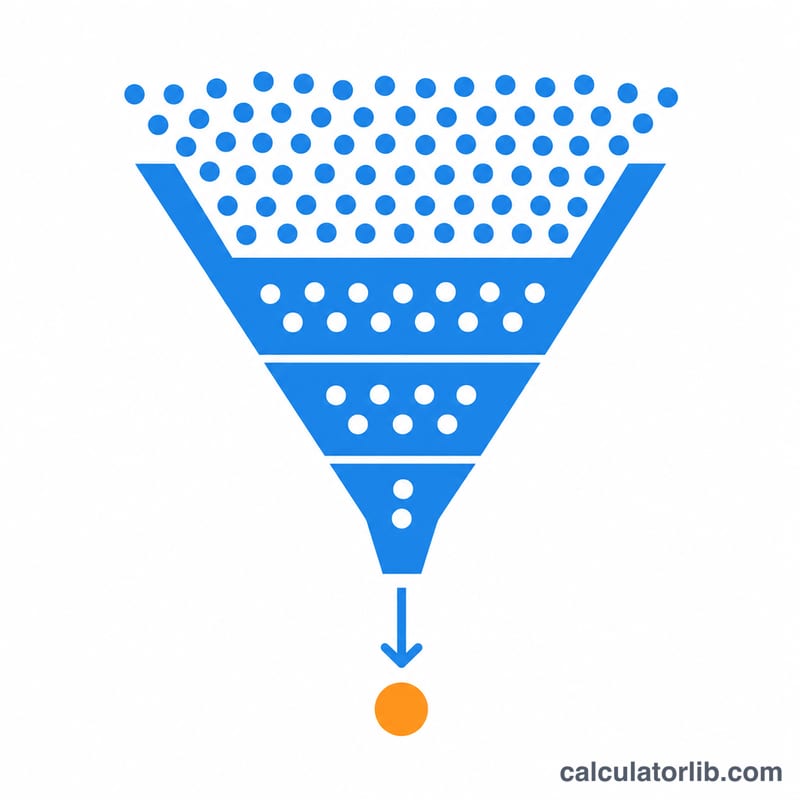
The lead-to-customer conversion rate measures how effectively your sales and marketing efforts turn prospects into paying customers. It is one of the most important metrics in any sales funnel because it tells you, in a single percentage, how well leads move from interest to purchase. A higher conversion rate means you're getting more revenue from the same number of leads.
How to Use This Calculator
Enter the total number of leads generated in a given period, then enter the number of those leads that converted into customers. The calculator instantly returns your conversion rate as a percentage, plus the average number of leads required to win a single customer.
The Formula Explained
The calculation is simple division expressed as a percentage:
$$\text{Conversion \%} = \left(\frac{\text{Customers}}{\text{Leads}}\right) \times 100$$
For example, if you have 500 leads and 75 of them become customers, your conversion rate is \((75 \div 500) \times 100 = 15\%\). That also means you needed roughly \(500 \div 75 \approx 6.67\) leads to gain each customer.
Worked Example
Suppose a marketing campaign produced 1,200 leads last quarter and the sales team closed 96 deals. The conversion rate is \((96 \div 1{,}200) \times 100 = 8\%\). The leads-per-customer figure is \(1{,}200 \div 96 = 12.5\), so on average it took 12 to 13 leads to land each new customer.
FAQ
What is a good lead conversion rate? It varies widely by industry, but many B2B businesses see rates between 2% and 15%. Compare against your own historical baseline rather than a universal benchmark.
Can the rate exceed 100%? No. Since customers are a subset of leads, the rate is always between 0% and 100%.
How can I improve my conversion rate? Focus on lead quality, faster follow-up times, better lead nurturing, and aligning sales messaging with customer needs.