
What is Conversion Rate (CVR)?
Conversion Rate (CVR) is one of the most important metrics in digital marketing and e-commerce. It measures the percentage of visitors to a website, landing page, or campaign who complete a desired outcome — such as making a purchase, signing up for a newsletter, requesting a document, or submitting an inquiry. A higher CVR means your site is turning more of its traffic into meaningful results. This metric is universal and applies identically to any market or country.
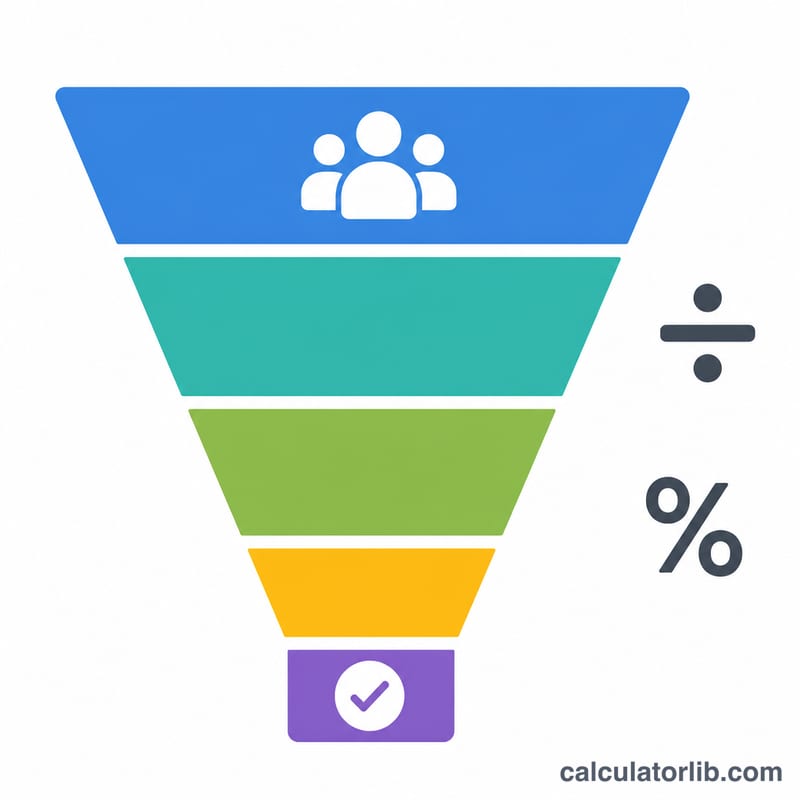
How to use this calculator
Enter the Number of conversions (visitors who completed your target action) and the Number of visitors (total sessions or users). The calculator instantly returns the conversion rate as a percentage. Keep the numerator and denominator consistent — if you count unique users as visitors, then count one conversion per user, not per session or pageview.
The formula explained
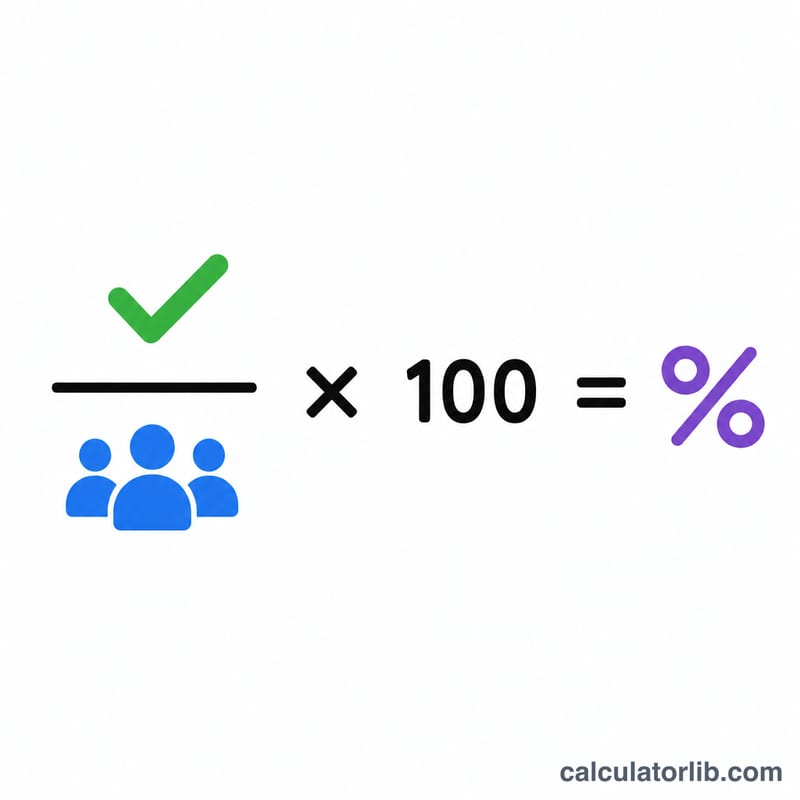
The conversion rate is the ratio of conversions to visitors, expressed as a percentage:
$$\text{CVR} = \frac{\text{Conversions}}{\text{Visitors}} \times 100\%$$
The ratio of conversions to visitors gives a fraction between 0 and 1, and multiplying by 100 converts it into a percentage that is easy to read and compare.
Worked example
Suppose a store had 15 purchases from 1,000 visitors. \(\text{CVR} = \frac{15}{1000} \times 100 = 0.015 \times 100 = \textbf{1.5\%}\). In a stronger campaign with 320 conversions out of 8,000 visitors, \(\text{CVR} = \frac{320}{8000} \times 100 = \textbf{4.0\%}\).
FAQ
What is a good conversion rate? Typical e-commerce CVR ranges from roughly 1% to 4%, though this varies widely by industry, traffic source, and goal type.
Why is my CVR above 100%? That usually signals a data error — for example, counting multiple conversions per visitor or mismatched numerator and denominator definitions. In normal usage conversions should not exceed visitors.
What if visitors is zero? The conversion rate is undefined when there are no visitors, since division by zero is not allowed. The calculator returns 0 in that case.