
What is the Right Circular Cone Calculator?
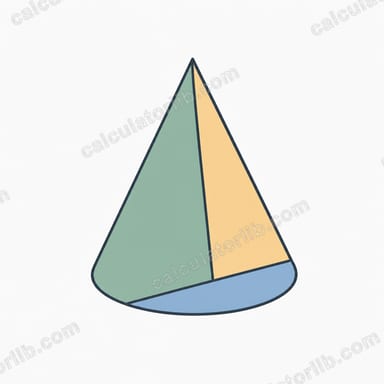
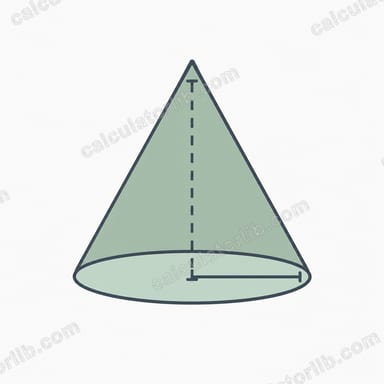
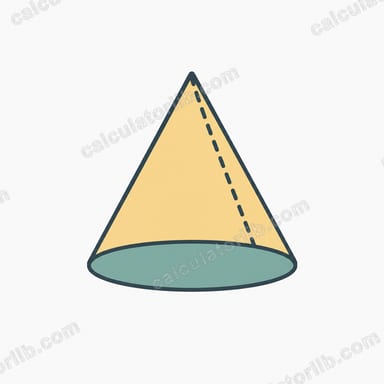
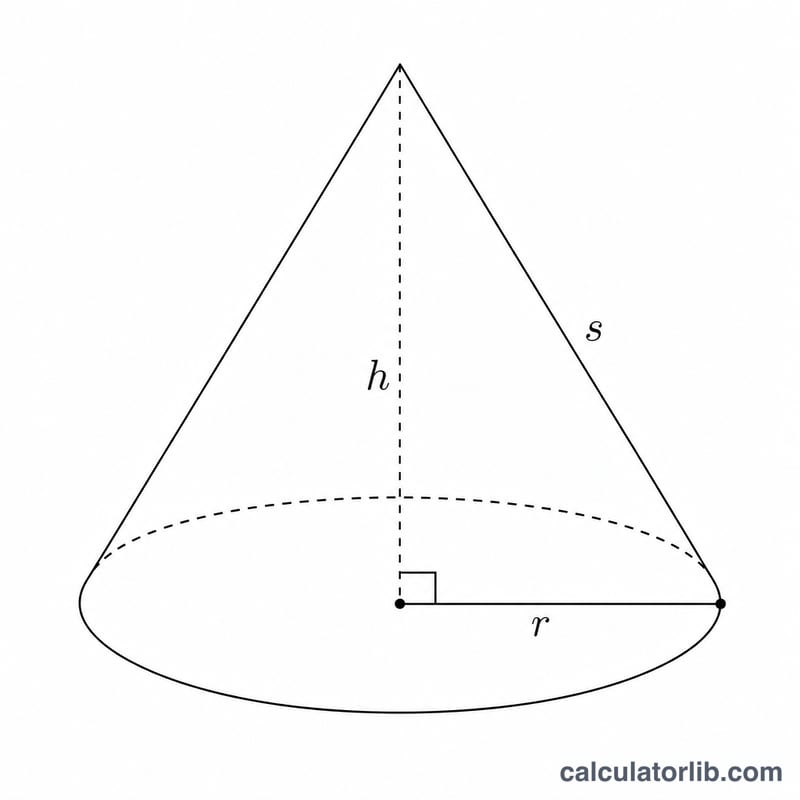
A right circular cone has a circular base of radius r and an apex sitting directly above the center at height h. The slant height s runs from the apex down to the edge of the base. This calculator solves the entire cone from any two known values — pick a calculation mode, enter the two figures, and it returns every remaining dimension, all surface areas, the volume, and the three characteristic angles. It is pure geometry and works the same everywhere, in any consistent length unit.
How to use it
Choose what you know from the "Choose a Calculation" dropdown (for example radius and height, or radius and volume). Fill in the two matching fields. Optionally override pi, pick a display unit label, and set how many significant figures to round to. Press calculate to see radius, height, slant height, lateral / base / total surface area, volume, the same quantities expressed as a multiple of pi, and the half, aperture and base angles.
The formulas explained
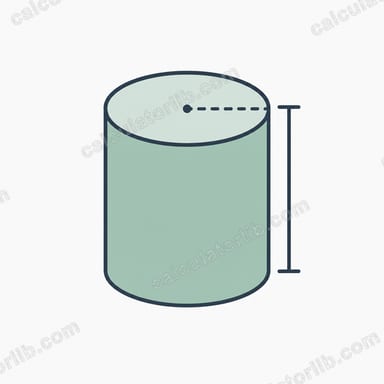
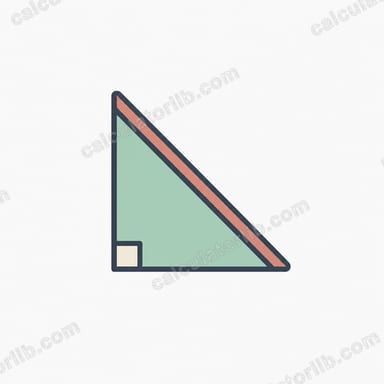
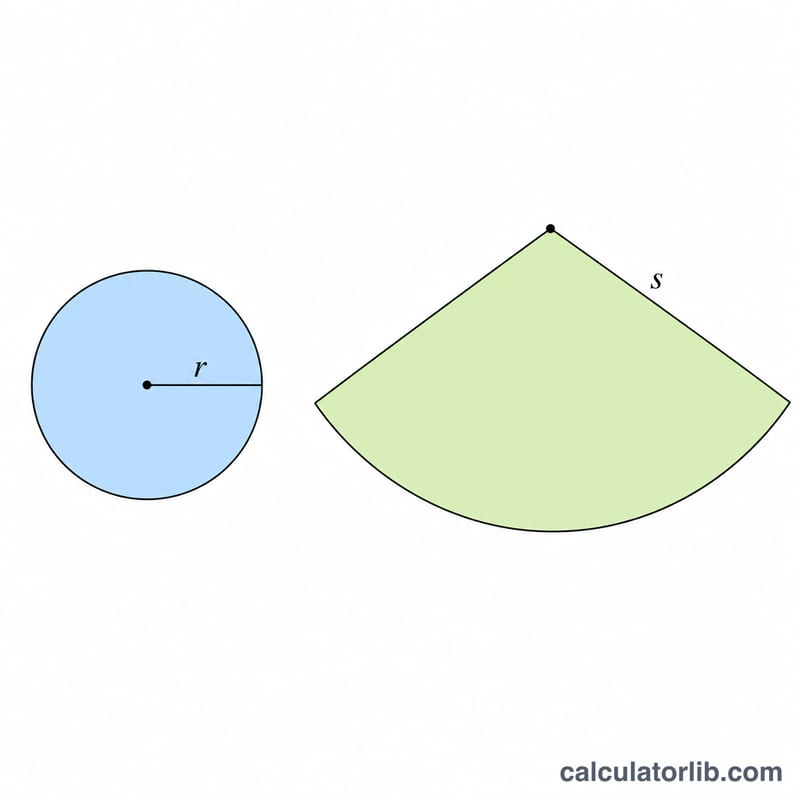
The radius, height and slant height form a right triangle, so \(s = \sqrt{r^2 + h^2}\). Volume is one third of the enclosing cylinder: \(V = \tfrac{1}{3}\pi r^2 h\). The curved side area is \(L = \pi r s\), the base is \(B = \pi r^2\), and the total is \(A = L + B = \pi r (s + r)\). The half-angle between the axis and the slant side is \(\theta = \arctan\frac{r}{h}\), the aperture angle is \(2\theta\), and the base angle is \(90^\circ - \theta\).
Worked example
Take \(r = 3\) and \(h = 4\). Then $$s = \sqrt{9 + 16} = 5.$$ Volume \(= \tfrac{1}{3}\pi\cdot 9\cdot 4 = 12\pi \approx 37.699\). Lateral area \(= \pi\cdot 3\cdot 5 = 15\pi \approx 47.124\). Base \(= 9\pi \approx 28.274\). Total \(= 24\pi \approx 75.398\). Half-angle \(= \arctan(3/4) = 36.87^\circ\), aperture \(= 73.74^\circ\), base angle \(= 53.13^\circ\).
FAQ
Does the unit dropdown convert numbers? No — it is only a display label. All inputs are assumed to be in one consistent unit and outputs are reported in that same unit, unit² and unit³.
Why do I get an "impossible geometry" error? The slant height must always be greater than both the radius and the height; if a given pair implies otherwise the cone cannot exist.
What are the "in terms of pi" values? They are the coefficients of pi — e.g. a volume of \(12\pi\) is shown as 12, so you can read exact symbolic answers.