
What this calculator does
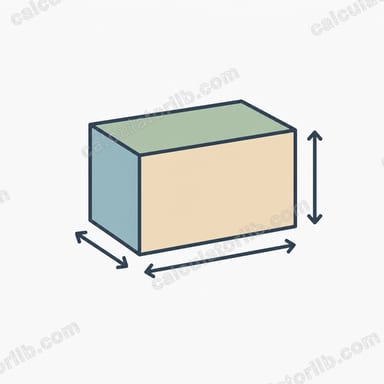
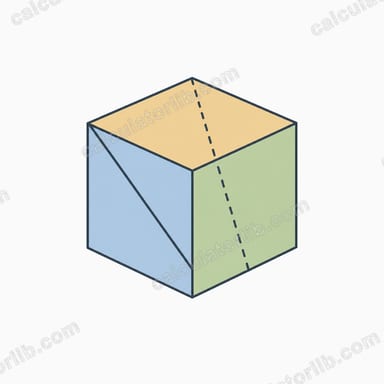
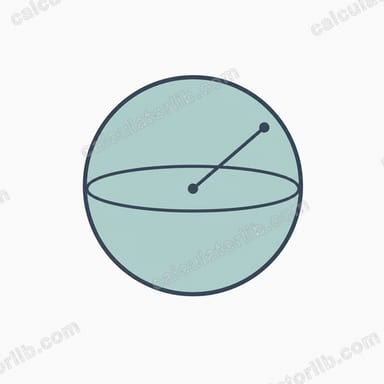
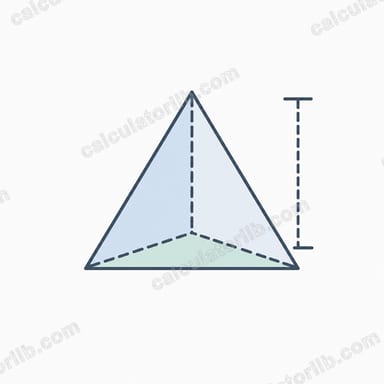
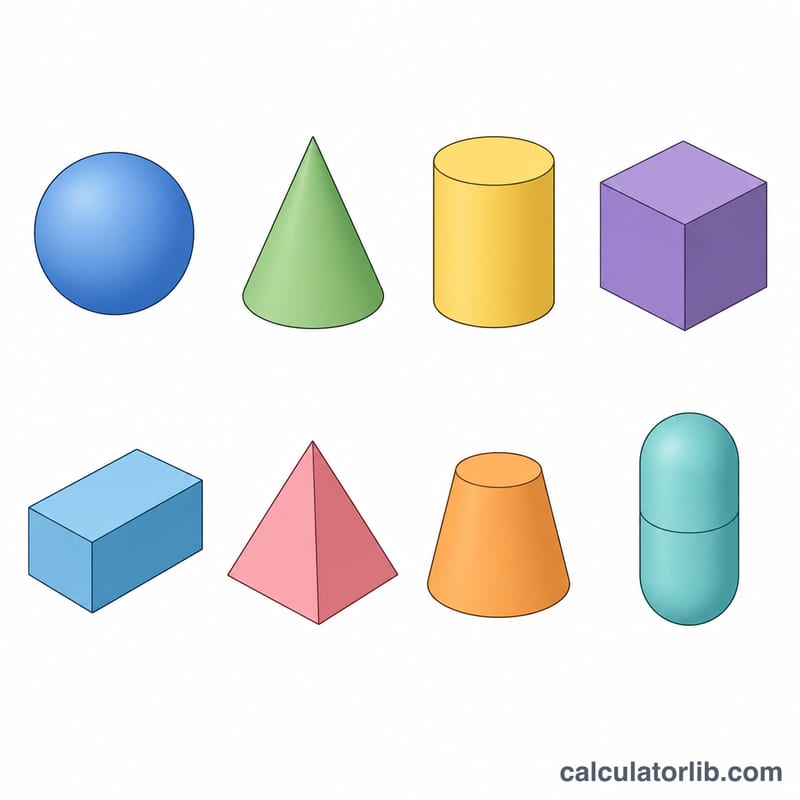
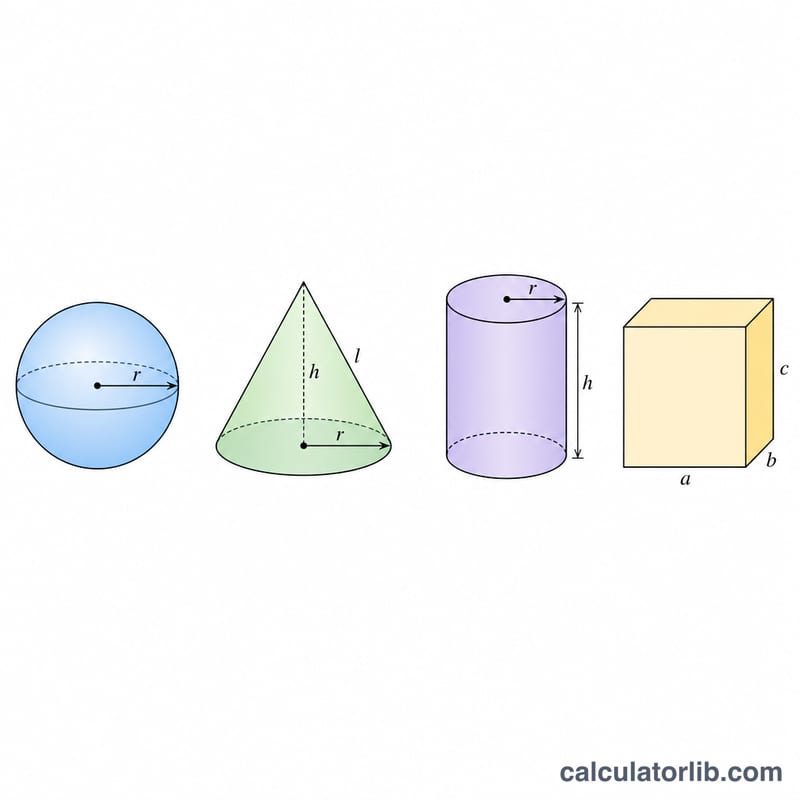
The Solid Geometry Shapes Calculator computes the volume, surface area and key extras (slant height, diagonals, circumference) of nine common three-dimensional solids: capsule, circular cone, circular cylinder, conical frustum, cube, hemisphere, square pyramid, rectangular prism (box) and sphere. It is pure mathematics, so the results are valid anywhere in the world with any consistent length unit.
How to use it
Pick a solid from the dropdown, then enter its dimensions in the same length unit (all millimetres, all centimetres, etc.). The unit selector is for labelling only — it does not rescale your numbers. Press calculate to see the volume in cubic units, surface areas in square units, and any shape-specific values such as slant height or the space diagonal. Every dimension must be greater than zero.
The formulas explained
Each solid uses its standard closed-form formula. A cone of base radius \(r\) and height \(h\) has volume $$V = \tfrac{1}{3}\pi r^{2} h$$ and slant height $$s = \sqrt{r^{2}+h^{2}},$$ so its total surface area is \(\pi r (r + s)\). A sphere of radius \(r\) has $$V = \tfrac{4}{3}\pi r^{3}, \quad A = 4\pi r^{2}.$$ The conical frustum (a cone with its tip cut off parallel to the base) uses $$V = \tfrac{1}{3}\pi h\left(r_1^{2}+r_2^{2}+r_1\cdot r_2\right);$$ when the top and bottom radii are equal it gracefully reduces to a cylinder.
Worked example
Take a circular cone with base radius \(r = 3\) cm and height \(h = 4\) cm. The slant height is $$s = \sqrt{3^{2}+4^{2}} = \sqrt{25} = 5 \text{ cm}.$$ The volume is $$\tfrac{1}{3}\pi(9)(4) = 12\pi \approx 37.70 \text{ cm}^{3}.$$ The lateral surface area is $$\pi(3)(5) = 15\pi \approx 47.12 \text{ cm}^{2},$$ the base is \(\pi(9) \approx 28.27 \text{ cm}^{2}\), and the total surface area is $$\pi(3)(3+5) = 24\pi \approx 75.40 \text{ cm}^{2}.$$
FAQ
Do all inputs need the same unit? Yes. Mixing units (some in cm, some in m) gives meaningless results. Convert everything to one unit first.
Why does my volume have so many decimals? The tool computes at full precision and rounds the display to four decimals. Internally nothing is lost.
What is the difference between lateral and total surface area? Lateral surface area is just the curved or slanted side(s); total surface area adds the flat base(s) on top.