
What this calculator does
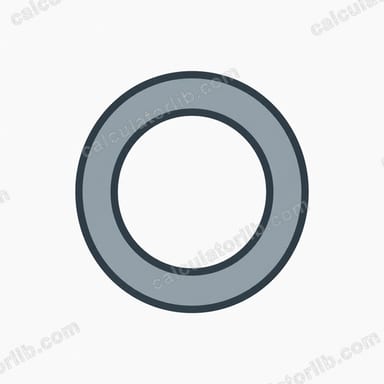
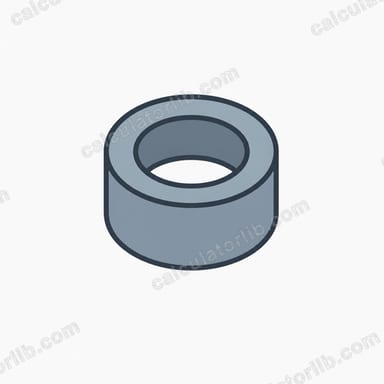
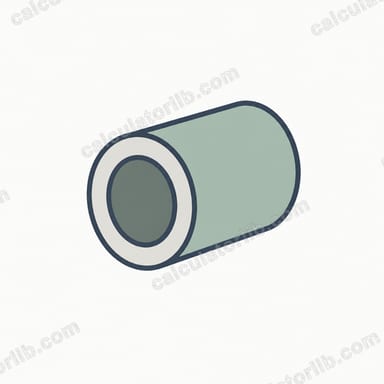
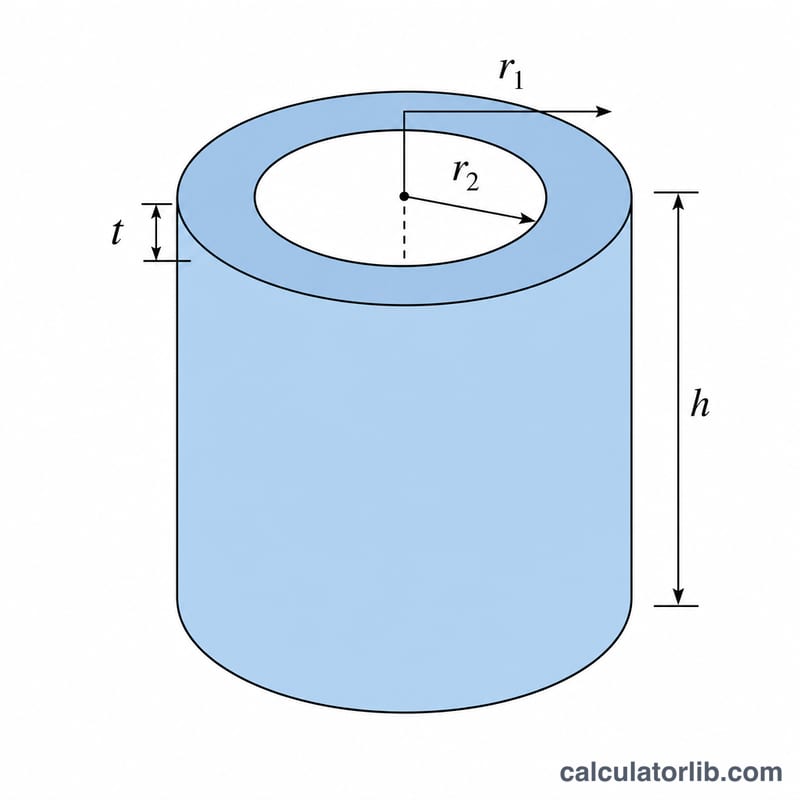
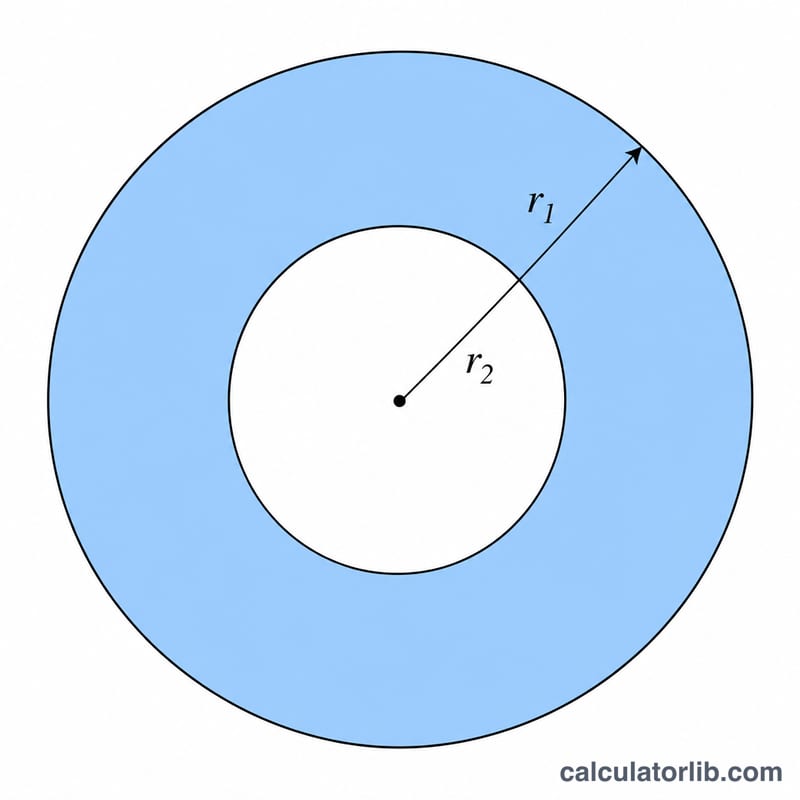
A tube (hollow cylinder or pipe) is defined by an outer radius \(r_1\), an inner radius \(r_2\) with \(r_1 > r_2 > 0\), and a height \(h\). The solid material is the ring (annulus) of wall thickness \(t = r_1 - r_2\) extruded along the height. This tool computes every geometric property of that tube from any of several input combinations: the two outer/inner radii, the two circumferences, or a radius/circumference together with the wall thickness, plus either the height or the known solid volume.
How to use it
Pick a calculation mode from the dropdown. The form then shows exactly the three inputs you need. Enter your values in a single consistent length unit (this calculator does not convert between units; the chosen unit is only printed on the answers). You can set the value of pi for the precision you want and round all outputs to a chosen number of significant figures. Press calculate to see radii, circumferences, wall thickness, height, the inner and outer lateral surface areas, the combined ring end area, the inner/outer cylinder volumes and the solid wall volume.
The formulas explained
From a circumference, the radius is \(r = C / (2\pi)\). With a wall thickness, the inner radius is \(r_2 = r_1 - t\). The key results are: \(C_1 = 2\pi r_1\), \(C_2 = 2\pi r_2\), \(L_1 = 2\pi r_1 h\) (outer lateral), \(L_2 = 2\pi r_2 h\) (inner lateral), \(A = 2\pi (r_1^2 - r_2^2)\) for both annular ends, \(V_1 = \pi r_1^2 h\) (outer cylinder), \(V_2 = \pi r_2^2 h\) (the hole), and the solid wall volume $$V = \pi h (r_1^2 - r_2^2) = V_1 - V_2.$$ When height is unknown but the solid volume \(V\) is given, height is recovered as $$h = \frac{V}{\pi (r_1^2 - r_2^2)}.$$
Worked example
For \(r_1 = 5\), \(r_2 = 3\), \(h = 10\) with \(\pi = 3.14159265359\): \(t = 2\), \(C_1 = 31.4159\), \(C_2 = 18.8496\), \(L_1 = 314.159\), \(L_2 = 188.496\), \(A = 100.531\), \(V_1 = 785.398\), \(V_2 = 282.743\) and the solid wall volume $$V = \pi \cdot 10 \cdot (5^2 - 3^2) = 502.655.$$ Notice \(V_1 - V_2 = 502.655\), confirming the solid volume formula.
FAQ
Does it convert units? No. Enter all values in one unit; the unit selector only labels the outputs (lengths as the unit, areas squared, volumes cubed).
Why can I set pi? Choosing a higher-precision pi or rounding to more significant figures lets you match textbook or engineering tolerances exactly.
What if I get an invalid result? The outer dimension must exceed the inner one (\(r_1 > r_2\), \(C_1 > C_2\), or \(t < r_1\)) and all values must be positive, otherwise the wall has zero or negative thickness.