
What this calculator does
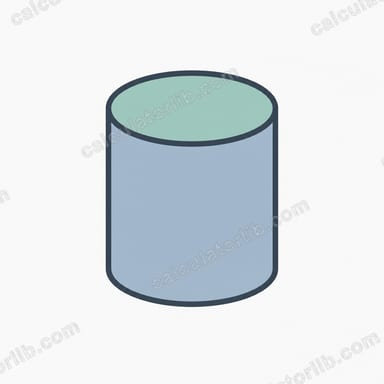
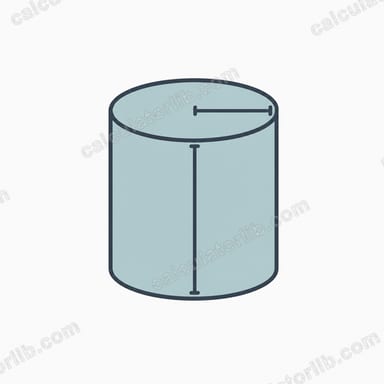
This tool solves every defining property of a right circular cylinder — radius, height, volume, lateral (curved) surface area, top and base circle areas, and total surface area — from any two known quantities. Pick what you know (for example radius and height, or radius and volume) and the calculator inverts the standard formulas to find the rest. Results are also shown "in terms of pi" as a clean coefficient.
How to use it
Choose a mode from the dropdown that matches the two values you have. Enter those two numbers, optionally adjust the value of pi, choose a length-unit label, and read the full result table. All inputs are assumed to be in the same chosen unit; the unit is a label only and no scaling is applied. Areas come out in unit² and volume in unit³.
The formulas explained
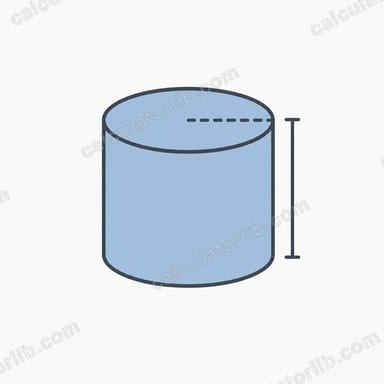
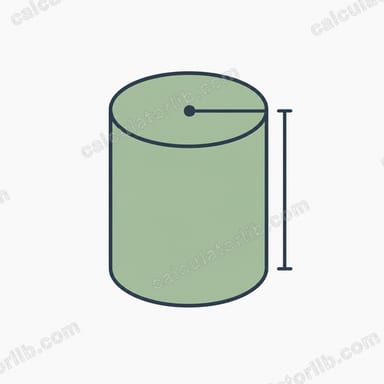
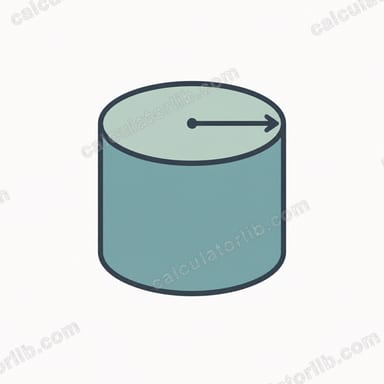
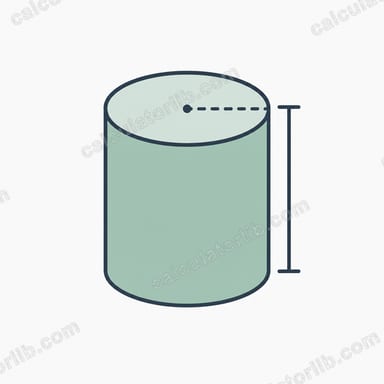
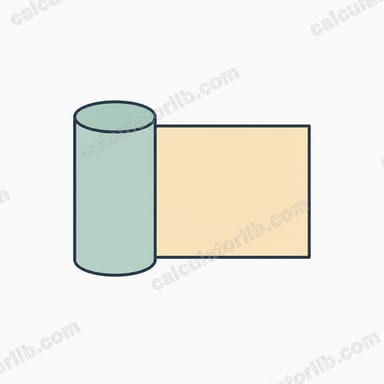
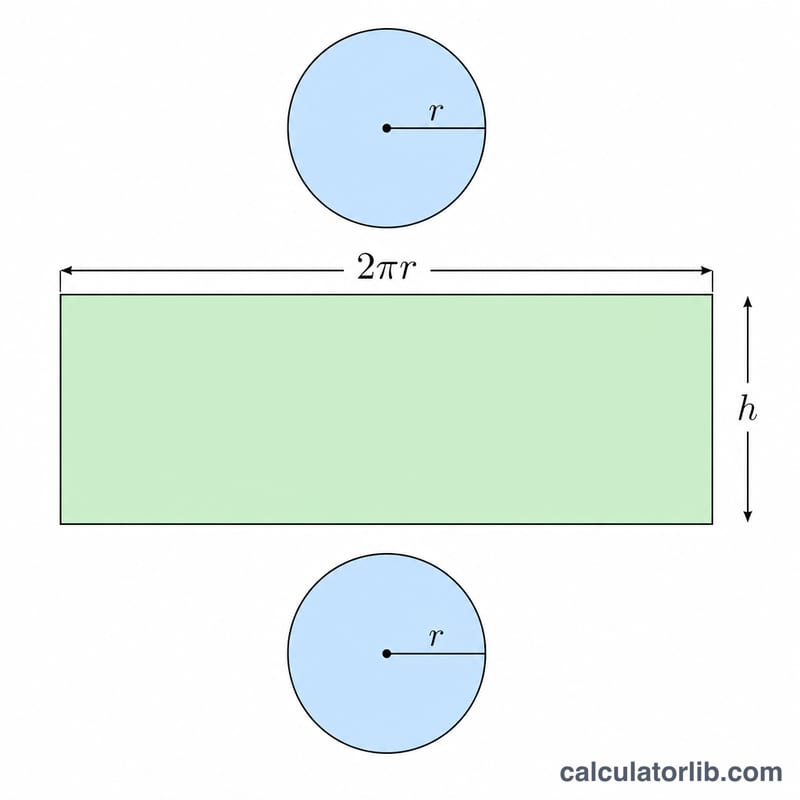
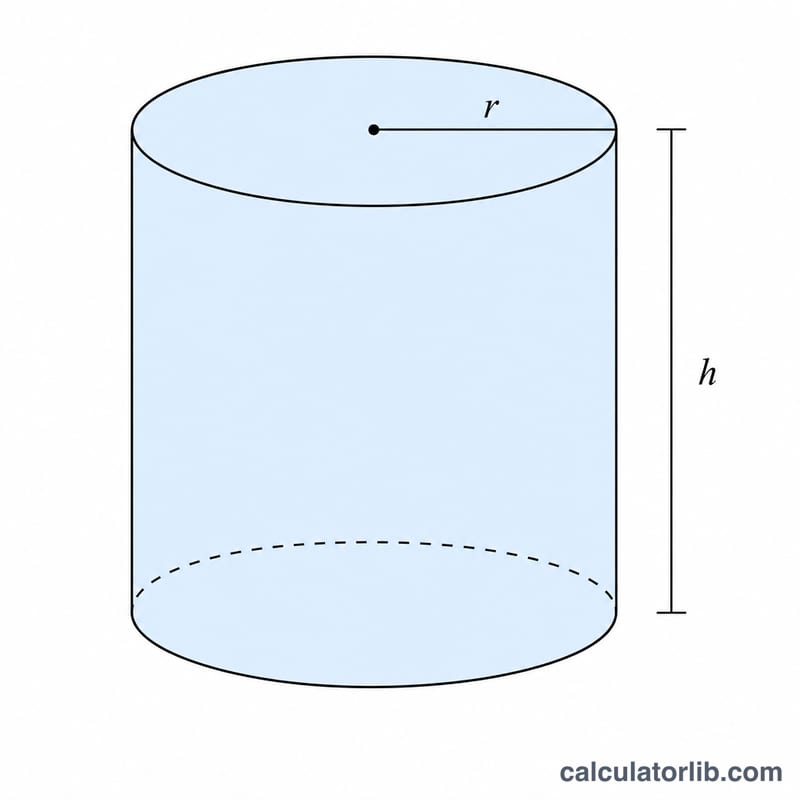
For a cylinder of radius \(r\) and height \(h\): the volume is $$V = \pi r^2 h,$$ the curved (lateral) area is $$L = 2\pi r h,$$ each end circle has area \(\pi r^2\), and the total surface area is $$A = 2\pi r^2 + 2\pi r h = 2\pi r(r + h).$$ To solve from other pairs the calculator rearranges these: \(h = V/(\pi r^2)\), \(h = L/(2\pi r)\), \(r = L/(2\pi h)\), \(r = \sqrt{V/(\pi h)}\), and from total area \(h = A/(2\pi r) - r\).
Worked example
Given \(r = 2\) and \(h = 5\) with \(\pi = 3.14159265359\): $$V = \pi \cdot 4 \cdot 5 = 20\pi \approx 62.8319,$$ $$L = 2\pi \cdot 2 \cdot 5 = 20\pi \approx 62.8319,$$ each end \(= 4\pi \approx 12.5664\), and $$A = 2\pi \cdot 2 \cdot (2+5) = 28\pi \approx 87.9646.$$ Feeding \(r = 2\) and \(A = 87.9646\) back in gives \(h = 87.9646/(12.5664) - 2 = 5\), confirming the inverse.
FAQ
Does it convert units? No. All values are treated in the single unit you select; the unit is only a label for the results.
What is the "in terms of pi" column? It is the exact coefficient that multiplies pi — e.g. a volume of \(20\pi\) is shown as 20.
What if total area is too small? When solving from radius and total area, \(A\) must exceed \(2\pi r^2\); otherwise the implied height is zero or negative and a warning is shown.