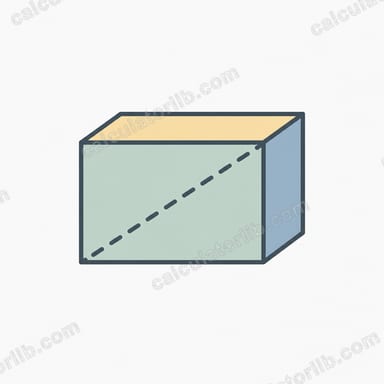

What is a rectangular prism (cuboid)?
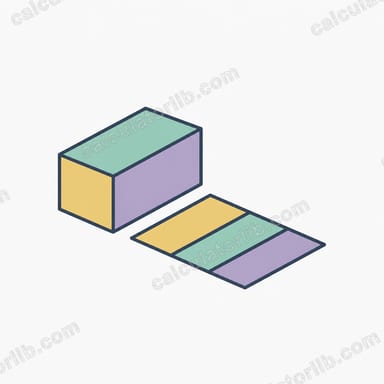
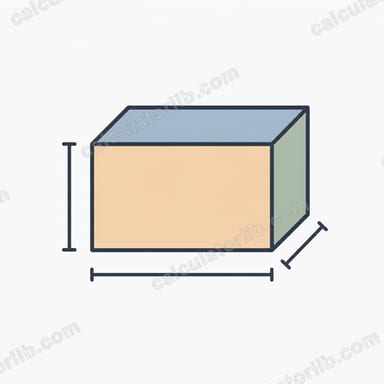
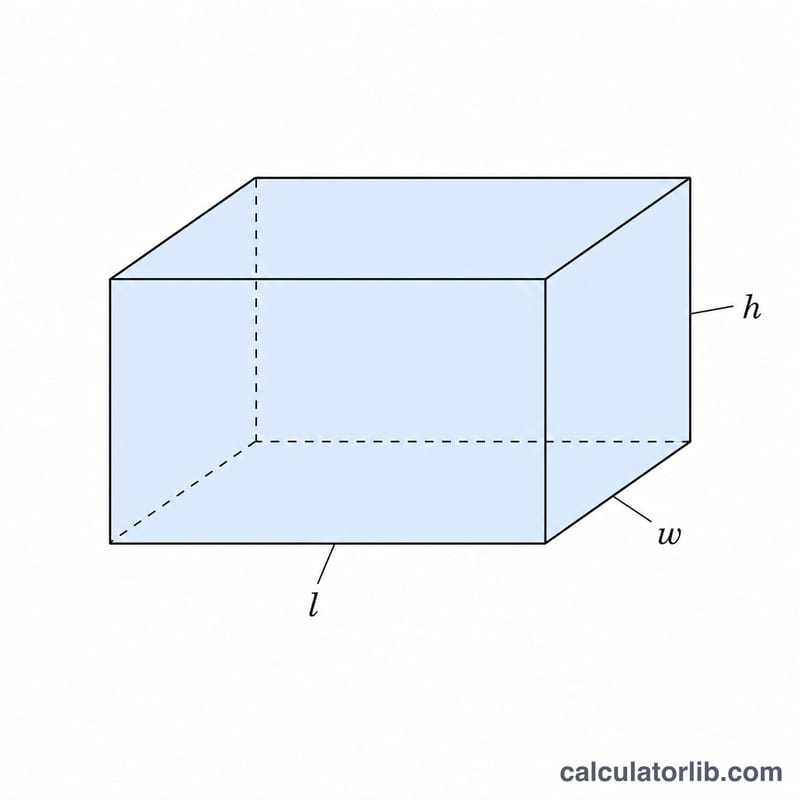
A rectangular prism, also called a cuboid, is a three-dimensional box bounded by six rectangular faces meeting at right angles. It is fully described by three edge lengths: length (\(l\)), width (\(w\)) and height (\(h\)). A cube is the special case where \(l = w = h\). This calculator works in pure geometry, so it applies universally — no country or unit system is assumed.
How to use this calculator
Pick a calculation mode based on what you know. Length and width are always required. The third known value can be the height, the total surface area, the volume, or the space diagonal. The tool solves for the missing height and then reports every property: volume, total/lateral/top/bottom surface area and the body diagonal. Choose a unit label (or none) and how many significant figures to round to.
The formulas explained
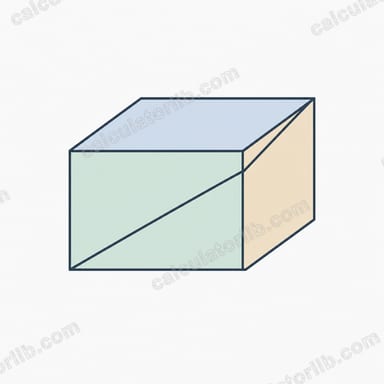
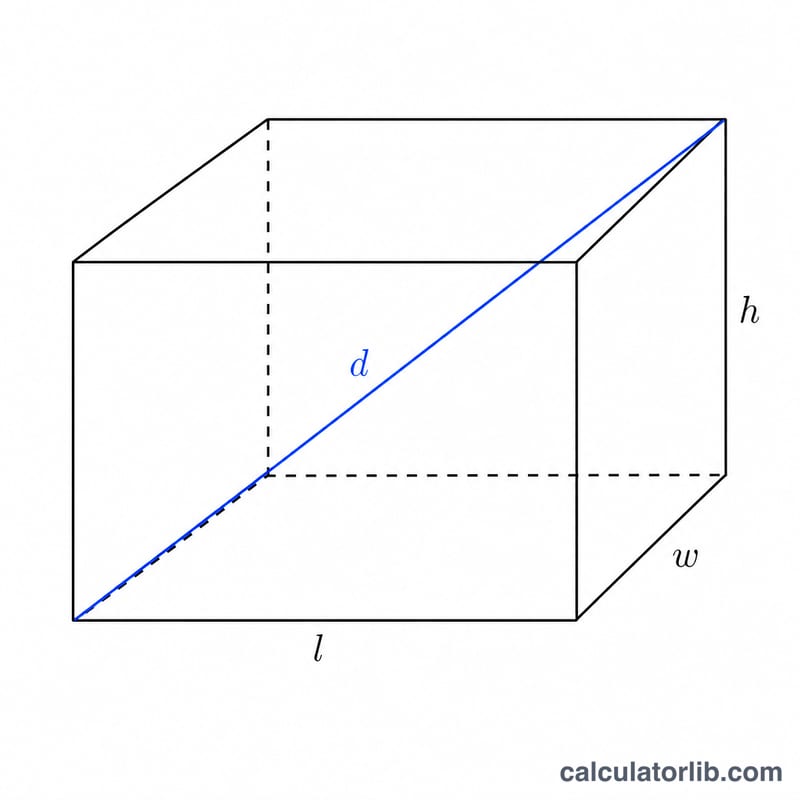
Volume is $$V = l \cdot w \cdot h.$$ Total surface area is $$S_{tot} = 2(lw + lh + wh).$$ The four vertical side faces give the lateral area $$S_{lat} = 2h(l + w),$$ while top and bottom each equal \(l \cdot w\). The space diagonal is $$d = \sqrt{l^2 + w^2 + h^2}.$$ To recover height: from surface area, \(h = \frac{S - 2lw}{2(l + w)}\); from volume, \(h = \frac{V}{l \cdot w}\); from diagonal, \(h = \sqrt{d^2 - l^2 - w^2}\).
Worked example
With \(l = 5\), \(w = 3\), \(h = 2\): $$V = 5 \cdot 3 \cdot 2 = 30.$$ Top = bottom = \(5 \cdot 3 = 15\). Lateral = \(2 \cdot 2 \cdot (5+3) = 32\). Total = \(2 \cdot (15 + 10 + 6) = 62\), which equals \(32 + 15 + 15\). Diagonal = \(\sqrt{25 + 9 + 4} = \sqrt{38} \approx 6.16441\).
FAQ
What if my surface area gives no solution? If \(S \le 2lw\), the base alone already uses all the area, leaving no room for height — that prism cannot exist.
Why is my diagonal rejected? The space diagonal must satisfy \(d^2 > l^2 + w^2\). A shorter diagonal cannot reach across a real box with that base.
Does it convert units? No. All inputs are assumed to share one unit; outputs simply carry that label (lengths in unit, areas in unit\(^2\), volume in unit\(^3\)).