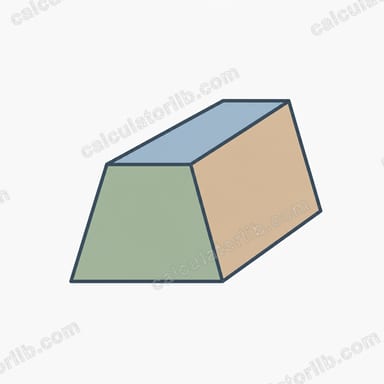

What is a Trapezoidal Prism?
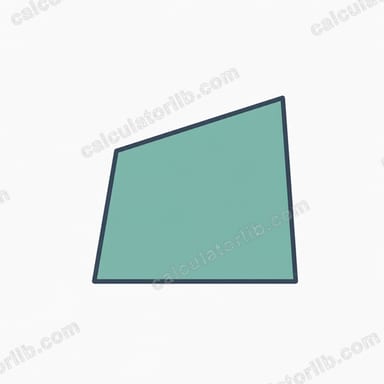
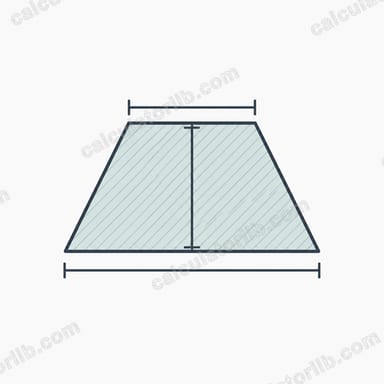
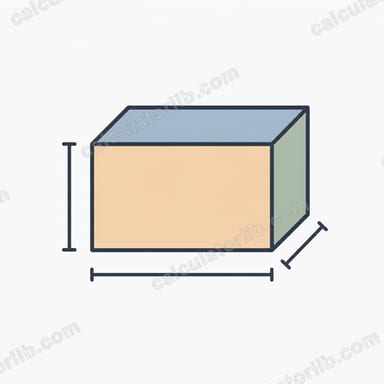
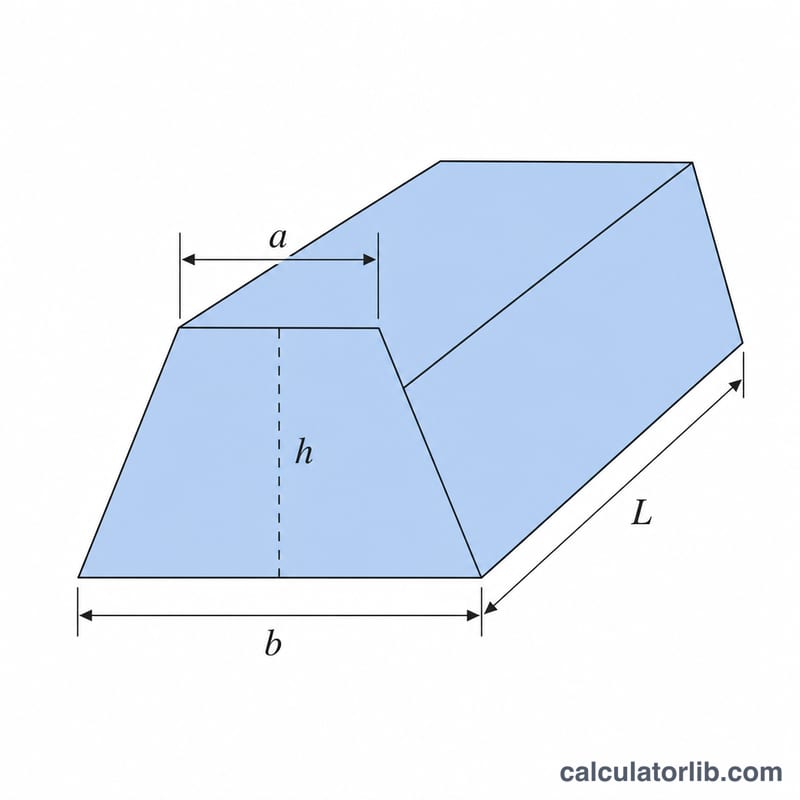
A trapezoidal prism is a three-dimensional solid whose cross-section is a trapezoid extruded along its length. Think of a ramp, a swimming-pool channel, a beam, or a section of a canal — many real-world shapes are trapezoidal prisms. This calculator finds the volume from four simple measurements: the two parallel sides of the trapezoid (a and b), the perpendicular height between them (h), and the length of the prism (L).
How to Use the Calculator
Enter the length of the longer parallel side (a), the shorter parallel side (b), the trapezoid height (h) — the perpendicular distance between the two parallel sides — and the prism length (L). All values must use the same unit (for example centimeters). The result is the volume in cubic units, plus the area of the trapezoidal cross-section.
The Formula Explained
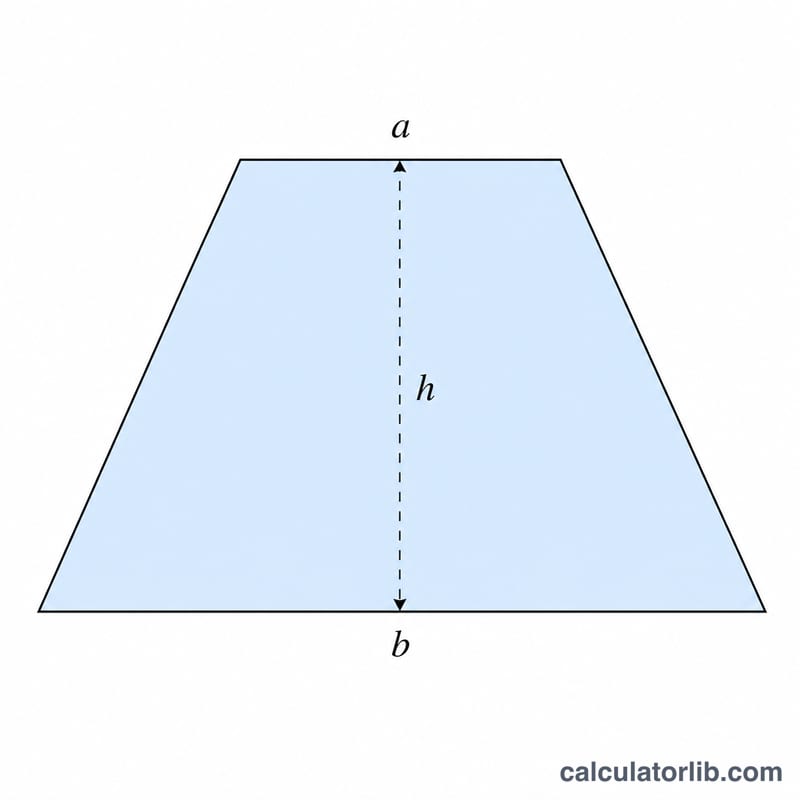
The volume of any prism equals its cross-sectional area multiplied by its length. The area of a trapezoid is the average of its two parallel sides times the height: \( A = \frac{a + b}{2} \times h \). Multiplying by the prism length \(L\) gives:
$$V = \frac{\text{Side } a + \text{Side } b}{2} \times \text{Height } h \times \text{Length } L$$
Worked Example
Suppose \(a = 6\), \(b = 4\), \(h = 3\), and \(L = 10\). First find the cross-section area: $$\frac{6 + 4}{2} \times 3 = 5 \times 3 = 15 \text{ square units}.$$ Then multiply by the length: $$15 \times 10 = 150 \text{ cubic units}.$$ So the trapezoidal prism holds 150 cubic units.
FAQ
Which side is a and which is b? It doesn't matter — a and b are the two parallel sides, and addition is commutative, so the order has no effect on the result.
What is the trapezoid height h? It is the perpendicular distance between the two parallel sides, not the slanted side length.
What units does the answer use? Whatever unit you input. If you enter centimeters, the volume is in cubic centimeters; meters give cubic meters.