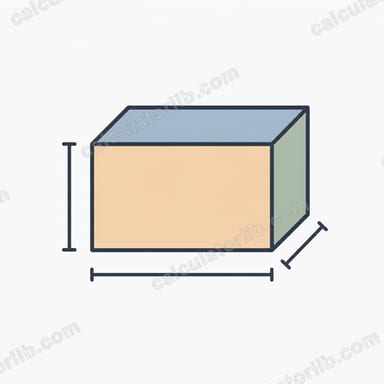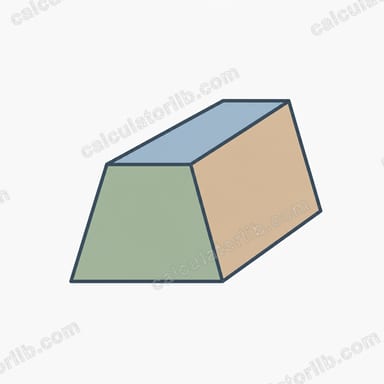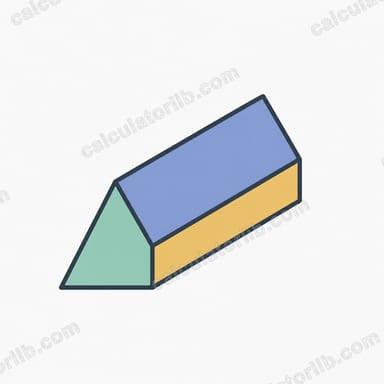

What Is a Prism Volume Calculator?
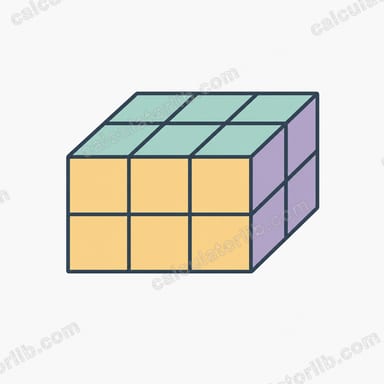
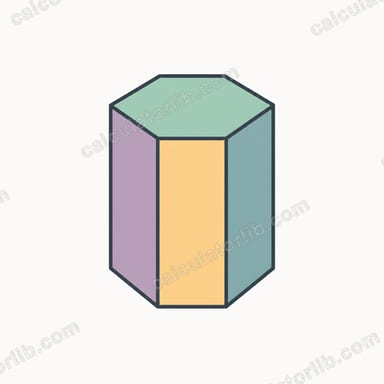
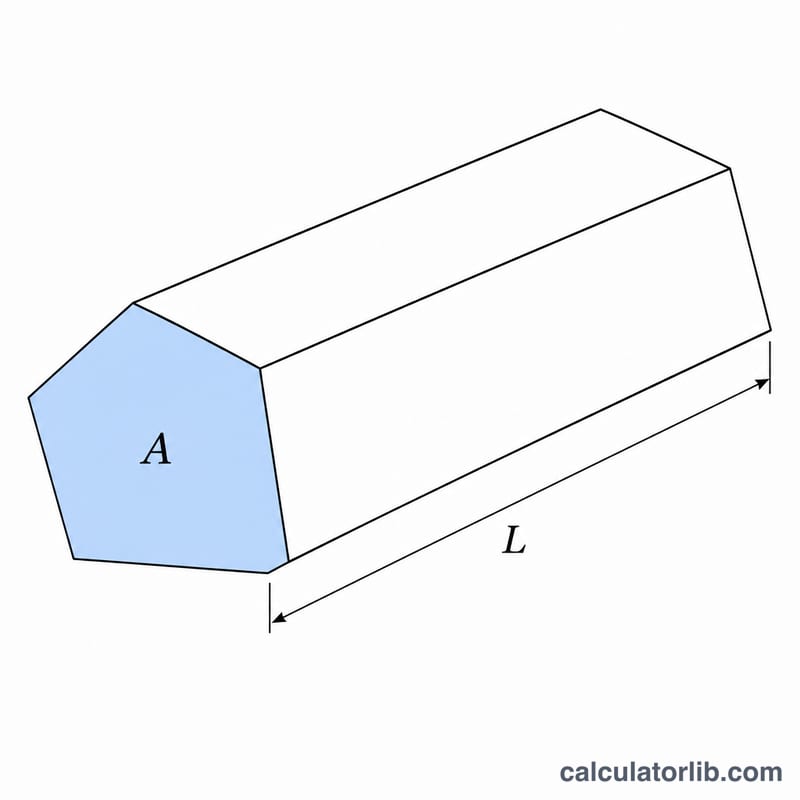
A prism is a solid with two identical parallel ends (the cross-section) joined by flat sides. As long as that cross-section stays the same all along the solid, its volume is simply the area of the cross-section multiplied by the length of the prism. This calculator works for any prism shape — triangular, rectangular, pentagonal, hexagonal, L-shaped or completely irregular — because you supply the cross-section area directly.
How to Use It
Enter the area of the cross-section (the end face) in any square units, then enter the length of the prism in the matching linear units. Click calculate to get the volume in cubic units. Keep your units consistent: if the area is in cm² and the length is in cm, the volume comes out in cm³.
The Formula Explained
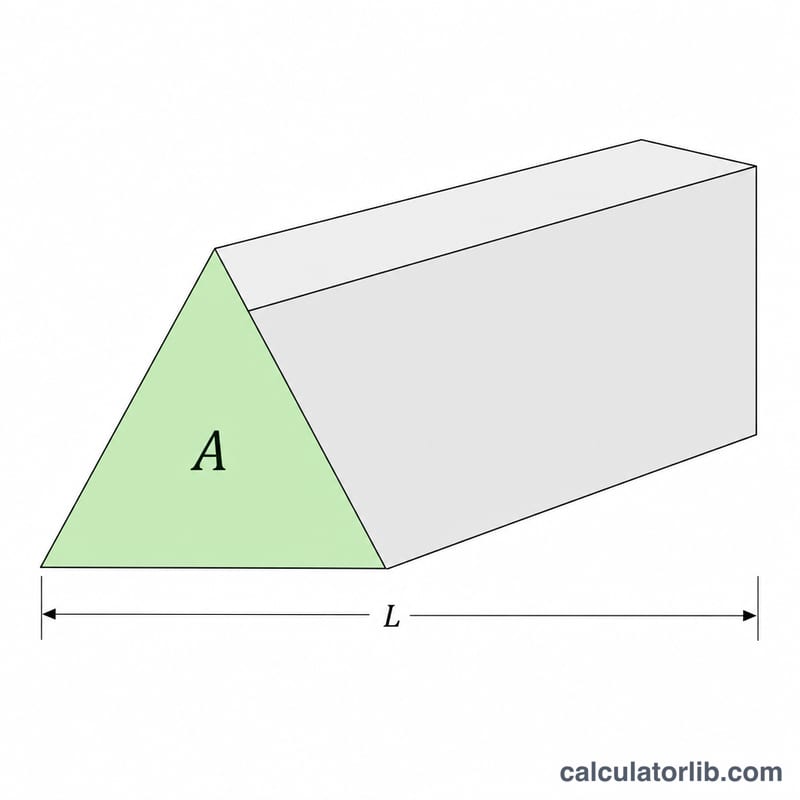
The governing equation is $$V = A \times L$$ where A is the cross-section area and L is the length (sometimes called the height or depth). This is just stacking infinitely many identical thin slices of area A along a distance L, so the total volume scales linearly with both quantities.
Worked Example
Suppose a steel beam has a constant cross-section area of 24 cm² and is 150 cm long. Then $$V = 24 \times 150 = 3{,}600 \text{ cm}^3.$$ If you only know the cross-section is a triangle with base 6 cm and height 8 cm, first compute its area \(= \tfrac{1}{2} \times 6 \times 8 = 24 \text{ cm}^2\), then multiply by the length as above.
FAQ
Does this work for cylinders? Yes — a cylinder is a prism with a circular cross-section. Enter the circle's area (\(\pi r^2\)) as the cross-section area.
What if the cross-section changes along the length? Then the shape is not a true prism and this simple formula does not apply; you would need integration or to split it into prism-like segments.
What units does it return? The result is in cubic units that match your inputs — if area is in m² and length in m, the volume is in m³.