

What This Calculator Does
Applicable jurisdiction: United States. Unemployment insurance in the US is administered by individual states, so exact formulas and maximums vary. This tool uses one of the most common methods — dividing your highest-earning calendar quarter of base-period wages by 26 — and then caps the result at your state's maximum weekly benefit amount (WBA). Use it as a planning estimate, not an official determination.
How to Use It
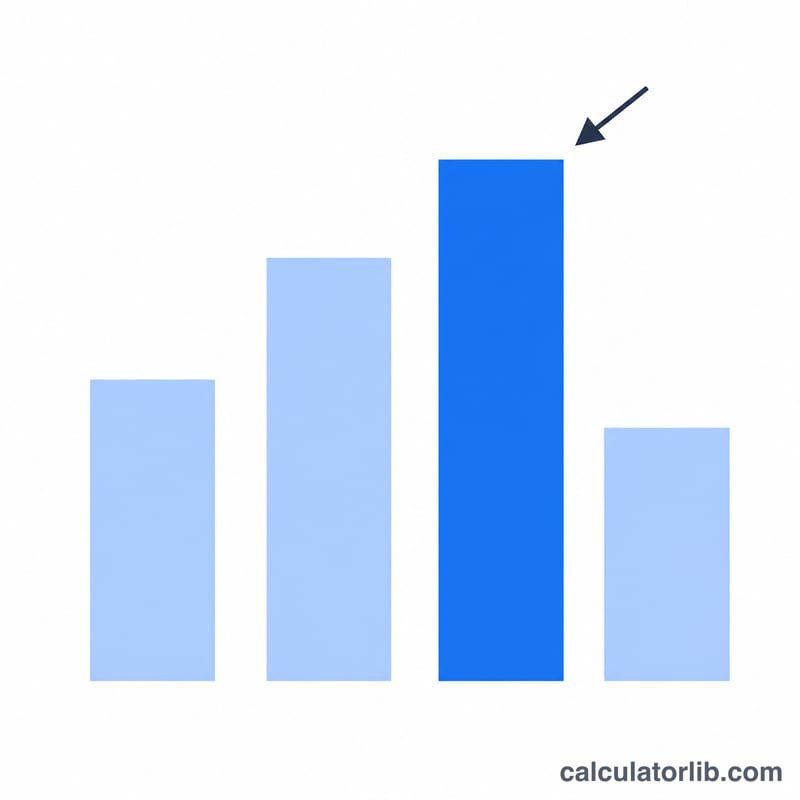
Enter the total gross wages from your highest-earning quarter during the base period (typically the first four of the last five completed calendar quarters). Enter your state's maximum weekly benefit — you can find this on your state workforce agency website (for example, around $504 in some states, higher or lower in others). Optionally enter the number of weeks to estimate your total potential benefit.
The Formula Explained
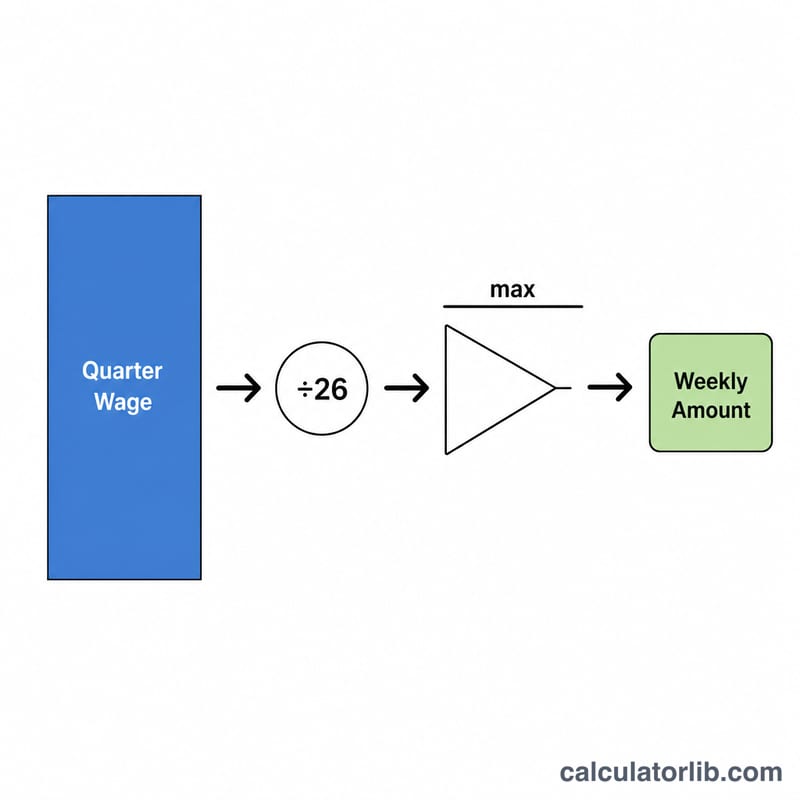
The core calculation is $$\text{WBA} = \min\!\left( \frac{\text{High Quarter Wages}}{26},\ \text{State Max} \right)$$ Dividing by 26 approximates half of the weekly wage during a 13-week quarter. The min ensures your benefit never exceeds the legal cap your state sets each year.
Worked Example
Suppose your highest quarter wages were $13,000 and your state maximum is $504. The uncapped amount is $$\$13{,}000 \div 26 = \$500$$ Since \(\$500\) is below the \(\$504\) cap, your estimated WBA is \(\$500\). Over 26 weeks that totals $$\$500 \times 26 = \$13{,}000$$
FAQ
Is this my official benefit amount? No. Only your state agency can make the legal determination. Methods, base periods, and caps differ by state.
What is the "high quarter"? It is the calendar quarter within your base period in which you earned the most wages.
Why divide by 26? It is a widely used convention that yields roughly 50% of your average weekly wage, subject to the state maximum.