What is the Company Car BIK Tax Calculator?
This calculator applies to the United Kingdom. If your employer provides a car that you can use privately, HMRC treats it as a taxable "benefit in kind" (BIK). This tool estimates how much income tax you will pay on that benefit each year and each month. Figures are based on HMRC's standard approach where the taxable benefit equals the car's P11D price multiplied by its appropriate CO₂ percentage.
How to use it
Enter three values:
P11D list price – the manufacturer's list price including VAT, delivery and most factory options (but excluding road tax and first-registration fee). CO₂/BIK percentage – the "appropriate percentage" for your car's CO₂ emissions and fuel type, taken from HMRC's published bands (0%–37%). Electric cars sit at the very low end; high-emission petrol/diesel cars approach 37%. Income tax rate – your highest marginal band: 20% basic, 40% higher or 45% additional.
The formula explained
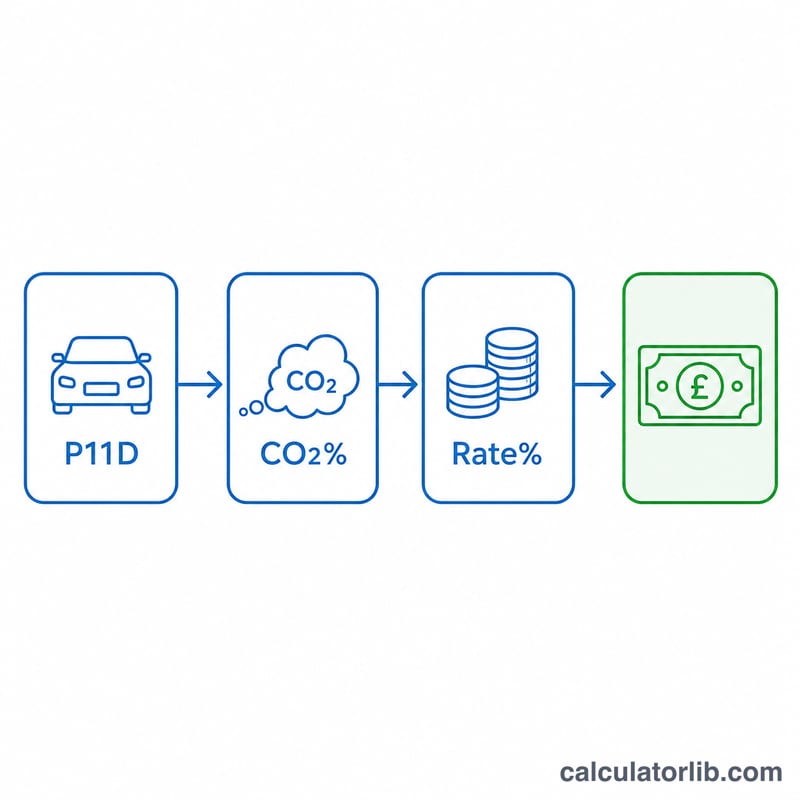
First the taxable benefit is calculated: $$\text{BIK} = \text{P11D} \times \frac{\text{CO}_2\,\%}{100}$$ This is the cash-equivalent value of the perk. Your tax is then simply that benefit taxed at your marginal rate: $$\text{Tax} = \text{BIK} \times \frac{\text{Rate}\,\%}{100}$$ The monthly figure divides the annual tax by 12.
Worked example
A car with a P11D price of £30,000 and a 25% CO₂ percentage has a taxable benefit of $$£30{,}000 \times 0.25 = £7{,}500$$ A higher-rate (40%) taxpayer pays $$£7{,}500 \times 0.40 = £3{,}000 \text{ per year}$$ or \(£250\) per month.
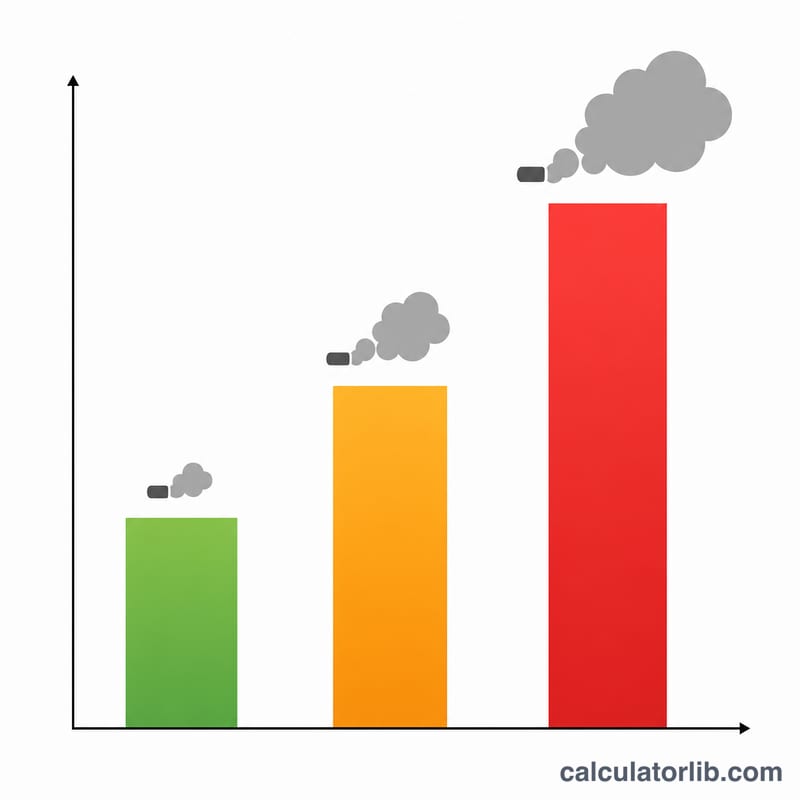
UK Company Car BIK Appropriate Percentages by CO₂ Band
These figures are for the United Kingdom and are HMRC's appropriate percentages for the 2025/26 tax year (6 April 2025 to 5 April 2026). They apply to cars registered on or after 6 April 2020, which are measured under WLTP. HMRC has announced that the zero-emission rate rises to 4% in 2026/27, 5% in 2027/28, 7% in 2028/29 and 9% in 2029/30. Always check HMRC's current published tables before relying on any figure, because rates and band rules can change.
| CO₂ (g/km) | Electric range (miles) | Petrol / RDE2-compliant diesel (%) |
|---|---|---|
| 0 (zero emission) | n/a | 3 |
| 1–50 | 130 or more | 3 |
| 1–50 | 70–129 | 6 |
| 1–50 | 40–69 | 10 |
| 1–50 | 30–39 | 12 |
| 1–50 | under 30 | 14 |
| 51–54 | n/a | 15 |
| 55–59 | n/a | 16 |
| 60–64 | n/a | 17 |
| 65–69 | n/a | 18 |
| 70–74 | n/a | 19 |
| 75–79 | n/a | 20 |
| 80–84 | n/a | 21 |
| 85–89 | n/a | 22 |
| 90–94 | n/a | 23 |
| 95–99 | n/a | 24 |
| 100–104 | n/a | 25 |
| 105–109 | n/a | 26 |
| 110–114 | n/a | 27 |
| 115–119 | n/a | 28 |
| 120–124 | n/a | 29 |
| 125–129 | n/a | 30 |
| 130–134 | n/a | 31 |
| 135–139 | n/a | 32 |
| 140–144 | n/a | 33 |
| 145–149 | n/a | 34 |
| 150–154 | n/a | 35 |
| 155–159 | n/a | 36 |
| 160 or more | n/a | 37 (maximum) |
Diesel treatment and RDE2
- Diesel cars that do not meet the Real Driving Emissions Step 2 (RDE2) standard carry a 4 percentage-point surcharge on the percentage for their CO₂ band, capped at 37%. For example, a 100 g/km diesel that is not RDE2-compliant is 25% + 4% = 29%.
- Diesel cars that are RDE2-certified are exempt from the surcharge and use the same percentage as petrol.
- The calculator asks for the percentage directly. Look up your car's figure from the table above or from the car's V5C or manufacturer's data, and enter that percentage.
Key BIK Terms Explained
- P11D value
- The car's list price as reported to HMRC on form P11D. It is the published UK list price including delivery, VAT and any optional extras fitted, minus certain allowances. It is not the price the employer actually paid, and discounts negotiated by the employer do not reduce it.
- Benefit in kind (BIK)
- A non-cash perk from an employer, such as a company car, that HMRC treats as taxable income.
- Appropriate percentage
- The percentage of the P11D value that is treated as taxable income. It depends on the car's CO₂ emissions, fuel type, electric range (for cars emitting 1–50 g/km) and the tax year. It is capped at 37%.
- Cash equivalent
- The taxable value of the car benefit, which is the P11D value multiplied by the appropriate percentage. This is the amount added to your taxable income.
- Marginal tax rate
- The rate of income tax you pay on your top slice of income, such as 20% (basic rate), 40% (higher rate) or 45% (additional rate). The calculator applies this rate to the whole taxable benefit. If the benefit pushes you across a band threshold, the real figure will be a blend of rates. Scottish rates differ from those in the rest of the UK.
- Taxable benefit vs tax payable
- The taxable benefit is the amount added to your income (P11D × appropriate percentage). The tax payable is what you actually owe on it (benefit × your tax rate). For example, a £11,200 benefit at 40% means £4,480 of tax, usually collected through your tax code.
What this tool excludes: it does not include the fuel benefit charge for free private fuel, and it does not reduce the P11D value for capital contributions you make towards the car (HMRC allows up to £5,000). It also does not include employer Class 1A National Insurance, any payments you make for private use, or the effect of the benefit on your tax band. Use it as an estimate and check your figures against HMRC guidance.
FAQ
Where do I find the CO₂ percentage? HMRC publishes annual benefit-in-kind percentage tables by CO₂ band and fuel type; your car's V5C and the manufacturer state the official CO₂ figure.
Does this include fuel benefit? No. If your employer also pays for private fuel, a separate fuel-benefit charge applies and is not included here.
Are electric cars cheaper? Yes — fully electric cars have a very low appropriate percentage, so the taxable benefit and resulting tax are dramatically lower than for a comparable petrol or diesel car.