
What This RMR Calculator Does
Your Resting Metabolic Rate (RMR) is the number of calories your body burns at complete rest just to keep you alive — powering your heart, lungs, brain, and other organs. This calculator estimates that figure using the widely respected Mifflin-St Jeor equation, then projects how many total calories you might burn per day across five different activity levels. It works in metric units (kilograms and centimetres) and applies to adults of any nationality.

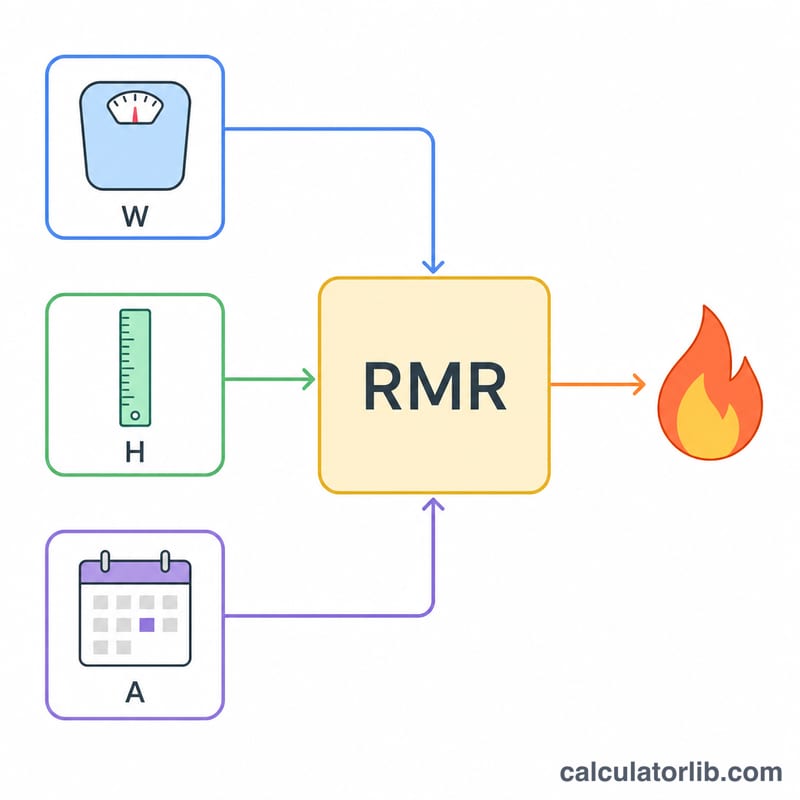
The Inputs You Provide
- Age – your age in years; metabolic rate declines slightly as you get older.
- Gender – Male or Female; the formula uses a different constant for each.
- Weight (kg) – your body weight in kilograms.
- Height (cm) – your standing height in centimetres.
The Formula Explained
The calculator uses the Mifflin-St Jeor equation:
- Men: RMR = (10 × weight kg) + (6.25 × height cm) − (5 × age) + 5
- Women: RMR = (10 × weight kg) + (6.25 × height cm) − (5 × age) − 161
Once your RMR is known, the tool multiplies it by activity factors to estimate total daily calorie needs:
- Sedentary (little exercise): RMR × 1.2
- Lightly active (1–3 days/week): RMR × 1.375
- Moderately active (3–5 days/week): RMR × 1.55
- Very active (6–7 days/week): RMR × 1.725
- Extra active (hard daily training/physical job): RMR × 1.9
Worked Example
Consider a 30-year-old man weighing 80 kg and standing 180 cm tall:
RMR = (10 × 80) + (6.25 × 180) − (5 × 30) + 5 = 800 + 1125 − 150 + 5 = 1,780 calories per day.
If he is moderately active, his daily calorie need is 1,780 × 1.55 ≈ 2,759 calories. A sedentary day would be 1,780 × 1.2 = 2,136 calories, while very active days reach roughly 3,071 calories.
Frequently Asked Questions
Is RMR the same as BMR? They are very close and often used interchangeably. RMR (Resting Metabolic Rate) measures calories burned at rest, while BMR (Basal Metabolic Rate) is measured under stricter laboratory fasting conditions and tends to be slightly lower. The Mifflin-St Jeor equation is commonly applied to both.
How can I use these numbers? To maintain weight, aim to eat roughly your activity-adjusted total. To lose weight, eat below it (a deficit of about 500 calories a day equals roughly 0.5 kg loss per week); to gain, eat above it.
How accurate is the result? The Mifflin-St Jeor equation is one of the most accurate prediction formulas for the general population, but individual metabolism varies with muscle mass, genetics, and health conditions. Treat the result as a reliable estimate rather than an exact measurement.