What This Calculator Does
The Cast-On Stitches Calculator tells you exactly how many stitches to cast on to reach a desired finished width, based on the gauge from your swatch. Gauge in knitting patterns is almost always given as the number of stitches over 4 inches (10 cm), so this tool uses that standard. Stop guessing or doing math in your head before you start a scarf, blanket, or sweater panel.
How to Use It
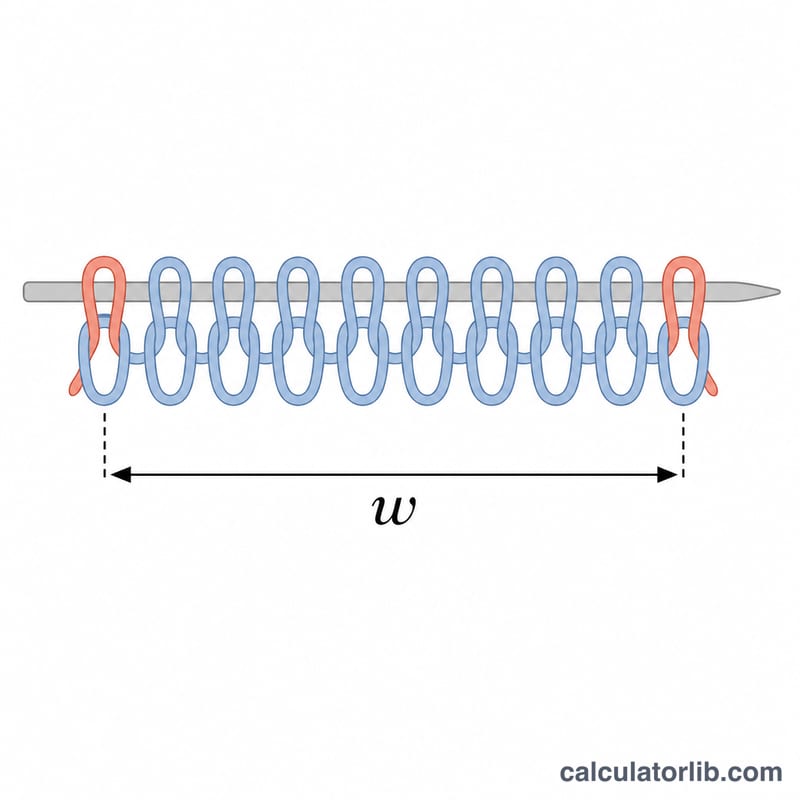
Enter the finished width you want in inches, then enter your gauge — the number of stitches you measured across 4 inches of your swatch. If your pattern uses edge or selvedge stitches (for example, a slip-stitch border), add those in the optional field and they'll be included in the total. The calculator rounds the base stitch count to the nearest whole stitch, because you can't cast on a fraction of a stitch.
The Formula Explained
The math is simple: $$\text{Stitches} = \operatorname{round}\!\left(\text{Width (in)} \times \frac{\text{Gauge}}{4}\right) + \text{Edge Stitches}$$ First we convert gauge to stitches per inch by dividing by 4. Then we multiply by the width to get a raw stitch count, round it to a whole number, and add any edge stitches. For stitch patterns with a repeat (like ribbing or cables), you may want to round the base count up or down to the nearest multiple of your repeat.
Worked Example
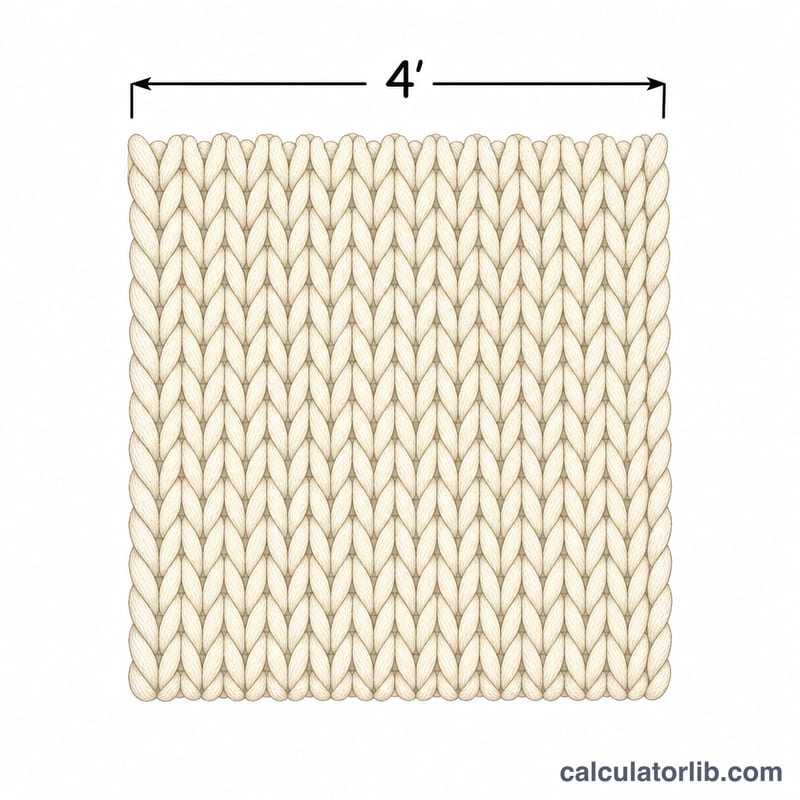
You want a scarf 8 inches wide and your gauge is 20 stitches per 4 inches. That's \(20 \div 4 = 5\) stitches per inch. \(8 \times 5 = 40\) stitches. With no edge stitches, cast on 40 stitches. If you add 2 garter-edge stitches per side, cast on 44.
Standard Gauge by Yarn Weight
If you have not yet knitted a swatch, the yarn's weight category gives you a starting estimate for the Gauge field. The table below lists the Standard Yarn Weight System published by the Craft Yarn Council (a United States industry body); its gauge figures are for stockinette stitch, measured over 4 inches (about 10 cm), which is exactly the unit this calculator expects.
| Category name (number) | Typical yarn names | Stockinette gauge (sts per 4 in) | Recommended needle size (metric) | Recommended needle size (US) |
|---|---|---|---|---|
| Lace (0) | Fingering, 10-count crochet thread | 33–40 | 1.5–2.25 mm | 000–1 |
| Super Fine (1) | Sock, fingering, baby | 27–32 | 2.25–3.25 mm | 1–3 |
| Fine (2) | Sport, baby | 23–26 | 3.25–3.75 mm | 3–5 |
| Light (3) | DK, light worsted | 21–24 | 3.75–4.5 mm | 5–7 |
| Medium (4) | Worsted, afghan, aran | 16–20 | 4.5–5.5 mm | 7–9 |
| Bulky (5) | Chunky, craft, rug | 12–15 | 5.5–8 mm | 9–11 |
| Super Bulky (6) | Super bulky, roving | 7–11 | 8–12.75 mm | 11–17 |
| Jumbo (7) | Jumbo, roving | 6 and fewer | 12.75 mm and larger | 17 and larger |
Two cautions about using these numbers. First, they are label and standard ranges, not measurements of your knitting: the Craft Yarn Council itself presents them as guidelines, and yarn companies print their own gauge on the ball band, which may sit outside the range above. Lace weight is the least reliable row, because lace is usually worked on deliberately oversized needles for an open fabric, so its gauge varies enormously.
Second, your own hands, needle material and stitch pattern shift gauge by several stitches per 4 inches. A blocked swatch always overrides the table. Knit at least 6 inches wide in the actual stitch pattern, wash and block it the way you will treat the finished piece, then count stitches across a 4-inch span in the middle of the swatch (away from the edges) and enter that count as the gauge. If the count falls between whole numbers — say 19.5 sts over 4 inches — enter the decimal rather than rounding; the calculator rounds only once, at the end.
Cast-On Stitches for Common Projects
Every cell below comes from the calculator's formula, with the gauge expressed per 4 inches:
$$\text{Cast-on} = \operatorname{round}\!\left(\text{Width (in)} \times \frac{\text{Gauge}}{4}\right) + \text{Edge stitches}$$Worked example (the standard scarf row at 20 sts per 4 in, with a 2-stitch garter border on each side):
$$\operatorname{round}\!\left(8 \times \frac{20}{4}\right) + 4 = \operatorname{round}(8 \times 5) + 4 = 40 + 4 = 44$$So you cast on 44 stitches. The same substitution produces every number in the table.
| Project | Finished width | Gauge (sts / 4 in) | Stitches per inch | Cast-on (no edge sts) | Cast-on + 4 edge sts |
|---|---|---|---|---|---|
| Narrow scarf | 6 in | 14 | 3.5 | 21 | 25 |
| Narrow scarf | 6 in | 18 | 4.5 | 27 | 31 |
| Narrow scarf | 6 in | 20 | 5 | 30 | 34 |
| Narrow scarf | 6 in | 24 | 6 | 36 | 40 |
| Standard scarf | 8 in | 14 | 3.5 | 28 | 32 |
| Standard scarf | 8 in | 18 | 4.5 | 36 | 40 |
| Standard scarf | 8 in | 20 | 5 | 40 | 44 |
| Standard scarf | 8 in | 24 | 6 | 48 | 52 |
| Cowl panel (flat) | 12 in | 14 | 3.5 | 42 | 46 |
| Cowl panel (flat) | 12 in | 18 | 4.5 | 54 | 58 |
| Cowl panel (flat) | 12 in | 20 | 5 | 60 | 64 |
| Cowl panel (flat) | 12 in | 24 | 6 | 72 | 76 |
| Baby blanket | 30 in | 14 | 3.5 | 105 | 109 |
| Baby blanket | 30 in | 18 | 4.5 | 135 | 139 |
| Baby blanket | 30 in | 20 | 5 | 150 | 154 |
| Baby blanket | 30 in | 24 | 6 | 180 | 184 |
| Throw | 45 in | 14 | 3.5 | 158 | 162 |
| Throw | 45 in | 18 | 4.5 | 203 | 207 |
| Throw | 45 in | 20 | 5 | 225 | 229 |
| Throw | 45 in | 24 | 6 | 270 | 274 |
How to read the table. The widths are the common ranges used in North American and British pattern writing for these items (a scarf of 6–8 inches, a receiving-size baby blanket of about 30 inches, a lap throw of about 45 inches); they are conventions, not standards, so adjust them freely and re-run the calculator with your own width. Two of the throw rows land on an exact half stitch before rounding — 45 × 3.5 = 157.5 and 45 × 4.5 = 202.5 — and the formula rounds those up to 158 and 203, each a hair wider than the target. If your stitch pattern needs an even count or a multiple (ribbing, cables, a 6-stitch lace repeat), round the table value to the nearest workable multiple before adding your edge stitches, then accept the tiny width change.
The edge-stitch column assumes 2 stitches of garter or slip-stitch selvedge on each side, which is the usual amount for a scarf or blanket that will not be seamed. Set Edge Stitches to 0 for a piece whose full width is patterned, and raise it if you want a wider border — a 5-stitch garter border on both sides means entering 10. Edge stitches are added after rounding, so they never get absorbed into the width calculation.
FAQ
My gauge is in 10 cm, not 4 inches — is that a problem? No. 10 cm is the metric equivalent of 4 inches, so the same number works directly in this calculator.
Should I round up or down? The calculator rounds to the nearest stitch. If your stitch pattern needs a multiple (e.g. multiple of 4 for 2x2 rib), adjust the base count manually to the nearest valid multiple.
Why does my finished piece come out the wrong size? The most common cause is an inaccurate gauge swatch. Knit and block a generous swatch before measuring, and measure in the middle, not at the edges.