
What this calculator does
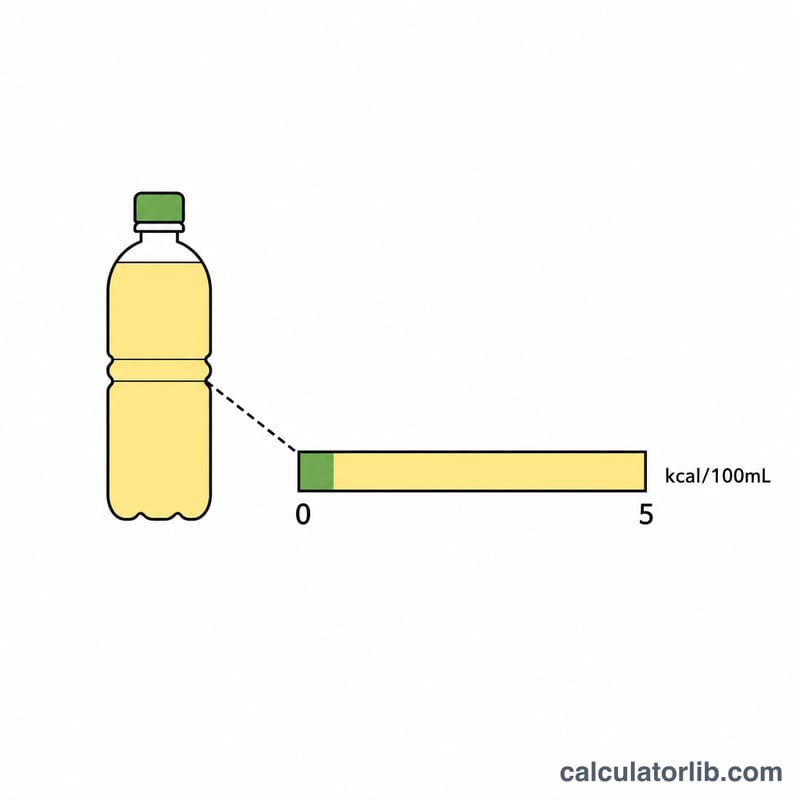
This tool applies Japan's nutrition-labeling standards (administered by the Consumer Affairs Agency) to estimate how many calories a drink marketed as "zero calorie" or "calorie off" could actually still contain. Under those rules a beverage may carry a "zero / free / no / non / less" claim if it has less than 5 kcal per 100 mL, and an "off / low / reduced / light / diet" claim if it has 20 kcal or less per 100 mL. In other words, "zero" does not always mean exactly 0 kcal. These thresholds are Japan-specific; other countries use different rules (for example, US FDA "calorie free" means under 5 kcal per serving, not per 100 mL).
How to use it
Enter your beverage size in milliliters (a typical Japanese can is 350 mL, a large PET bottle is 500 mL). The calculator returns two upper bounds: the maximum calories for a "zero"-labeled drink and the maximum for a "calorie-off"-labeled drink of that size.
The formula explained
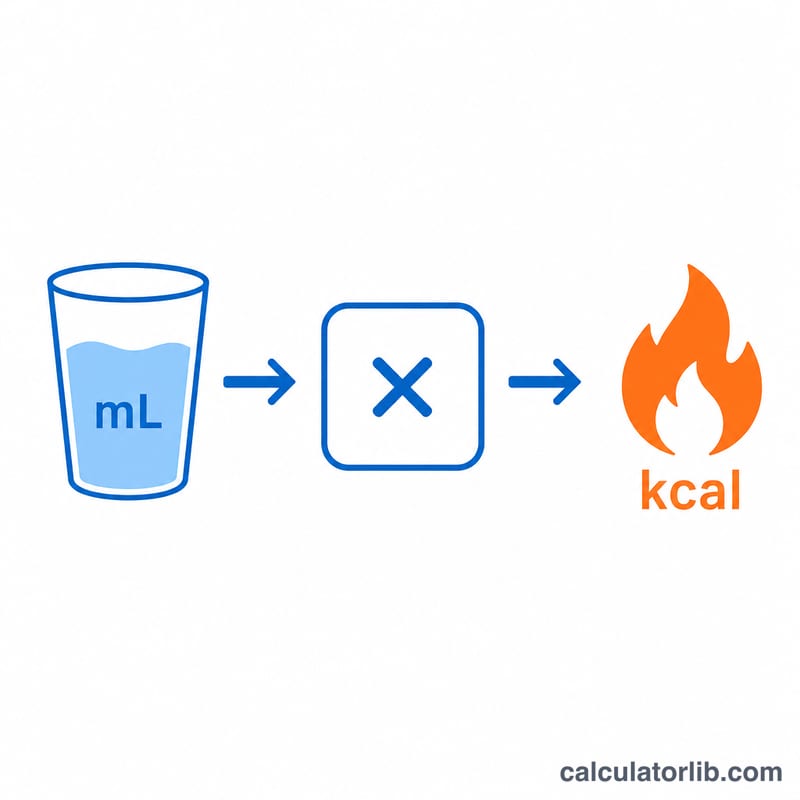
Both labeling thresholds are expressed per 100 mL, so we scale them to your serving: $$\text{maxCalories} = \text{threshold} \times \frac{\text{servingSize}}{100}$$ The "zero" threshold uses 5 kcal/100 mL as a practical ceiling (the legal rule is strictly less than 5), and the "off" threshold uses 20 kcal/100 mL.
Worked example
For a 350 mL can: $$\text{maxCaloriesZero} = 5 \times \frac{350}{100} = 17.5 \text{ kcal}$$ and $$\text{maxCaloriesOff} = 20 \times \frac{350}{100} = 70 \text{ kcal}$$ So a 350 mL "zero calorie" drink may still hold up to about 17.5 kcal, while a "calorie off" drink of the same size could contain up to 70 kcal. If you drink several a day, that adds up.
FAQ
Does "zero calorie" mean truly 0 kcal? Not necessarily. In Japan it only means under 5 kcal per 100 mL, so larger servings can carry meaningful hidden calories.
Why show "up to"? The figures are worst-case ceilings; an actual product may contain far fewer calories. Check the product's own nutrition label for the real value.
Do these rules apply outside Japan? No. These are Japanese labeling thresholds. The arithmetic is universal, but the 5 and 20 kcal/100 mL limits are specific to Japan.