
What Is Disposable Income?
Disposable income is the money you have left after paying all of your regular monthly expenses out of your take-home (net) pay. It is the cash available for saving, investing, paying down debt, or discretionary spending. This calculator gives you a quick, clear picture of how much is genuinely free each month — and what percentage of your income that represents.
How to Use This Calculator
Enter your net monthly income — the amount that actually lands in your account after taxes and deductions — and your total monthly expenses, including rent or mortgage, utilities, food, transport, insurance, subscriptions and debt payments. The tool subtracts expenses from income and shows the leftover amount plus your savings rate.
The Formula Explained
The core calculation is simple:
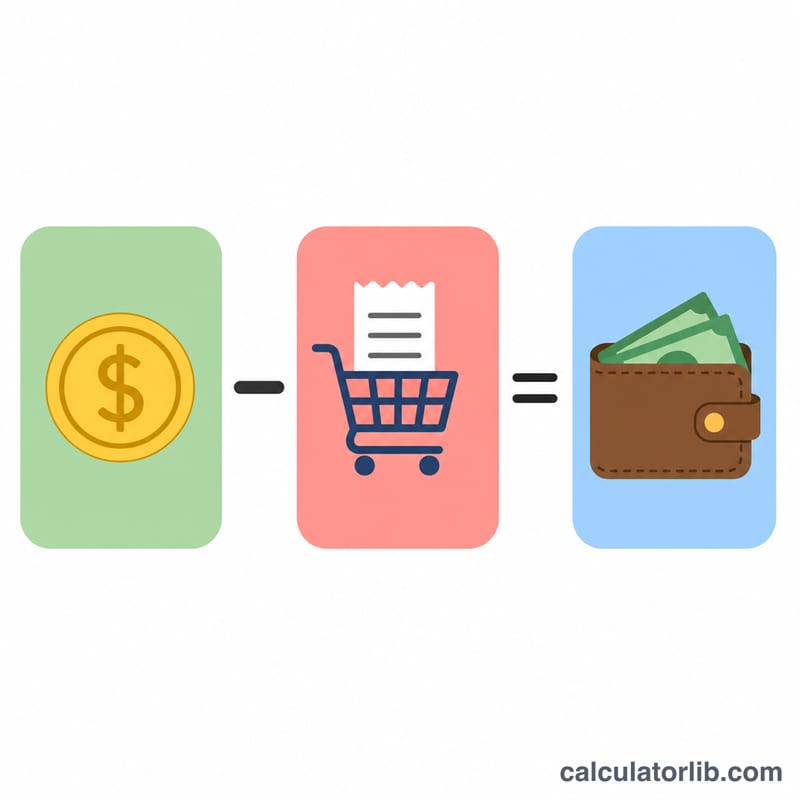
$$\text{Disposable Income} = \text{Net Income} - \text{Total Monthly Expenses}$$
The savings rate shows what fraction of your income is left over: $$\text{Savings Rate} = \frac{\text{Disposable Income}}{\text{Net Income}} \times 100$$ A higher rate means more financial breathing room. A negative disposable income means you are spending more than you earn and may be drawing on savings or credit.
Worked Example
Suppose your net monthly income is $4,000 and your total monthly expenses are $2,800. Disposable income = $$4{,}000 - 2{,}800 = \$1{,}200$$ Your savings rate = $$\frac{1{,}200}{4{,}000} \times 100 = 30\%$$ That $1,200 is what you can save, invest, or spend freely each month.
FAQ
Is disposable income the same as discretionary income? No. Disposable income is what is left after taxes; discretionary income is what remains after both taxes and essential living costs. This tool treats your "expenses" as everything you must pay, so the result is closer to discretionary income.
Should I use gross or net income? Use net income — your actual take-home pay — for an accurate result.
What is a good savings rate? Many financial planners suggest aiming for 15–20% or higher, but any positive figure is a healthy start.