

What is the effective interest rate (APY)?
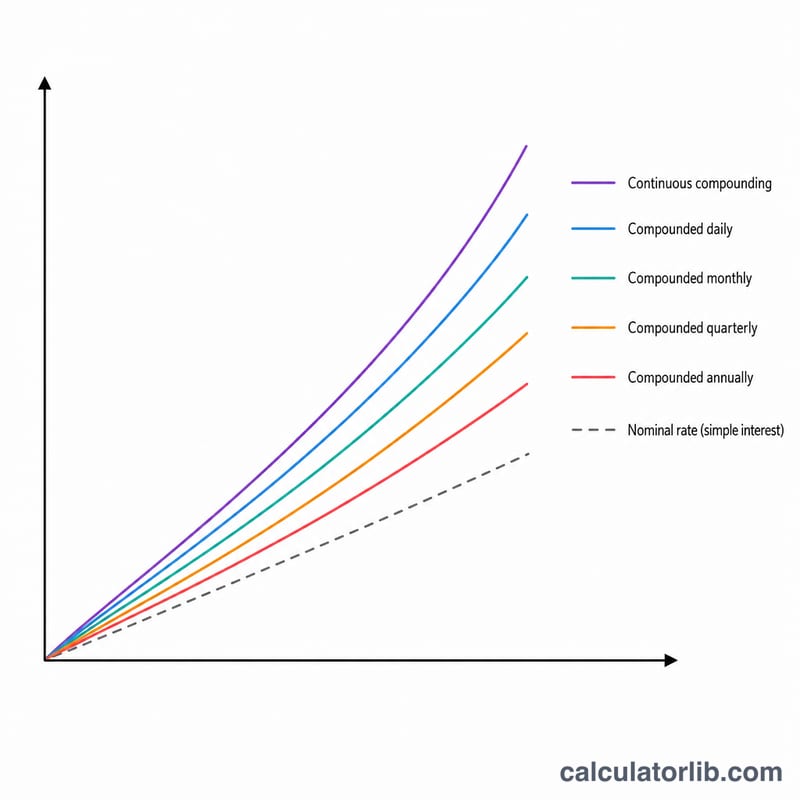
The effective interest rate — also called the effective annual rate (EAR/AER) or annual percentage yield (APY) — tells you the true return on an investment or the true cost of a loan once compounding is taken into account. A "nominal" rate ignores how often interest is added; the effective rate reflects interest earning interest within the year. This tool is universal: it works for any consistent time unit, though the "period" is most commonly a year.
How to use it
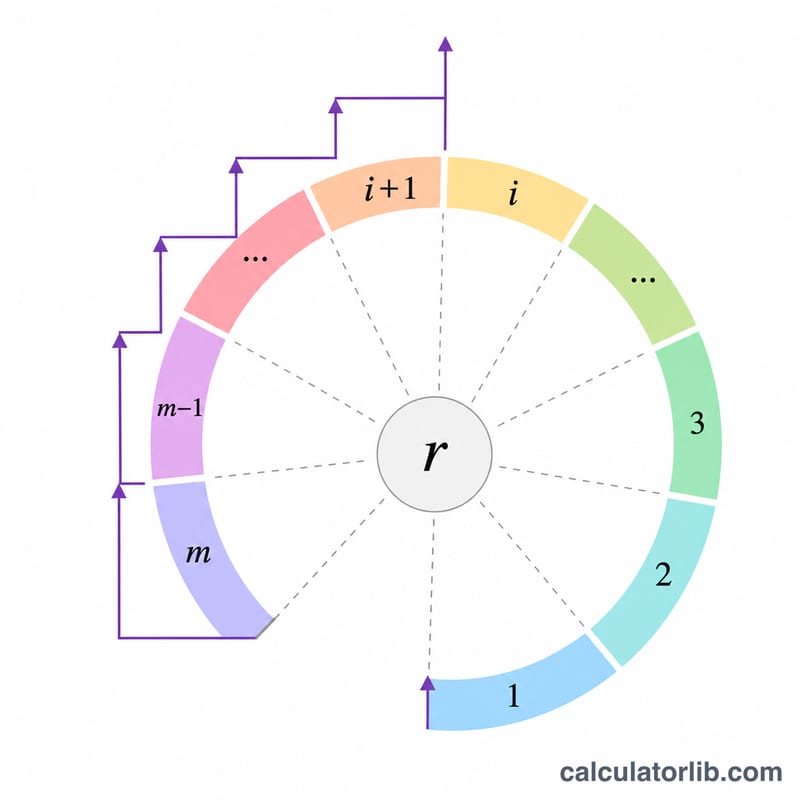
Enter three values: the nominal rate per period (R) as a percent, how many times interest compounds per period (m), and the number of periods (t). For continuous compounding, type the letter "c" instead of a number in the compounding field. The calculator returns the effective rate per period, the total effective rate accumulated over t periods, and the simple rate carried by each compounding interval (\(P = R / m\)).
The formula explained
Let \(r = R / 100\). The effective rate per period is $$i = \left(1 + \frac{r}{m}\right)^{m} - 1$$ Over t periods the cumulative effective rate is $$i_t = \left(1 + \frac{r}{m}\right)^{m \cdot t} - 1$$ The rate applied at each compounding step is just \(P = R / m\). When compounding is continuous (\(m \to \infty\)), the limits become \(i = e^r - 1\) and \(i_t = e^{r \cdot t} - 1\), and the per-interval rate approaches 0 because each interval is infinitesimal.
Worked example
With \(R = 3.25\%\), \(m = 12\), \(t = 5\): \(r = 0.0325\). The effective rate per period is $$\left(1 + \frac{0.0325}{12}\right)^{12} - 1 = 0.032989$$ or 3.2989%. Over 5 periods, $$\left(1 + \frac{0.0325}{12}\right)^{60} - 1 = 0.176190$$ or 17.619%. The rate per compounding interval is \(3.25 / 12 = 0.27083\%\).
FAQ
What is the difference between nominal and effective rate? The nominal rate states the annual figure without compounding; the effective rate includes the extra interest earned from compounding during the period, so it is always at least as large as the nominal rate.
How do I model continuous compounding? Enter "c" (or "C") in the Compounding (m) field. The calculator then uses the exponential formulas \(i = e^r - 1\) and \(i_t = e^{r \cdot t} - 1\).
What happens when t = 1? The effective rate over t periods equals the effective rate per period, since a single period accumulates exactly one period of growth.