
What is the Passive House Savings Calculator?
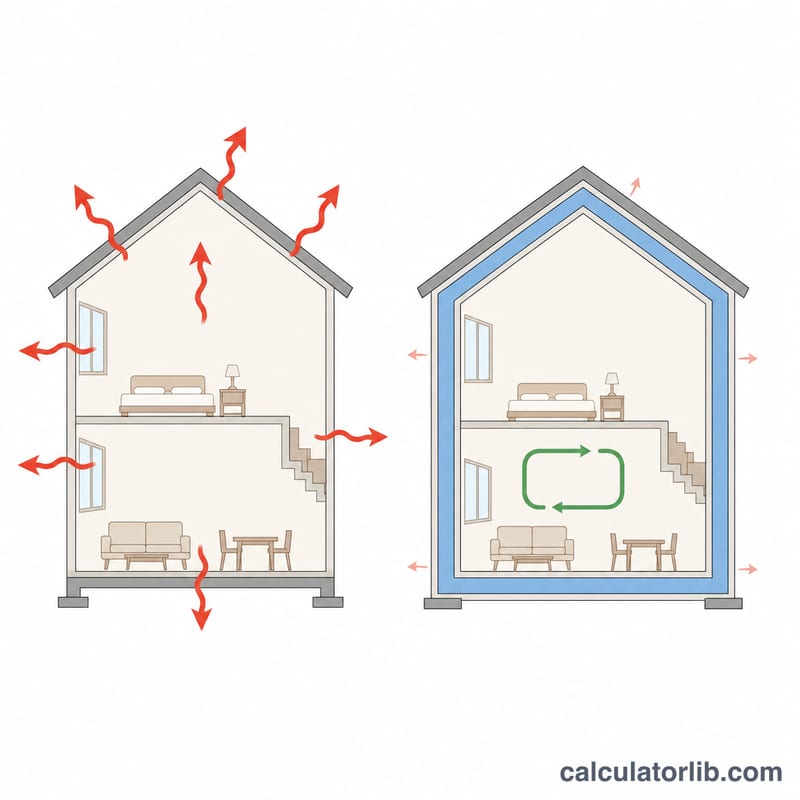
This tool estimates how much money you could save each year on heating and cooling energy by building or retrofitting to passive house standard. A passive house drastically cuts space-heating demand through super-insulation, airtightness, high-performance windows, and heat-recovery ventilation. The calculator is unit- and currency-neutral — enter your local energy price in whatever currency you use.
How to use it
Enter your building's treated floor area in square metres, the typical energy use intensity of a conventional building (kWh per m² per year), the target passive house energy use intensity, and your energy price per kWh. The calculator multiplies the difference in energy intensity by the floor area to get total kWh saved, then by the price to get annual cost savings.
The formula explained
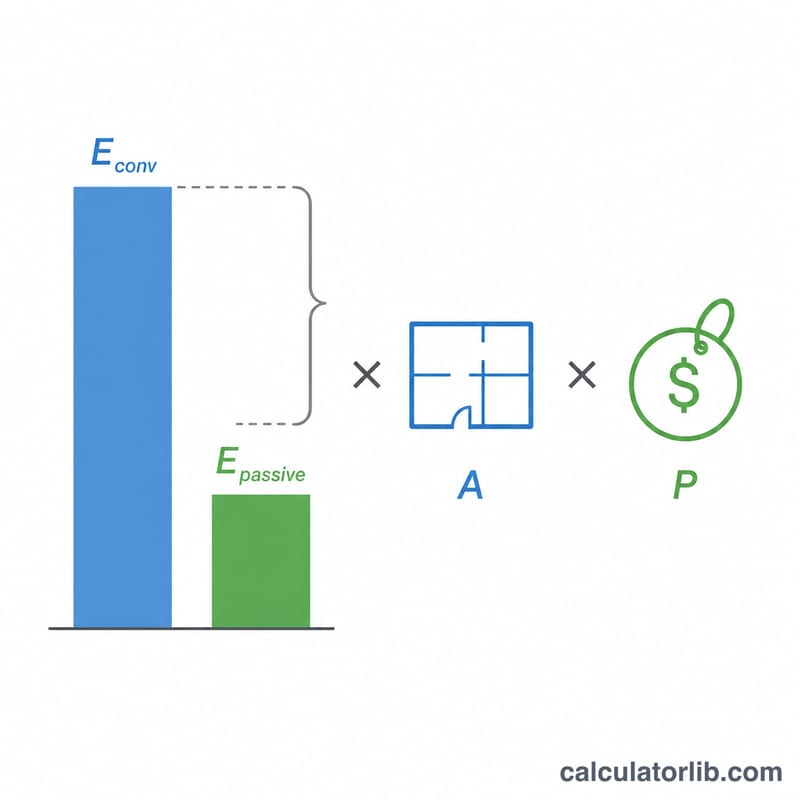
The core equation is $$\text{Annual Savings} = \left( E_{\text{conv}} - E_{\text{passive}} \right) \times A \times P$$ where \(E\) values are energy use intensities in kWh/m²·yr, \(A\) is floor area in m², and \(P\) is the energy price per kWh. The Passive House Institute caps space-heating demand at roughly 15 kWh/m²·yr, while conventional buildings often use 100–200 kWh/m²·yr.
Worked example
Consider a 150 m² home. A conventional build uses 150 kWh/m²·yr; the passive house target is 15 kWh/m²·yr. The saving is $$135 \text{ kWh/m}^2 \times 150 \text{ m}^2 = 20{,}250 \text{ kWh per year}.$$ At 0.30 per kWh that is $$20{,}250 \times 0.30 = 6{,}075 \text{ per year}.$$
FAQ
Does this include construction cost? No — it estimates only ongoing operational energy savings, not the upfront cost premium of passive house construction.
What energy intensity should I use? Use measured data from an energy audit if available, or national benchmarks for your building type and climate.
Is this for heating only? The intensities you enter can represent heating alone or total energy use — just be consistent between the two figures.