

What this calculator does
This tool computes the date of Easter Sunday for any year from 1583 to 4099 and, from it, the full cycle of Christian movable feasts. Because the date of Easter is not fixed, every feast that depends on it shifts from year to year. The calculator returns the Western (Gregorian) Easter used by Roman Catholic and most Protestant churches, the Eastern (Orthodox) Easter, and the Julian-calendar date of the Orthodox feast. This is pure calendar mathematics (the "computus") and applies worldwide, not to any single country.
How to use it
Enter a four-digit year (AD) between 1583 and 4099 and submit. The result shows Western Easter as the headline date, the Orthodox Easter (both on the Gregorian civil calendar and as written in the Julian calendar), and nine related feasts: Shrove Tuesday, Ash Wednesday, Palm Sunday, Maundy Thursday, Good Friday, Ascension Day, Pentecost, Trinity Sunday and Corpus Christi. Dates are given as year, month and day so that feasts crossing a month or year boundary are handled correctly.
The formula explained
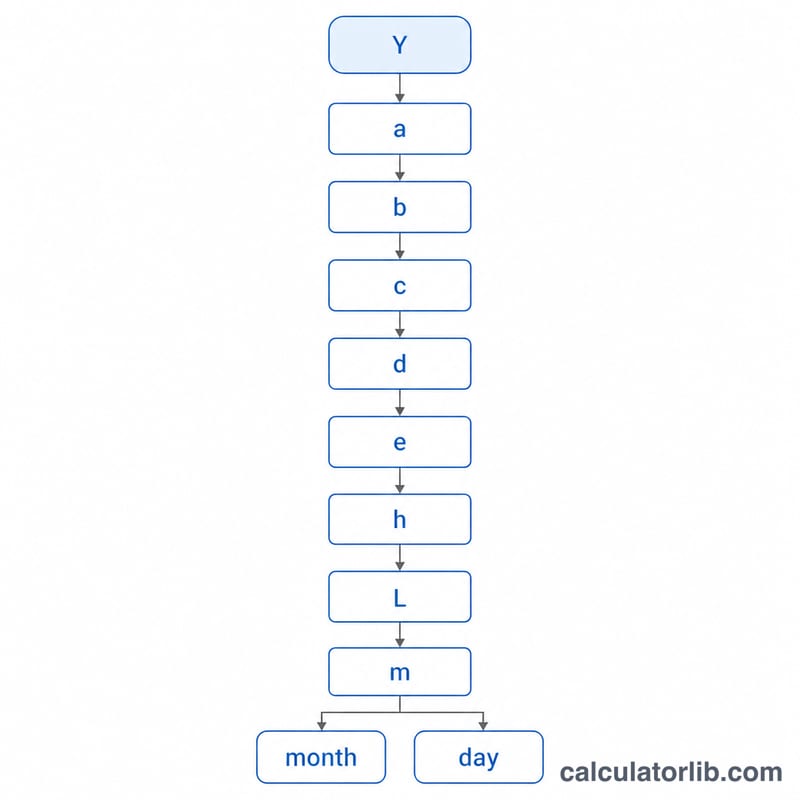
Western Easter uses the Anonymous Gregorian algorithm (Meeus/Jones/Butcher), built entirely from integer (floored) divisions and remainders. It locates the first Sunday after the ecclesiastical full moon on or after 21 March.
$$\text{Month} = \left\lfloor \frac{h + L - 7m + 114}{31} \right\rfloor, \quad \text{Day} = \big[(h + L - 7m + 114)\bmod 31\big] + 1$$ $$\text{where}\quad \left\{ \begin{aligned} a &= \text{Year}\bmod 19 \\ b &= \left\lfloor \text{Year}/100 \right\rfloor,\; c = \text{Year}\bmod 100 \\ d &= \lfloor b/4 \rfloor,\; e = b\bmod 4,\; f = \lfloor (b+8)/25 \rfloor \\ g &= \lfloor (b-f+1)/3 \rfloor \\ h &= (19a + b - d - g + 15)\bmod 30 \\ i &= \lfloor c/4 \rfloor,\; k = c\bmod 4 \\ L &= (32 + 2e + 2i - h - k)\bmod 7 \\ m &= \lfloor (a + 11h + 22L)/451 \rfloor \end{aligned} \right.$$Orthodox Easter uses the Meeus Julian algorithm, which returns a Julian-calendar date; adding the century offset \(\lfloor \text{year}/100 \rfloor - \lfloor \text{year}/400 \rfloor - 2\) (13 days for 1900-2099, 14 for 2100-2199) converts it to the Gregorian calendar.
$$\text{Month} = \left\lfloor \frac{d + e + 114}{31} \right\rfloor, \quad \text{Day} = \big[(d + e + 114)\bmod 31\big] + 1$$ $$\text{where}\quad \left\{ \begin{aligned} a &= \text{Year}\bmod 4 \\ b &= \text{Year}\bmod 7 \\ c &= \text{Year}\bmod 19 \\ d &= (19c + 15)\bmod 30 \\ e &= (2a + 4b - d + 34)\bmod 7 \\ \text{offset} &= \left\lfloor \tfrac{\text{Year}}{100} \right\rfloor - \left\lfloor \tfrac{\text{Year}}{400} \right\rfloor - 2 \end{aligned} \right.$$Every other feast is a fixed offset from Western Easter — for example Ash Wednesday is 46 days before and Pentecost is 49 days after.
Worked example (2025)
For 2025 the algorithm gives Western Easter on April 20. Ash Wednesday is 46 days earlier (March 5), Good Friday 2 days earlier (April 18), and Pentecost 49 days later (June 8). The Orthodox computus yields April 7 in the Julian calendar; adding the 13-day offset gives April 20 on the Gregorian calendar, so in 2025 both Easters coincide.
FAQ
Why do Western and Orthodox Easter differ? They use different calendars and full-moon tables; the Orthodox date is based on the older Julian calendar, so the two often fall on different Sundays, sometimes weeks apart.
What range of dates can Easter take? Gregorian Easter always falls between 22 March and 25 April inclusive.
Why start at 1583? The Gregorian calendar was introduced in October 1582, so 1583 is the first full year for which the Gregorian computus is meaningful.