
What is the Fagerström Test for Nicotine Dependence?
The Fagerström Test for Nicotine Dependence (FTND) is a widely used, validated questionnaire that estimates the physical dependence on nicotine in cigarette smokers. It is a self-assessment screening tool used in research and clinical practice; it is not a medical diagnosis. If you are concerned about your smoking, speak with a healthcare professional.
How to use this calculator
Answer all six questions about your smoking habits using the dropdowns. Each answer carries a point value shown in parentheses. The calculator adds your responses into a single score from 0 to 10 and tells you the corresponding dependence level.
The formula explained
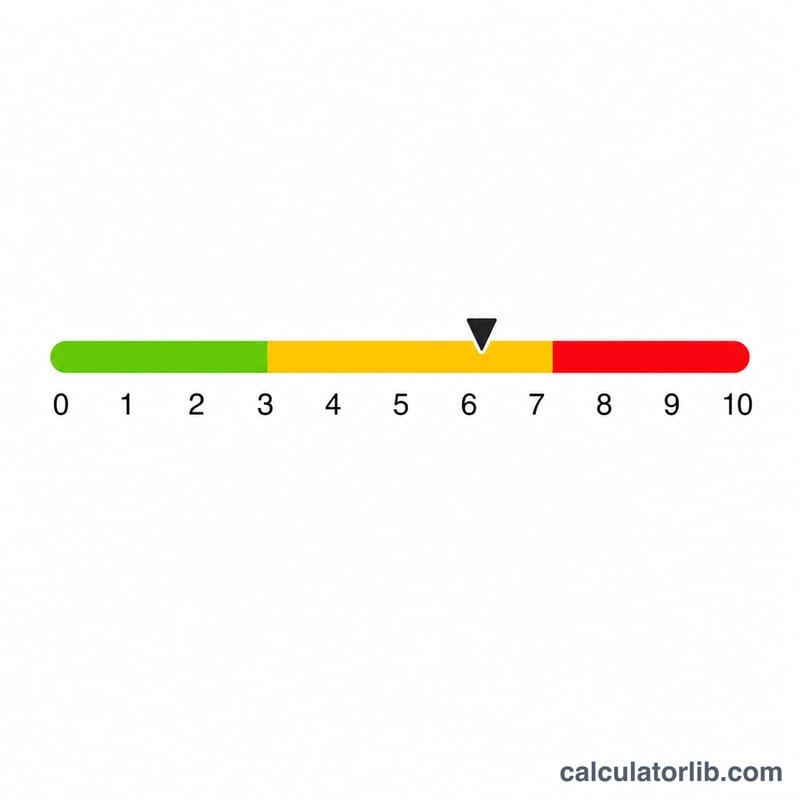
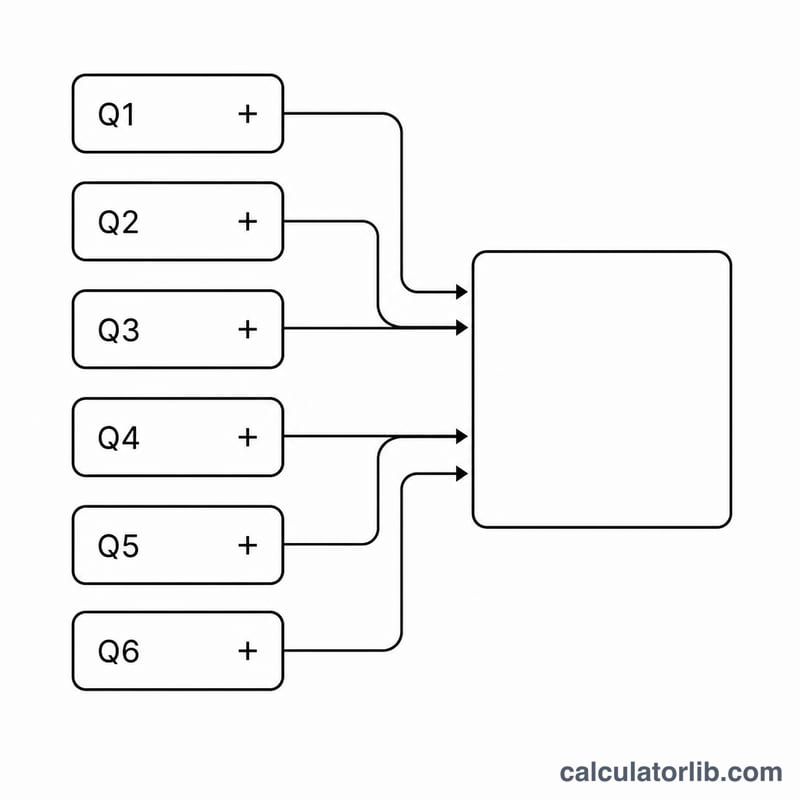
The total is a simple weighted sum: $$\text{Score} = \text{Q1} + \text{Q2} + \text{Q3} + \text{Q4} + \text{Q5} + \text{Q6}$$. Two items are weighted 0–3 (time to first cigarette and cigarettes per day), and the other four are yes/no items scored 0–1. The maximum possible total is 10. Interpretation bands commonly used are: 0–2 low dependence, 3–4 low to moderate, 5–7 moderate, and 8–10 high dependence.
Worked example
Suppose someone smokes their first cigarette within 5 minutes of waking (3), finds it hard to refrain in forbidden places (1), would most hate to give up the first morning cigarette (1), smokes 11–20 per day (1), smokes more in the morning (1), and smokes when ill in bed (1). The total is $$3 + 1 + 1 + 1 + 1 + 1 = \mathbf{8}$$ indicating high dependence.
FAQ
Is a high score dangerous? A higher score suggests stronger physical dependence and may mean you benefit from structured support or nicotine replacement therapy, but only a clinician can advise you.
What is the highest possible score? The maximum is 10 points.
Does this diagnose addiction? No. It is a screening estimate of dependence severity, not a diagnosis.