

What this calculator does
This tool computes simple interest and the resulting maturity value (principal plus interest) for a deposit or loan over a number of elapsed days. Simple interest means the interest is calculated only on the original principal — it is never added back during the term, so there is no compounding. The math is universal and currency-agnostic; it works the same in any country and for any currency.
Rate type / day-count basis
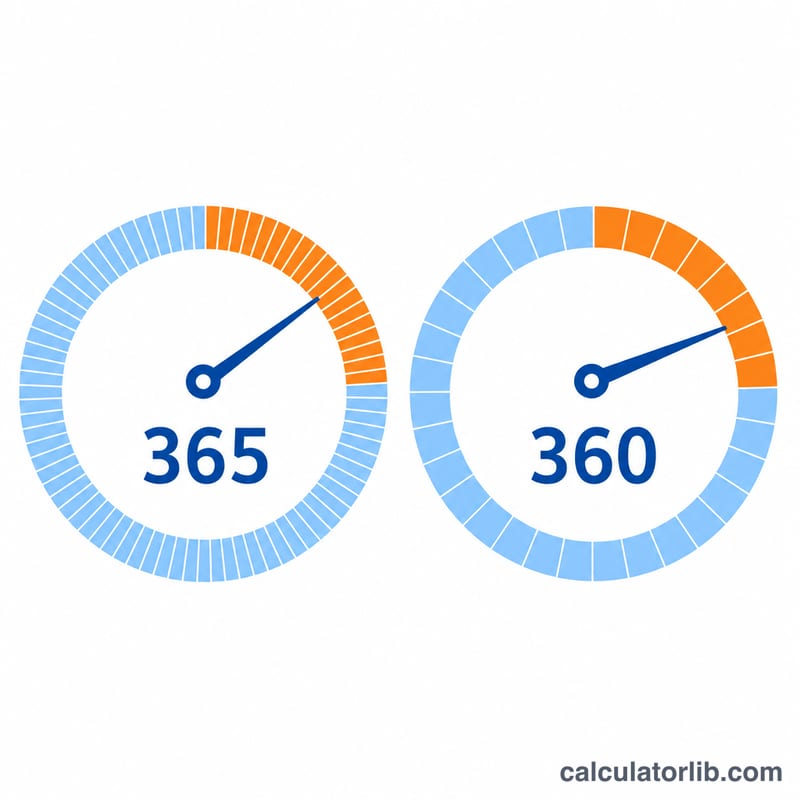
The "mode" you pick is the divisor applied to the elapsed days, matching how the rate is quoted:
- Annual rate, 365-day year (mode = 365): a standard yearly percentage spread linearly over 365 days.
- Annual rate, 360-day year (mode = 360): the commercial-year convention used by many banks.
- Monthly rate (mode = 30): the rate is a monthly percent and a month is treated as 30 days.
- Daily rate (hibu) (mode = 1): a per-day percent. In Japanese practice "5 sen hibu" equals 0.05% per day — enter the daily percent directly.
The formula
The interest is \(I = PV \times \dfrac{r}{100} \times \dfrac{\text{days}}{\text{mode}}\) and the maturity value is \(FV = PV + I\), where PV is the principal, r is the rate in percent, days is the elapsed days, and mode is the selected divisor.
$$MV = P + P \cdot \frac{r}{100} \cdot \frac{t}{B}$$where
$$\left\{ \begin{aligned} P &= \text{Principal} \\ r &= \text{Rate (\%)} \\ t &= \text{Elapsed days} \\ B &= \text{Day-count basis} \end{aligned} \right.$$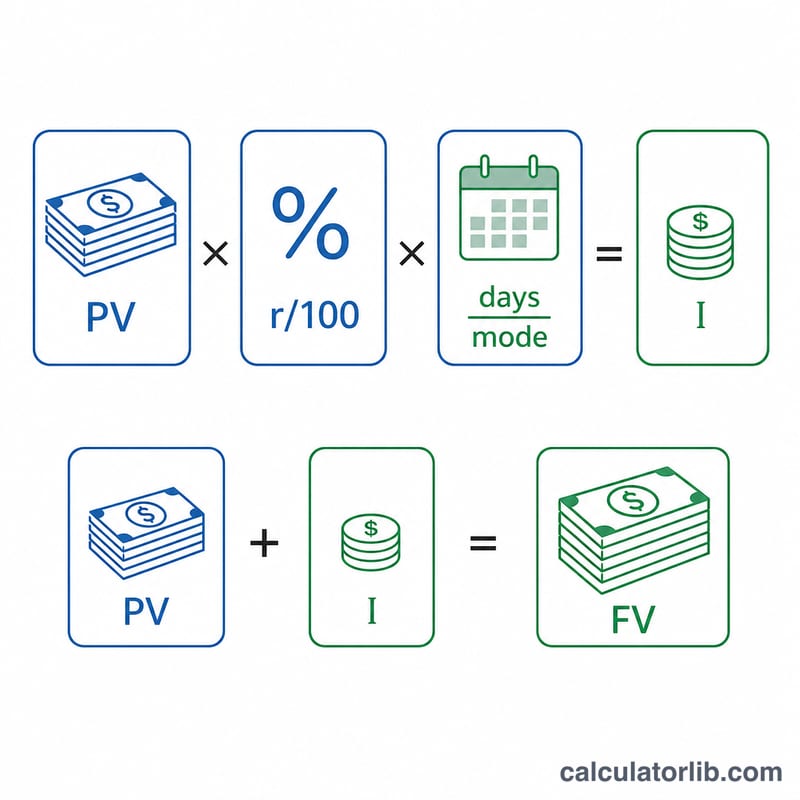
Worked example
Principal 100,000 at 5% annual on a 365-day year for 120 days:
$$I = 100{,}000 \times 0.05 \times \frac{120}{365} = 1{,}643.84$$so the maturity value is 101,643.84.
FAQ
Is this compound interest? No — it is simple interest only; the interest is not reinvested during the term.
Why 360 vs 365 days? Banks often use a 360-day "commercial year" for short-term instruments, which slightly increases the daily accrual versus a 365-day basis.
How is rounding handled? Rounding rules for fractional cents differ by institution; this calculator displays the unrounded computed result, so confirm exact figures with your bank.