
What Is the Electricity Savings Calculator?
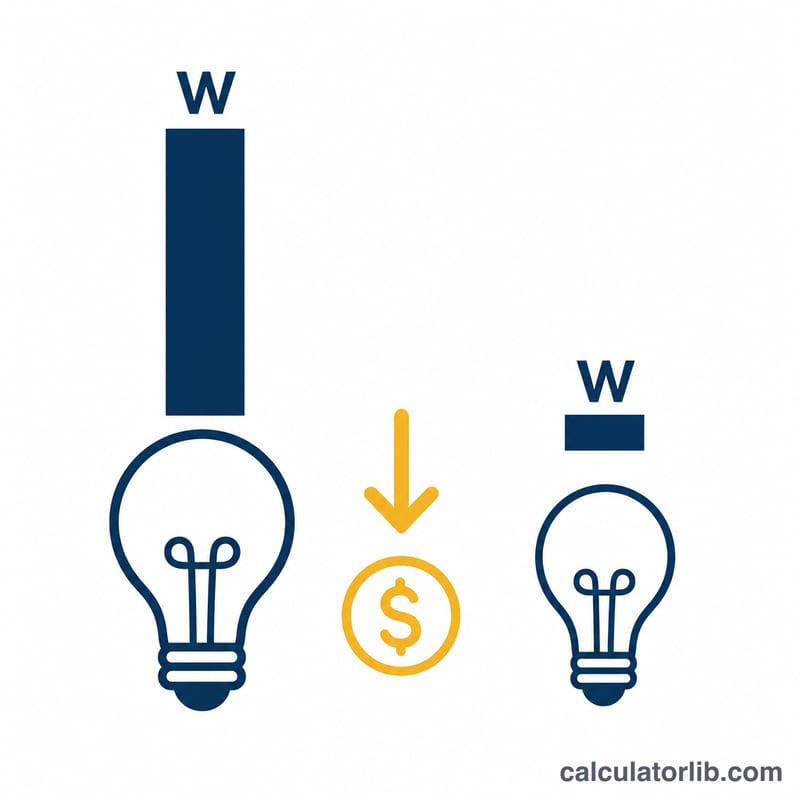
This calculator estimates how much money and energy you save by replacing an appliance, light bulb, or device with a more efficient lower-wattage model. By comparing the old and new power draw, the hours of daily use, and your local electricity rate, it shows your daily, monthly, and annual savings in both dollars and kilowatt-hours (kWh).
How to Use It
Enter the old wattage and the new (lower) wattage of the device, how many hours per day it runs, your electricity rate in dollars per kWh, and how many identical units you are upgrading. The tool instantly returns your savings. You can find the wattage printed on the device or its label, and your electricity rate on your utility bill.
The Formula Explained
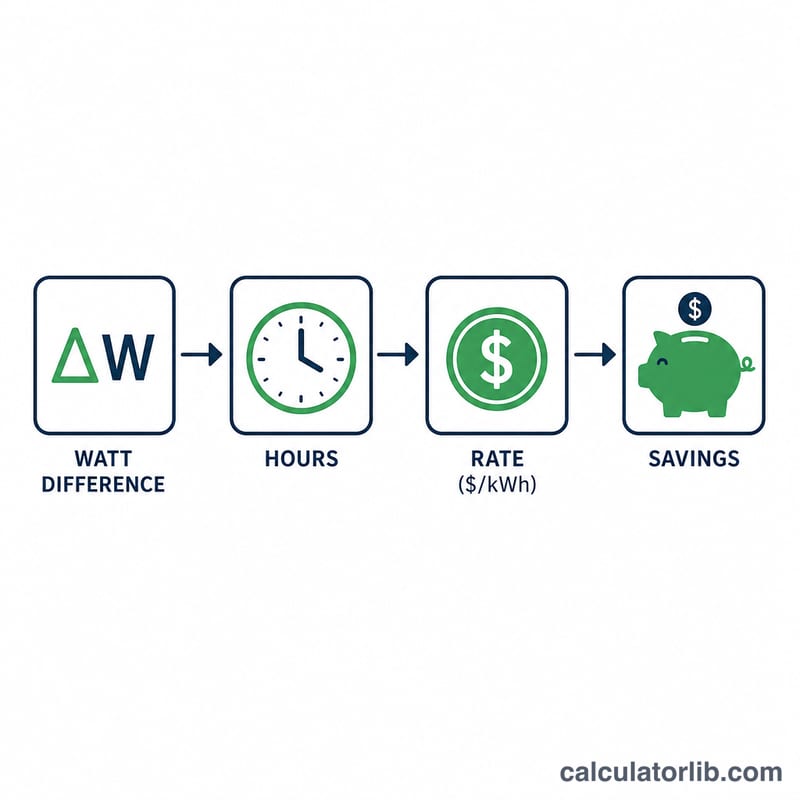
The core equation is:
$$\text{Savings} = \frac{W_{\text{old}} - W_{\text{new}}}{1000} \times \text{hours} \times \text{rate}$$
The wattage difference is divided by 1000 to convert watts to kilowatts. Multiplying by daily hours gives the kilowatt-hours saved per day, and multiplying by your rate converts that energy into money. Monthly figures use an average of 30.4375 days per month, and annual figures use 365 days.
Worked Example
Suppose you swap a 60 W incandescent bulb for a 10 W LED that runs 5 hours a day, at a rate of $0.15/kWh. The daily saving is $$\frac{60 - 10}{1000} \times 5 \times 0.15 = 0.05 \text{ kWh} \times 5 \times 0.15 = \$0.0375$$ Over a year that is \(\$0.0375 \times 365 \approx\) $13.69, while saving about 91.25 kWh of electricity.
FAQ
Where do I find my electricity rate? Check your utility bill for the price per kWh; in the US the average is roughly $0.15–$0.18/kWh.
Does this account for the cost of the new device? No — this shows energy savings only. To find payback time, divide the device cost by the annual savings.
Can I compare multiple units at once? Yes, set the "Number of Units" field to multiply the savings across all identical devices.