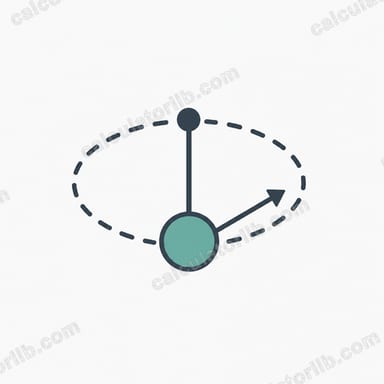

What this calculator does
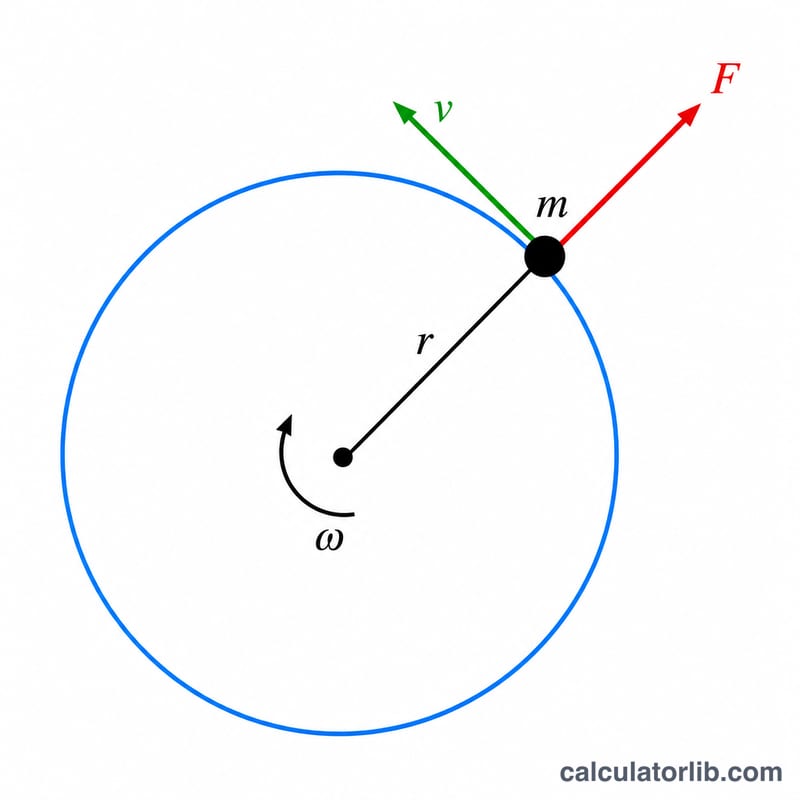
This tool computes the centrifugal force and tangential (linear) velocity of an object moving in a circle. Enter the rotating object's mass, the radius of rotation, and the rotation speed, and it returns the force in newtons (N) and kilogram-force (kgf), plus the tangential velocity in m/s and km/h. The physics is universal SI mechanics and applies everywhere; no country-specific rules are involved.
How to use it
Pick units as you go. Mass can be entered in kilograms or grams; radius in metres, centimetres, or millimetres. For rotation speed, choose how your number is expressed: revolutions per second (rps), revolutions per minute (rpm), or radians per second (rad/s). The calculator converts everything to SI internally before computing.
The formula explained
First the rotation speed is normalised to an angular velocity omega in rad/s: for rps, \(\omega = 2\pi n\); for rpm, \(\omega = 2\pi n/60\); for rad/s, \(\omega = n\). Then the tangential velocity is $$v = \omega \times r,$$ and the centrifugal force magnitude is $$F = m \times r \times \omega^{2}$$ (equivalently \(F = m v^{2} / r\)). The force in kgf is \(F / 9.80665\), using standard gravity, and the speed in km/h is \(v \times 3.6\).
Worked example: hammer throw
Take a 7.26 kg hammer swung at radius 2 m at 2 revolutions per second. Then $$\omega = 2\pi \times 2 \approx 12.566 \text{ rad/s}.$$ Tangential velocity $$v = 12.566 \times 2 \approx 25.13 \text{ m/s} \approx 90.48 \text{ km/h}.$$ Centrifugal force $$F = 7.26 \times 2 \times 12.566^{2} \approx 2292.9 \text{ N},$$ which is about 233.8 kgf — over 30 times the hammer's own weight.
FAQ
Is centrifugal force the same as centripetal force? They have the same magnitude, \(m r \omega^{2}\). Centripetal points toward the centre (the real force that keeps the object on its circular path); centrifugal is the apparent outward force felt in the rotating frame.
What if the radius is zero? An object at the exact centre has \(v = 0\) and \(F = 0\); this is returned as zero, not an error.
Why give force in kgf? Kilogram-force is intuitive for comparing against weight: 1 kgf is the gravitational pull on 1 kg, so the kgf value tells you the force as a multiple of a kilogram's weight.