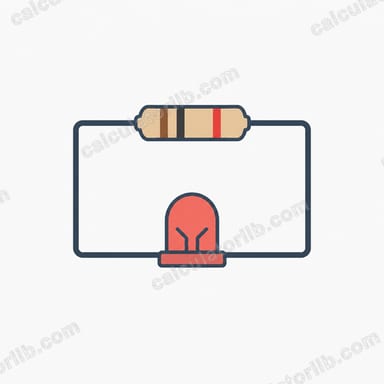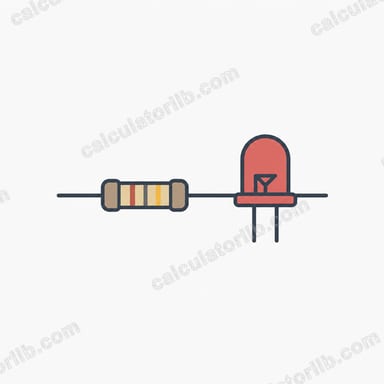

What is an LED current limiting resistor?
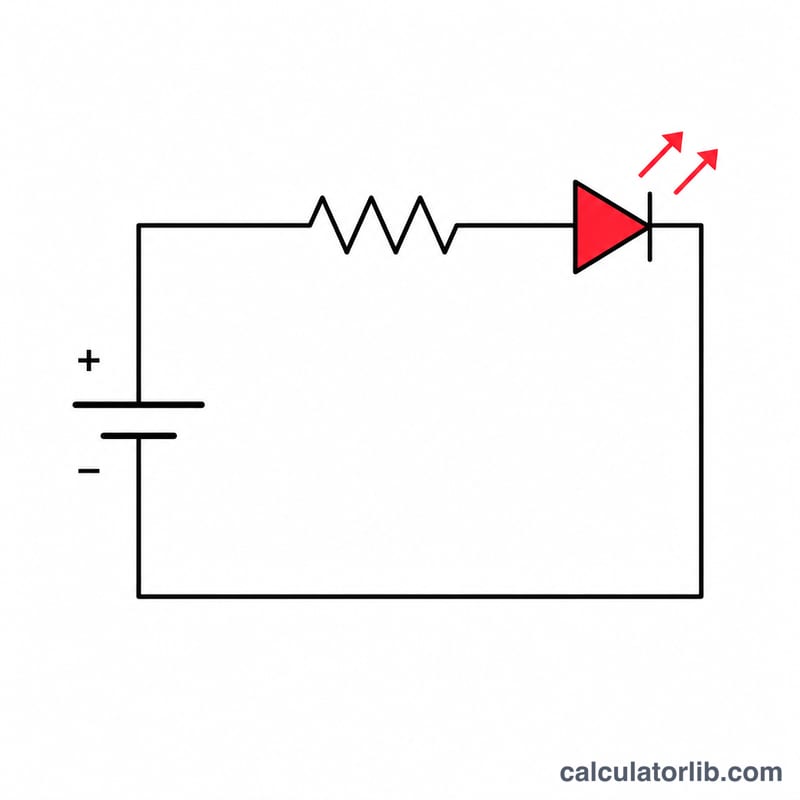
LEDs are current-driven devices and will draw destructive amounts of current if connected directly to a supply higher than their forward voltage. A series resistor limits that current to a safe value. This calculator computes the correct resistor value and the power it must safely dissipate, based on Ohm's Law.
How to use it
Enter the supply voltage (e.g. 5 V from a USB rail), the LED's forward voltage (typically 1.8–2.2 V for red, 3.0–3.4 V for blue/white — check the datasheet), and the desired LED current in milliamps (20 mA is common for standard 5 mm LEDs). The calculator returns the required resistance in ohms, the voltage dropped across the resistor, and the minimum power rating.
The formula explained
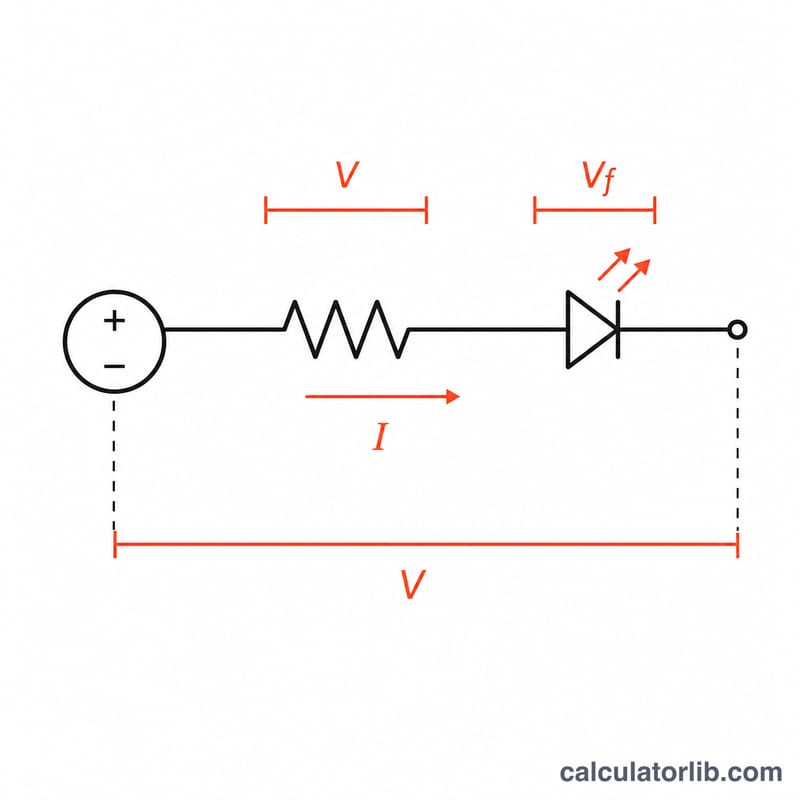
The resistor must drop the difference between the supply and the LED, which is \(V_{\text{supply}} - V_{\text{forward}}\). By Ohm's Law,
$$R = \frac{\text{Supply Voltage (V)} - \text{Forward Voltage (V)}}{\dfrac{\text{LED Current (mA)}}{1000}}$$where current is converted from mA to amps. The power the resistor dissipates is \(P = V_{\text{drop}} \times I\). Always choose a resistor with a power rating comfortably above this value (e.g. double it).
Worked example
For a 5 V supply, a red LED with 2 V forward voltage, and 20 mA target current:
$$R = \frac{5 - 2}{0.02} = \frac{3}{0.02} = 150 \ \Omega$$Power = \(3 \times 0.02 = 0.06 \ \text{W}\), so a standard 1/8 W or 1/4 W resistor is fine. Pick the nearest standard value, e.g. 150 Ω or 180 Ω for extra safety margin.
FAQ
What current should I use? 20 mA is typical for indicator LEDs, but many modern LEDs are bright at 2–10 mA. Lower current saves power and extends life.
What if the result isn't a standard value? Round up to the next standard resistor (E12/E24 series). A higher resistor means slightly less current and a dimmer but safer LED.
Can I use this for multiple LEDs? For LEDs in series, add their forward voltages. For parallel LEDs, give each its own resistor for reliable current sharing.