
What is the Days Left in the Year Calculator?
This calculator tells you exactly how many days remain in the calendar year from any date you choose. Whether you are counting down to New Year's Eve, planning a year-end deadline, or tracking annual goals, it gives an instant, accurate answer that correctly handles leap years.
How to use it
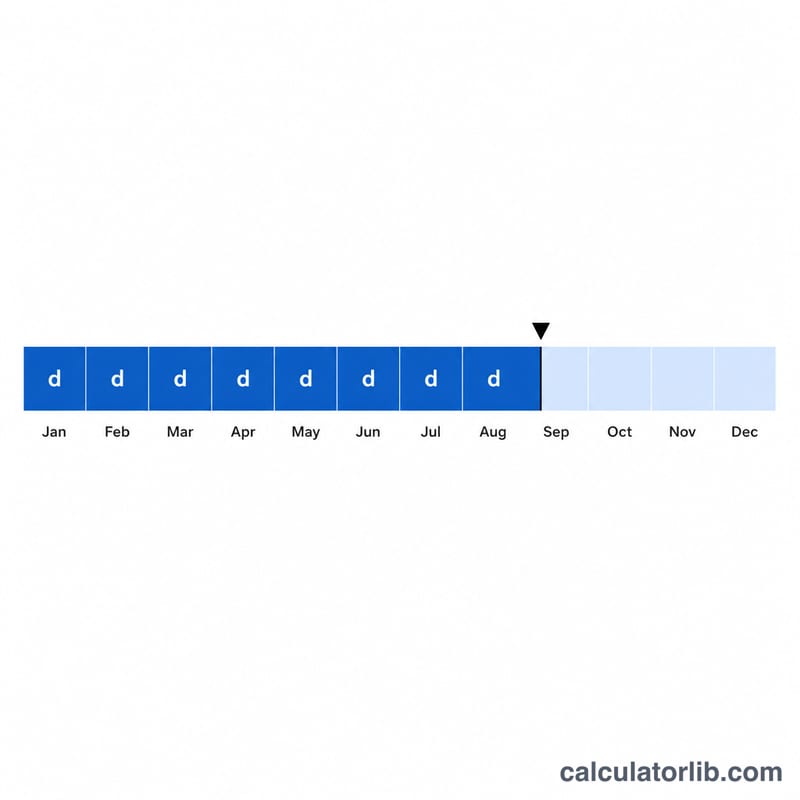
Enter a year, pick a month, and enter a day. The calculator finds the day-of-year number for that date (January 1 is day 1) and subtracts it from the total number of days in that year. The result is the number of full days remaining after the date you entered.
The formula explained
The core equation is:
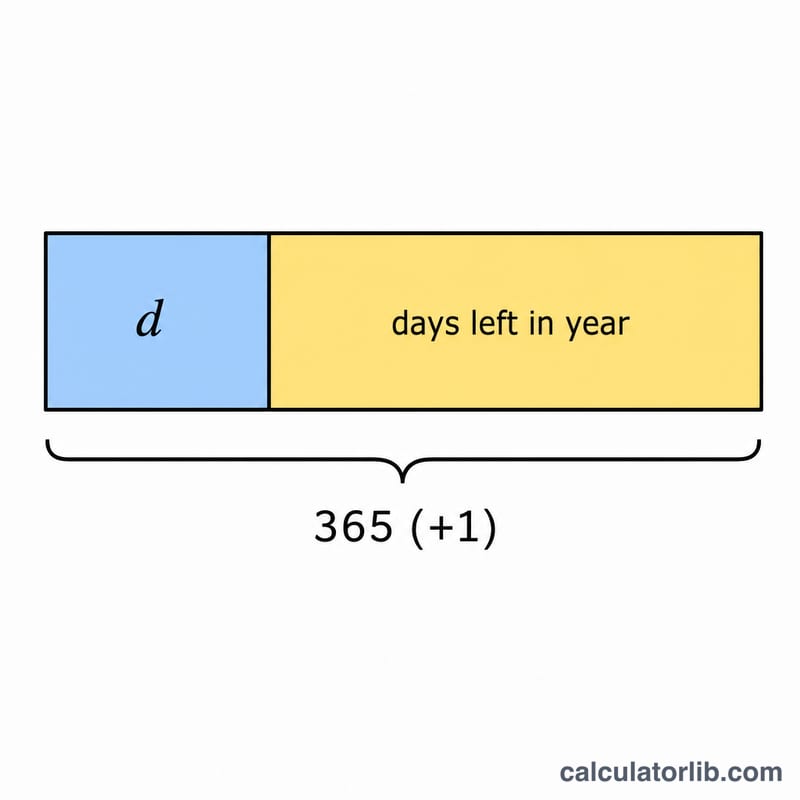
$$\text{daysLeft} = (365 + \text{leap}) - \text{dayOfYear}$$
Here leap is 1 if the year is a leap year and 0 otherwise, so a leap year has 366 total days. The dayOfYear is the sequential position of your date in the year. A leap year is any year divisible by 4, except century years which must also be divisible by 400 — so 2000 and 2024 are leap years, but 1900 and 2100 are not.
Worked example
Take December 25, 2023. That year is not a leap year, so total days = 365. December 25 is day 359 of the year (\(31+28+31+30+31+30+31+31+30+31+30 = 334\) days through November, plus 25). So $$\text{daysLeft} = 365 - 359 = 6 \text{ days}$$ remaining.
Day-of-Year Reference Table by Month
Every date's day-of-year number is simply the cumulative number of days that fall before the 1st of its month, plus the day of the month. The cumulative offsets differ by one from March onward in a leap year, because 29 February adds an extra day. This table lists both sets of offsets for the Gregorian calendar (the civil calendar used in most of the world).
| Month | Days in month (common / leap) | Cumulative days before the 1st — common year | Cumulative days before the 1st — leap year | Day-of-year of the 1st (common / leap) |
|---|---|---|---|---|
| January | 31 / 31 | 0 | 0 | 1 / 1 |
| February | 28 / 29 | 31 | 31 | 32 / 32 |
| March | 31 / 31 | 59 | 60 | 60 / 61 |
| April | 30 / 30 | 90 | 91 | 91 / 92 |
| May | 31 / 31 | 120 | 121 | 121 / 122 |
| June | 30 / 30 | 151 | 152 | 152 / 153 |
| July | 31 / 31 | 181 | 182 | 182 / 183 |
| August | 31 / 31 | 212 | 213 | 213 / 214 |
| September | 30 / 30 | 243 | 244 | 244 / 245 |
| October | 31 / 31 | 273 | 274 | 274 / 275 |
| November | 30 / 30 | 304 | 305 | 305 / 306 |
| December | 31 / 31 | 334 | 335 | 335 / 336 |
To use the table, add the day of the month to the cumulative value for that month:
$$N_{\text{day}} = C_{\text{month}} + \text{day} \quad\text{(add 1 more if the year is a leap year and the month is March or later)}$$
Worked example — 19 September 2026. The year 2026 is not divisible by 4, so it is a common year of 365 days. From the table, the cumulative offset for September in a common year is 243:
$$N_{\text{day}} = 243 + 19 = 262 \qquad D_{\text{left}} = 365 - 262 = 103$$
So 19 September 2026 is day 262 of the year, and there are 103 days left in the year after it. In a leap year the same calendar date sits one day later in the count: 1 September 2024 is day 245 rather than 244.
A quick check on the last row: December's leap-year offset of 335 plus 31 days gives 366, which is exactly the length of a leap year — confirming the offsets are consistent.
Key Terms Explained
- Day-of-year (ordinal date) — the position of a date counting from the start of the year, where 1 January = 1. It runs 1–365 in a common year and 1–366 in a leap year. 31 December is day 365 or 366 respectively.
- Days left in the year — the number of whole days remaining after the given date, up to and including 31 December. It is the total length of the year minus the day-of-year number: \(D_{\text{left}} = (365 + L) - N_{\text{day}}\), where \(L\) is 1 for a leap year and 0 otherwise. On 31 December the result is 0.
- Calendar year — the period from 1 January to 31 December inclusive. It is distinct from a fiscal, tax or academic year, which can start in any month depending on the country or institution.
- Common year — a calendar year of 365 days, with 28 days in February.
- Leap year — a calendar year of 366 days, with a 29th day added to February to keep the calendar aligned with the solar year (about 365.2422 days).
- Gregorian leap rule — in the Gregorian calendar a year is a leap year if it is divisible by 4, except that years divisible by 100 are not, unless they are also divisible by 400. So 2024 and 2000 are leap years, while 1900 and 2100 are not. This calculator applies the Gregorian rule; dates before the calendar's local adoption (1582 in Catholic Europe, 1752 in Britain and its colonies, later elsewhere) are treated as proleptic Gregorian and will not match historical records of the Julian calendar.
- ISO 8601 ordinal date (YYYY-DDD) — the international standard notation that writes a date as the year followed by a three-digit, zero-padded day-of-year, separated by a hyphen. For example, 19 September 2026 is written 2026-262, and 1 January 2026 is 2026-001. It is widely used in data formats, aviation and logistics because it sorts chronologically as plain text.
- Exclusive end-date convention — the counting rule used here: the input date itself is not counted among the days left, but 31 December is. So on 30 December the result is 1, not 2. If you need the date itself included (an "inclusive" count, as some deadline and billing rules require), add 1 to the result.
- Cumulative day offset — the fixed number of days in all months preceding a given month, listed in the reference table above (0, 31, 59, 90, 120, 151, 181, 212, 243, 273, 304, 334 for a common year). Adding the day of the month to this offset gives the day-of-year directly, with no need to sum month lengths each time.
FAQ
Does it count the entered date itself? No. The result is the number of days after the date you enter, ending on December 31.
How are leap years handled? In a leap year, February has 29 days and the total becomes 366, so dates from March onward shift by one day-of-year.
What if I enter an invalid day for the month? The tool clamps results to stay within the valid range of the year, so the day-of-year never exceeds the total days in the year.