What is the New Year's Countdown Calculator?
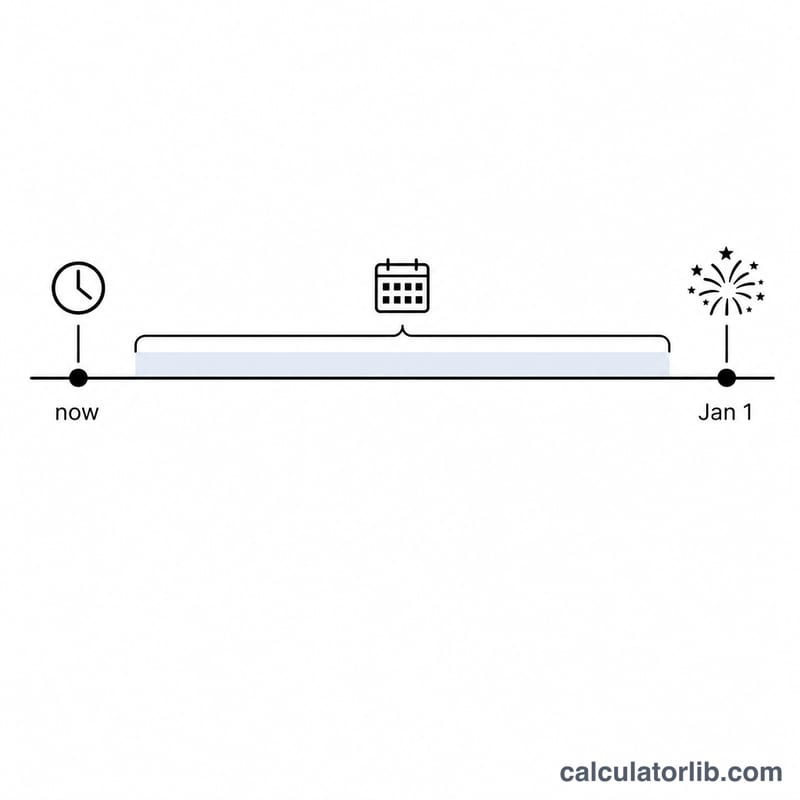
This tool tells you exactly how much time remains until the start of the next calendar year — January 1st at 00:00 (midnight). Pick any date and time, and it returns the remaining days, hours and minutes, plus the totals expressed entirely in days, hours and minutes.
How to use it
Enter or pick a "current date and time". By default it is pre-filled with the server's clock, but you can choose any moment in any year. The calculator then computes the gap to the following New Year and breaks it into an easy-to-read countdown.
The formula explained
The target is always January 1st of the year after the one you entered, set to midnight. The difference is measured in milliseconds, then divided down: 86,400,000 ms per day, 3,600,000 ms per hour, 60,000 ms per minute. The whole days are taken first, then the leftover hours, then leftover minutes.
$$\Delta t = \text{Jan 1, }\left(\text{Year}+1\right)\;00\!:\!00 \;-\; \text{Current date and time}$$$$\begin{gathered} \Delta t = T_{\text{target}} - \text{Current date and time} \\[1.5em] \text{where}\quad \left\{ \begin{aligned} T_{\text{target}} &= \text{Jan 1, }(\text{Year}+1)\;00\!:\!00 \\ \text{Days} &= \left\lfloor \tfrac{\Delta t}{86400} \right\rfloor \\ \text{Hours} &= \left\lfloor \tfrac{\Delta t}{3600} \right\rfloor - 24\,\text{Days} \\ \text{Minutes} &= \left\lfloor \tfrac{\Delta t}{60} \right\rfloor - 60(24\,\text{Days} + \text{Hours}) \end{aligned} \right. \end{gathered}$$
Worked example
Suppose the moment is December 31, 2024 at 23:00. The next New Year is January 1, 2025 at 00:00 — exactly one hour away. The calculator shows 0 days, 1 hour, 0 minutes, and a total of 60 minutes (0.04 days).
$$\Delta t = \text{Jan 1, 2025 }00\!:\!00 \;-\; \text{Dec 31, 2024 }23\!:\!00 = 3600\ \text{s} = 60\ \text{min}$$
Countdown Results at Different Dates
The table shows the time left until the next January 1 at 00:00 from several sample moments, each taken at 00:00 unless stated. Counts assume a common (365-day) year.
| Starting moment | Days | Hours | Minutes | Total hours |
|---|---|---|---|---|
| Jan 1, 00:00 (a full year) | 365 (366 in a leap year) | 0 | 0 | 8,760 (8,784 in a leap year) |
| Jul 1 | 184 | 0 | 0 | 4,416 |
| Oct 31 | 62 | 0 | 0 | 1,488 |
| Dec 1 | 31 | 0 | 0 | 744 |
| Dec 25 | 7 | 0 | 0 | 168 |
| Dec 31, 12:00 | 0 | 12 | 0 | 12 |
Check for Jul 1: the days remaining are July 31 + August 31 + September 30 + October 31 + November 30 + December 31 = 184, and \(184 \times 24 = 4{,}416\) hours.
Leap years: in a leap year such as 2024, any start date before February 29 includes the extra day. For example, Jan 1, 2024 00:00 to Jan 1, 2025 is 366 days (8,784 hours). Starting dates from March 1 onward are unaffected, so the rows from Jul 1 to Dec 31 stay the same.
Time Constants Used
| Quantity | Value |
|---|---|
| Milliseconds per day | 86,400,000 |
| Milliseconds per hour | 3,600,000 |
| Milliseconds per minute | 60,000 |
| Seconds per day | 86,400 |
| Hours per day | 24 |
| Minutes per hour | 60 |
| Days in a common year | 365 |
| Days in a leap year | 366 |
These values are consistent: \(24 \times 60 \times 60 = 86{,}400\) seconds per day, and \(86{,}400 \times 1000 = 86{,}400{,}000\) milliseconds per day.
Leap-year rule (Gregorian calendar): a year is a leap year if it is divisible by 4, except century years, which must also be divisible by 400. So 2024 and 2000 are leap years, while 1900 and 2100 are not.
Daylight saving time: where clocks change, a local calendar day can last 23 or 25 hours. A countdown that spans a clock change can therefore differ by one hour from a simple "days × 24" estimate. This applies only in regions that observe daylight saving time.
FAQ
Which New Year does it count to? Always the next January 1st after the year you entered.
Does it account for leap years? Yes — it uses real calendar dates, so leap days are handled automatically.
What if I pick a date already in January? It still counts to the following January 1st, since the target year is the entered year plus one.