
What is the Countdown to Summer Calculator?
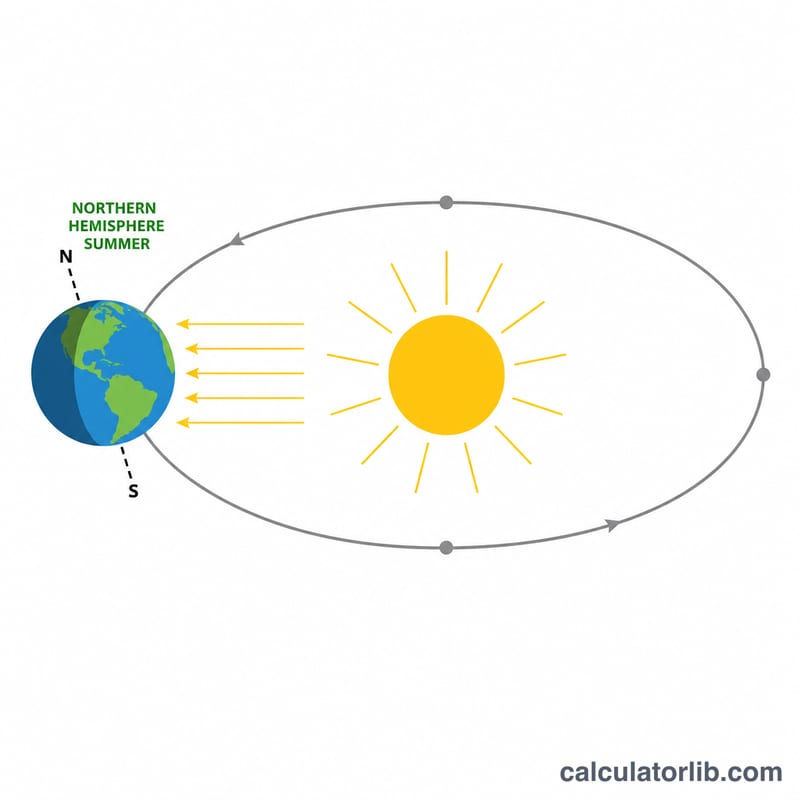
This tool tells you exactly how many days and weeks remain until the next summer solstice — the astronomical start of summer and the longest day of the year. The Northern Hemisphere summer solstice falls around June 20–21, while the Southern Hemisphere reaches its summer solstice around December 21–22. Pick your hemisphere and a starting date, and the calculator shows the countdown to the upcoming solstice.
How to use it
Choose the date you want to count from (often today), select your hemisphere, and read the result. If the chosen summer solstice has already passed for the current year, the calculator automatically rolls forward to next year's solstice, so you always get a positive countdown.
The formula
We take the millisecond timestamp of the target solstice and subtract the timestamp of your chosen date, then divide by the number of milliseconds in a day (86,400,000). Weeks are the whole-number part of days divided by seven. We use a fixed solstice date of June 21 (north) or December 21 (south) as a reliable approximation; the true astronomical moment can vary by a day.
$$\text{Days} = \left\lceil \text{June 21}_{\,\text{next}} - \text{From Date} \right\rceil$$
$$\text{Days} = \left\lceil \text{December 21}_{\,\text{next}} - \text{From Date} \right\rceil$$
Worked example
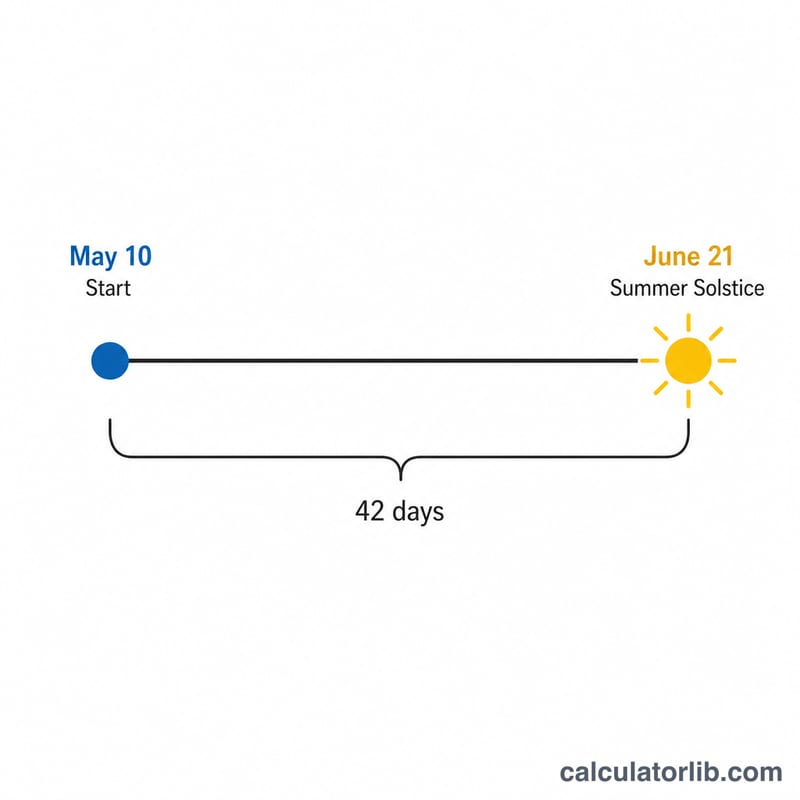
From June 1, 2024 in the Northern Hemisphere: June 21, 2024 minus June 1, 2024 = 20 days, which is 2 whole weeks, arriving in 2024. From July 1, 2024, the June 21 solstice has already passed, so the count rolls to June 21, 2025 — that's 355 days away.
$$\text{June 21, 2024} - \text{June 1, 2024} = 20 \text{ days} = 2 \text{ weeks}$$
FAQ
Why June 21 and not June 20? The exact solstice shifts between June 20 and 21 year to year. We use June 21 as a consistent estimate; expect up to a day of variation.
What about the Southern Hemisphere? Southern summer begins at the December solstice (~Dec 21), so select "Southern" to count toward that date.
Can I count from a past date? Yes — enter any date and the calculator finds the next solstice on or after it.