
What Is the Easter Date Calculator?
Easter is a "movable feast" — its date changes every year. It falls on the first Sunday after the first full moon (the Paschal Full Moon) on or after the spring equinox. Because this rule mixes the solar calendar with lunar cycles, working out the date by hand is tricky. This calculator uses the well-known Gregorian Computus (the "Anonymous" or Gauss-style algorithm) to instantly return the exact month and day of Easter Sunday for any year from 1583 onward, when the Gregorian calendar took effect.
How to Use It
Simply enter a year (for example 2025) and the calculator returns Easter Sunday's date — the month (March or April) and the day of the month. Western Christian churches that follow the Gregorian calendar (Roman Catholic and most Protestant denominations) observe this date. Eastern Orthodox churches often use the Julian calendar and may arrive at a different date.
The Formula Explained
The algorithm breaks the year down into a series of integer (whole-number) divisions and remainders. Starting values capture the year's position in the 19-year Metonic lunar cycle (\(a\)), the century (\(b\), \(c\)), and leap-year corrections (\(d\), \(e\), \(f\), \(g\)). The key value \(h\) locates the Paschal Full Moon, and \(L\) shifts it to the following Sunday. Finally \(m\), the month, and the day are derived. All divisions are integer divisions that discard the remainder.
$$\begin{gathered} \text{Month} = \left\lfloor \frac{h + L - 7m + 114}{31} \right\rfloor, \quad \text{Day} = \left((h + L - 7m + 114) \bmod 31\right) + 1 \\[1.5em] \text{where}\quad \left\{ \begin{aligned} a &= \text{Year} \bmod 19 \\ b &= \left\lfloor \text{Year} / 100 \right\rfloor, \quad c = \text{Year} \bmod 100 \\ d &= \left\lfloor b/4 \right\rfloor, \quad e = b \bmod 4, \quad f = \left\lfloor (b+8)/25 \right\rfloor \\ g &= \left\lfloor (b - f + 1)/3 \right\rfloor \\ h &= (19a + b - d - g + 15) \bmod 30 \\ i &= \left\lfloor c/4 \right\rfloor, \quad k = c \bmod 4 \\ L &= (32 + 2e + 2i - h - k) \bmod 7 \\ m &= \left\lfloor (a + 11h + 22L)/451 \right\rfloor \end{aligned} \right. \end{gathered}$$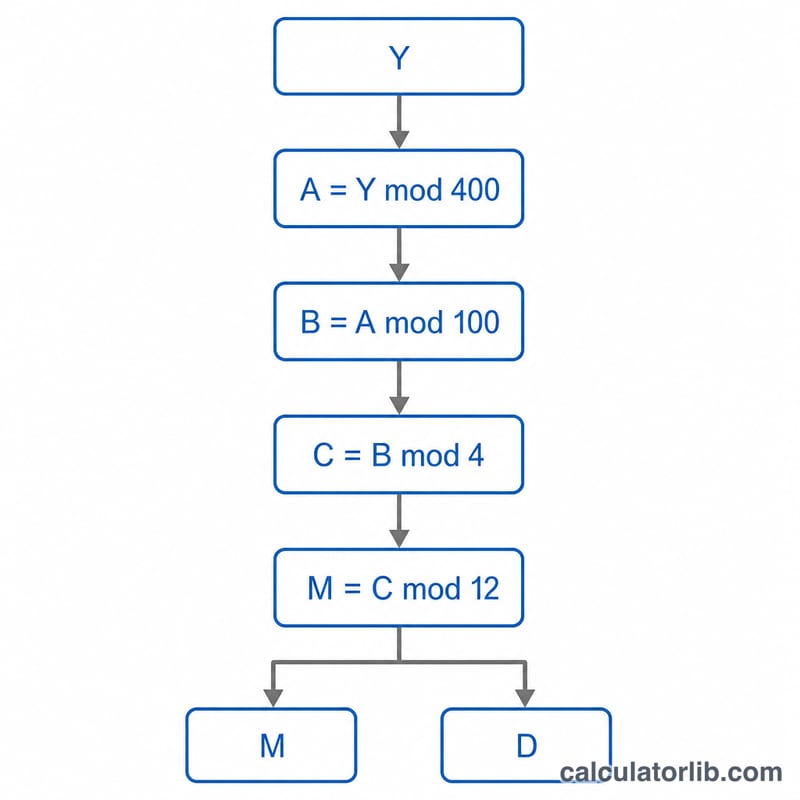
Worked Example (2025)
For year 2025: \(a = 2025 \bmod 19 = 11\); \(b = 20\), \(c = 25\), \(d = 5\), \(e = 0\), \(f = 0\), \(g = 6\). Then \(h = (209 + 20 - 5 - 6 + 15) \bmod 30 = 233 \bmod 30 = 23\). \(i = 6\), \(k = 1\), \(L = (32 + 0 + 12 - 23 - 1) \bmod 7 = 20 \bmod 7 = 6\). \(m = (11 + 253 + 132)/451 = 0\). \(\text{month} = (23 + 6 - 0 + 114)/31 = 143/31 = 4\) (April). \(\text{day} = (143 \bmod 31) + 1 = 19 + 1 = 20\). So Easter 2025 falls on April 20.
FAQ
Why does Easter move? It is tied to the lunar phase relative to the spring equinox, so it can land anywhere from March 22 to April 25.
Does this work for Orthodox Easter? No — this uses the Gregorian (Western) computus. Orthodox Easter is computed on the Julian calendar and can differ.
What years are valid? The Gregorian calendar began in 1583, so the calculator is accurate for 1583 and later.