What This Calculator Does
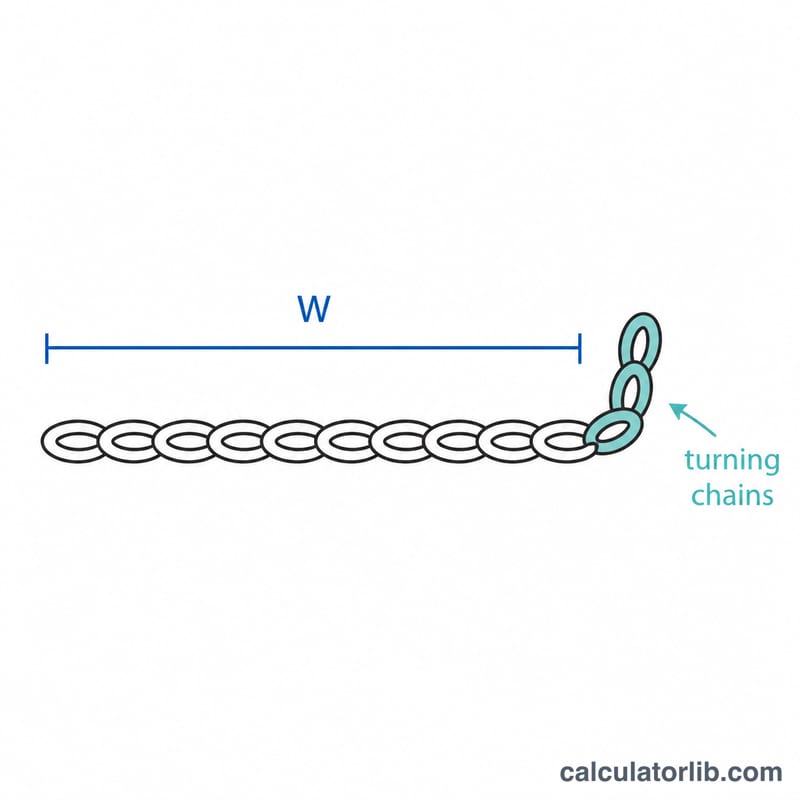
The Crochet Foundation Chain Calculator tells you exactly how many chain stitches to make before you start a row of crochet. Instead of guessing — and ending up with a piece that's too wide or too narrow — you enter the finished width you want, your gauge (stitches per inch), and any extra turning chains your stitch pattern requires. The tool returns the total number of foundation chains to crochet.
How to Use It
Make a quick gauge swatch first: crochet a small square, then count how many stitches fit in one inch — that's your stitches per inch. Measure or decide your desired width in inches. Add the turning/edge chains your pattern calls for (often 1 for single crochet, 2 for half double, 3 for double crochet). Hit calculate and chain that many stitches.
The Formula Explained
The math is simple: $$\text{chains} = \operatorname{round}\!\left(\text{desired width} \times \text{stitches per inch}\right) + \text{edge chains}$$ Multiplying width by gauge gives the number of working stitches your fabric needs to reach that width. We round to the nearest whole stitch (you can't make a fraction of a chain), then add the turning chains that lift your hook to the correct height for the first stitch.
Worked Example
You want a scarf 8 inches wide, your gauge is 4 stitches per inch, and you're working in double crochet (3 turning chains). Working stitches = \(8 \times 4 = 32\). Add 3 turning chains = 35 foundation chains. Chain 35 and you're ready to work your first row.
Turning Chains by Stitch Type
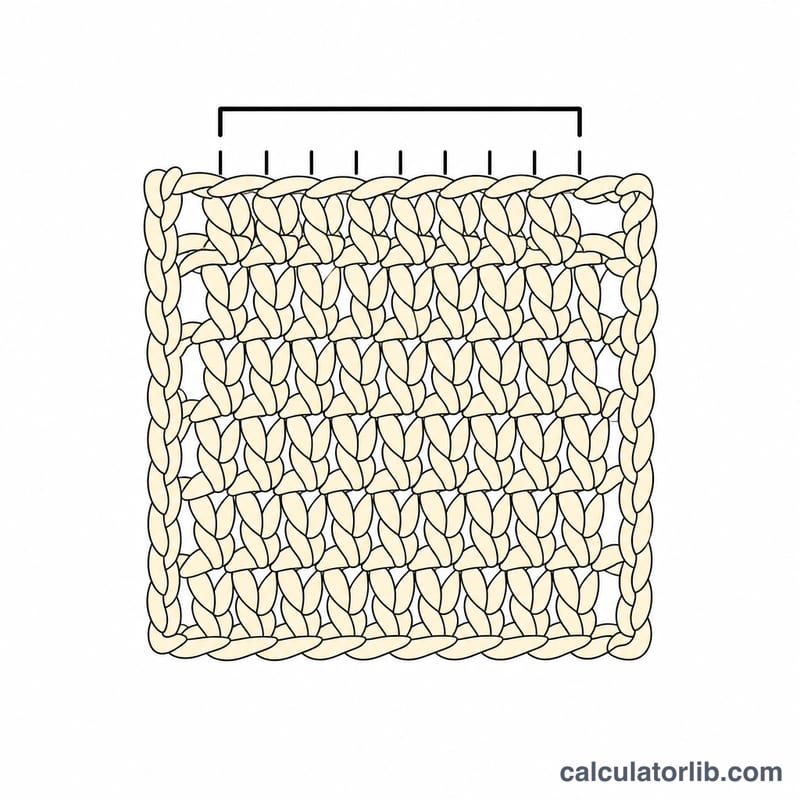
Each stitch has a typical turning chain that raises the hook to the height of the next row. The table shows common US-terminology conventions. The "Edge chains" value you enter in the calculator is normally the turning chain count (or the chains needed to reach the first stitch).
| Stitch | Typical turning chains | Usually counts as a stitch? |
|---|---|---|
| Slip stitch (sl st) | 0 (sometimes 1) | No |
| Single crochet (sc) | 1 | No |
| Half double crochet (hdc) | 2 | Varies; often yes, but many patterns say no |
| Double crochet (dc) | 3 | Yes |
| Treble crochet (tr) | 4 | Yes |
| Double treble (dtr) | 5 | Yes |
Patterns vary, and stitch names differ between US and UK terminology (for example, US single crochet is UK double crochet). Always check your pattern's instructions on how many chains to make and whether the turning chain counts as a stitch.
Foundation Chains for Common Project Widths and Gauges
These examples use \(\text{Chains} = \operatorname{round}(\text{width} \times \text{gauge}) + \text{edge chains}\), with gauge in stitches per inch.
| Width (in) | Gauge (st/in) | Stitch (edge chains) | Calculation | Foundation chains |
|---|---|---|---|---|
| 6 | 4 | sc (1) | 6 × 4 = 24; 24 + 1 | 25 |
| 8 | 3.5 | hdc (2) | 8 × 3.5 = 28; 28 + 2 | 30 |
| 10 | 3 | dc (3) | 10 × 3 = 30; 30 + 3 | 33 |
| 14 | 2.5 | dc (3) | 14 × 2.5 = 35; 35 + 3 | 38 |
If width × gauge is not a whole number, it is rounded to the nearest whole stitch before the edge chains are added.
Practical Tips for Chaining the Right Length
- Swatch in the real stitch pattern. Gauge changes with stitch type, yarn and hook. Wash and block the swatch the way you will treat the finished item, then measure stitches per inch.
- Chain loosely. A tight foundation chain pulls in the bottom edge. Chain loosely or use a hook one size larger for the foundation only, then switch back.
- Match the stitch multiple. Many stitch patterns need a specific multiple, such as a multiple of 2 plus 1. Adjust the calculated count up or down to the nearest valid number.
- Add a few extra if unsure. Extra chains are easy to unravel, but too few means starting over. Count in groups of 10 to avoid mistakes.
- Use stitch markers. Place a marker every 10 or 20 chains so you can recount quickly, and mark the first chain from the hook as well.
- Check the pattern. If it gives its own foundation count or turning chain rule, follow that over a generic calculation.
FAQ
What is gauge? Gauge is how many stitches fit in a given measurement, usually one inch. It depends on your yarn, hook size, and tension, so always swatch.
How many turning chains should I add? A common guide: single crochet 1, half double crochet 2, double crochet 3, treble crochet 4. Always check your specific pattern.
Why round the stitches? Fabric is made of whole stitches, so we round \(\text{width} \times \text{gauge}\) to the nearest whole number before adding edge chains.