What is the Birthday Countdown Calculator?
The Birthday Countdown Calculator tells you exactly how long you have to wait until your next birthday. Just enter the month and day you were born, and it instantly works out the number of days, hours, minutes and seconds remaining. It is perfect for building excitement, planning a party, or simply satisfying your curiosity about how soon the big day arrives.
How to use it
Select your birth month from the dropdown and type your birth day (1–31). Leave the optional reference date/time blank to count from right now, or enter a specific moment in YYYY-MM-DD HH:mm:ss format to count down from that point. The calculator finds the next occurrence of your birthday — this year if it hasn't happened yet, otherwise next year — and subtracts the current time from it.
The formula explained
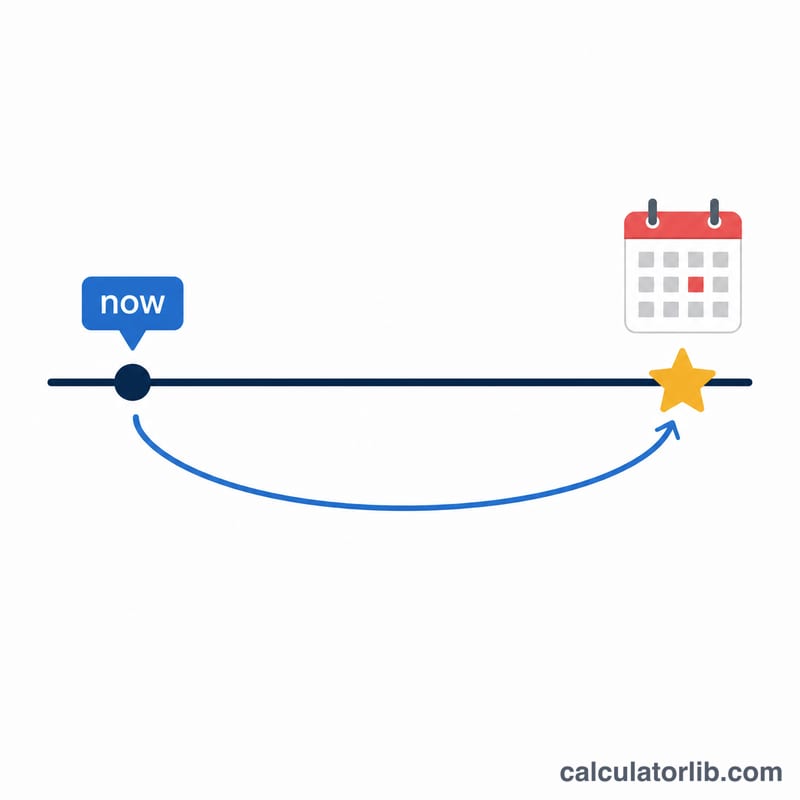
The core calculation is a simple time difference: countdown = next_birthday − now. Expressed formally:
$$\text{Days Until Birthday} = \left\lfloor \frac{\text{NextBirthday}(\text{Month},\ \text{Day}) - \text{Now}}{86400} \right\rfloor$$The result, measured in milliseconds, is converted to a total number of seconds and then split into whole days, hours, minutes and seconds:
$$\begin{gathered} \Delta = \text{NextBirthday} - \text{Now} \quad(\text{seconds}) \\[1.5em] \text{where}\quad \left\{ \begin{aligned} \text{NextBirthday} &= \text{midnight of } \text{Month}/\text{Day} \\ \text{Days} &= \left\lfloor \Delta / 86400 \right\rfloor \\ \text{Hours} &= \left\lfloor (\Delta \bmod 86400) / 3600 \right\rfloor \\ \text{Minutes} &= \left\lfloor (\Delta \bmod 3600) / 60 \right\rfloor \\ \text{Seconds} &= \Delta \bmod 60 \end{aligned} \right. \end{gathered}$$If your birthday for the current year is in the past (or is exactly now), the target rolls forward to the same date next year so the countdown is always positive.
Worked example
Suppose the reference moment is 2024-12-25 00:00:00 and your birthday is January 1. This year's January 1 has already passed, so the target becomes 2025-01-01 00:00:00. The gap is 7 days exactly, which equals 168 hours, 10,080 minutes, or 604,800 seconds — so the countdown shows 7 days, 0 hours, 0 minutes and 0 seconds.
$$\Delta = 604800 \text{ s} = \left\lfloor \frac{604800}{86400} \right\rfloor = 7 \text{ days}$$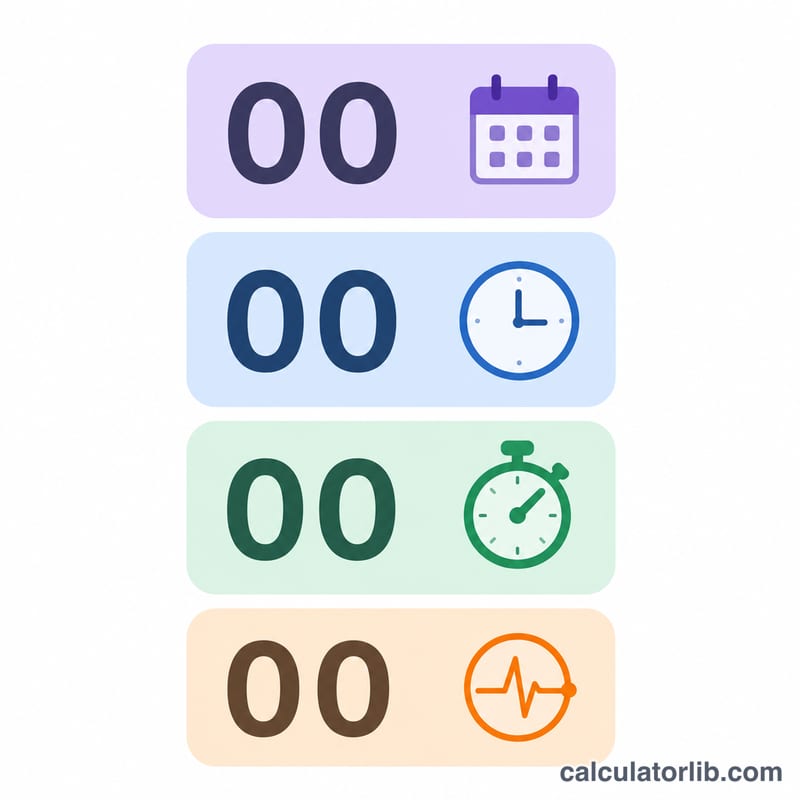
Countdown Results for Different Birthday Scenarios
The table uses a fixed reference moment of 2024-12-25 00:00:00 and shows how the countdown behaves for several birthdays. Days are whole days (the floor of the time difference divided by 86,400 seconds). Total hours are days × 24. These figures use the Gregorian calendar, and no daylight-saving shift is applied.
| Birthday | Target date | Days | Total hours |
|---|---|---|---|
| Dec 25 (today) | 2025-12-25 (rolls to next year) | 365 | 8,760 |
| Dec 26 | 2024-12-26 | 1 | 24 |
| Jan 1 | 2025-01-01 | 7 | 168 |
| Dec 24 (just passed) | 2025-12-24 | 364 | 8,736 |
| Feb 29 (leap day) | 2028-02-29 (next leap year) | 1,161 | 27,864 |
How the rows work:
- Dec 25: the birthday falls on the reference day itself, so this scenario treats it as already reached and counts to the next year. 2025 is a common year, so \(365\) days = \(365 \times 24 = 8{,}760\) hours.
- Dec 24: it passed one day earlier, so the next one is 2025-12-24, which is \(365 - 1 = 364\) days away, or \(364 \times 24 = 8{,}736\) hours.
- Feb 29: 2025, 2026 and 2027 have no Feb 29, so the next one is 2028-02-29. From 2024-12-25 to 2027-12-25 is \(3 \times 365 = 1{,}095\) days. Then 7 days to Jan 1, 31 days of January and 28 more days to Feb 29 add \(66\) days. The total is \(1{,}095 + 66 = 1{,}161\) days, or \(1{,}161 \times 24 = 27{,}864\) hours.
Some tools move a leap-day birthday to Feb 28 or Mar 1 in common years instead. That would shorten the Feb 29 countdown to about 65 or 66 days. The table above uses the true next Feb 29.
Time Constants Used in the Calculation
| Constant | Value |
|---|---|
| Seconds per minute | 60 |
| Seconds per hour | 3,600 (60 × 60) |
| Seconds per day | 86,400 (24 × 3,600) |
| Milliseconds per second | 1,000 |
| Milliseconds per day | 86,400,000 |
| Days in a common year | 365 |
| Days in a leap year | 366 |
Leap-year rule (Gregorian calendar)
A year is a leap year if it is divisible by 4, except century years (such as 1900 or 2100), which are leap years only if they are also divisible by 400. So 2024 and 2028 are leap years, 1900 was not, and 2000 was.
Days per month
| Days | Months |
|---|---|
| 31 | January, March, May, July, August, October, December |
| 30 | April, June, September, November |
| 28 (29 in a leap year) | February |
The calculator converts the difference between the next birthday and the current moment into seconds, then divides by 86,400 and takes the floor to get whole days: \(\text{days} = \left\lfloor \frac{ \text{seconds remaining} }{86400} \right\rfloor\). The leftover seconds give the hours, minutes and seconds in the countdown.
FAQ
What if my birthday is today? If the birthday matches the reference moment exactly, the countdown rolls to next year so you see a full year remaining rather than zero.
Does it handle leap years? Yes. The calculator uses a real calendar, so the number of days naturally accounts for February 29 when relevant.
Why are the seconds frozen? This is a snapshot calculation based on the reference time you submit; reload or resubmit to refresh the countdown to the current moment.