What this calculator does
The Age to Birthday Calculator tells you exactly how many days are left until your next birthday. Simply enter the month and day you were born, along with today's date, and the tool counts the days, weeks, and tells you which calendar year your birthday will fall in. It's a fun and practical countdown for planning parties, gifts, and milestones.
How to use it
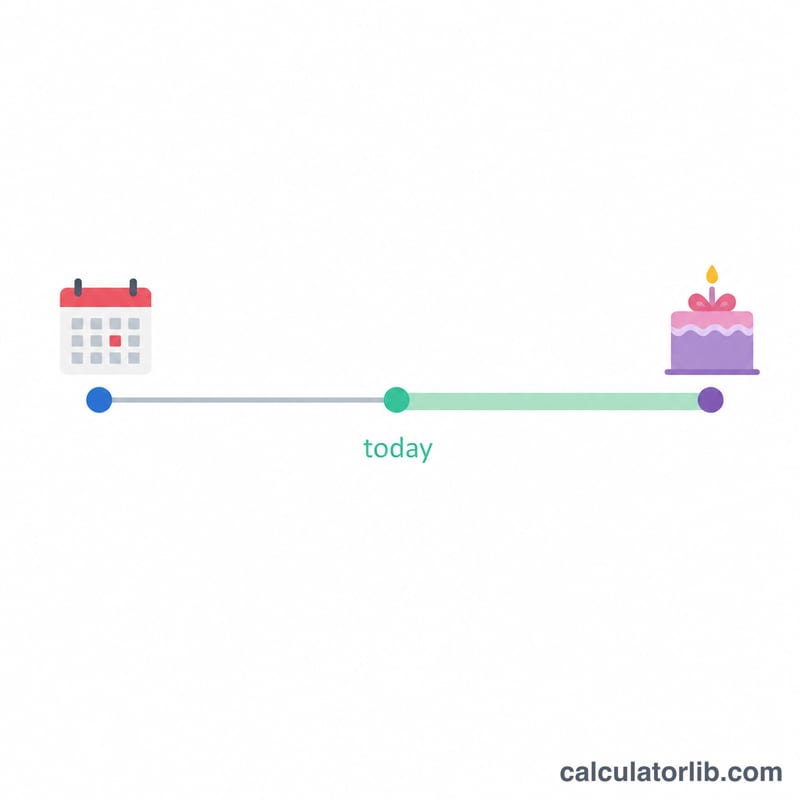
Pick your birth month from the dropdown and type your birth day. Then enter today's date (year, month, and day). The calculator finds the next time your birthday occurs on or after today and counts the days between the two dates. If your birthday has already happened this year, it automatically rolls forward to next year.
The formula explained
The core calculation is a simple date difference: $$\text{Days} = \text{Next Birthday Date} - \text{Today}$$ The calculator builds a date for your birthday in the current year. If that date is earlier than today, it adds one year so the result is always a future (or same-day) birthday. The difference in milliseconds is divided by the number of milliseconds in a day (\(86{,}400{,}000\)) and rounded to whole days, correctly handling leap years through the calendar engine.
Worked example
Suppose today is June 1, 2024 and your birthday is December 25. December 25, 2024 is later than June 1, 2024, so we count the days between them. From June 1 to December 25, 2024 there are \(207\) days. That's \(29\) weeks and \(4\) days, with the birthday landing in the year 2024. $$\text{Weeks} = \left\lfloor \frac{207}{7} \right\rfloor = 29,\quad \text{Rem} = 207 \bmod 7 = 4$$
Countdown Across Different Birth Dates
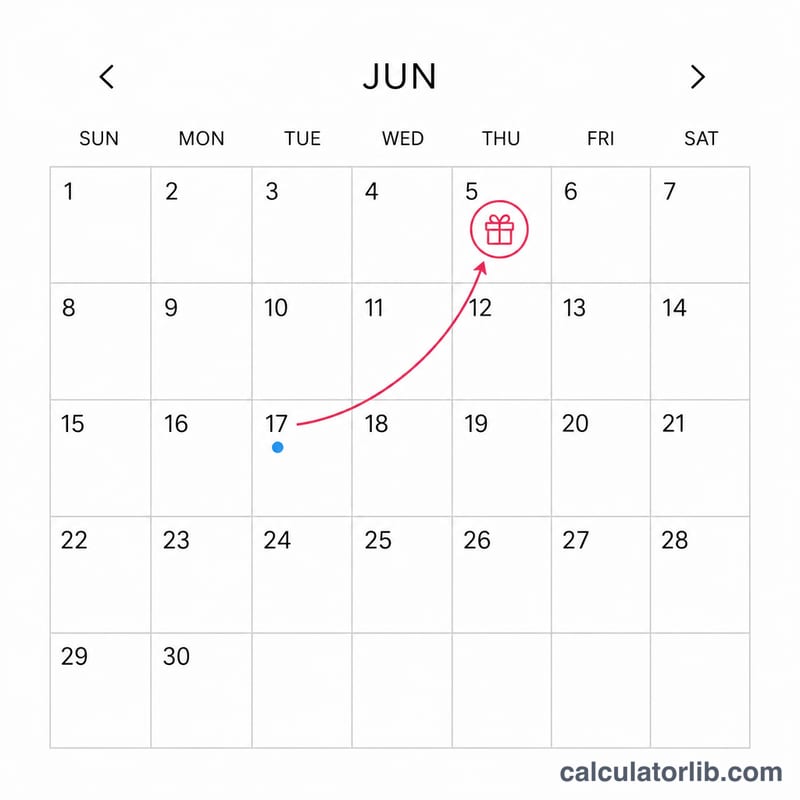
All rows below use the same fixed reference date: today = June 1, 2024. The countdown is a plain calendar difference — today is not counted, and the birthday itself is the day the count lands on. Because the reference date sits in the middle of the year, some birthdays still fall in 2024 while earlier ones roll forward into 2025.
| Birthday | Next Birthday Date | Days Until | Weeks + Days | Birthday Year |
|---|---|---|---|---|
| January 15 | January 15, 2025 | 228 | 32 weeks + 4 days | 2025 (already passed this year) |
| February 29 | February 28 or March 1, 2025 (see note) | 272 or 273 | 38 weeks + 6 days, or 39 weeks + 0 days | 2025 (observed date) |
| June 1 | June 1, 2024 | 0 | 0 weeks + 0 days | 2024 (today is the birthday) |
| September 30 | September 30, 2024 | 121 | 17 weeks + 2 days | 2024 (still to come) |
| December 25 | December 25, 2024 | 207 | 29 weeks + 4 days | 2024 (still to come) |
Note on February 29. A leap-day birthday has no exact calendar match in a common year. 2025 is not a leap year, so the countdown must land on an observed date: counting to February 28, 2025 gives 272 days, and counting to March 1, 2025 gives 273 days. The next real February 29 after June 2024 falls in 2028, which is more than a year away and therefore outside a one-year countdown.
The Weeks + Days column is nothing more than the day count split by 7 — for example \(228 = 32 \times 7 + 4\) and \(121 = 17 \times 7 + 2\).
How to Count the Days by Hand
Month lengths (Gregorian calendar): 31 days — January, March, May, July, August, October, December; 30 days — April, June, September, November; 28 days — February, or 29 in a leap year.
- Write down today's date (year, month, day) and your birth month and day. The birth year does not affect the countdown at all — only the month and day matter.
- Compare your birth month and day with today's month and day. If the birthday is later in the year, it falls in the current year; if it is earlier, it has already passed and rolls into the next year. If month and day match exactly, the answer is 0.
- Count the days left in the current month: \(\text{days in this month} - \text{today's day number}\).
- Add the full length of every month that lies completely between today and the birthday month, using the 31 / 30 / 28–29 lengths above.
- Add the birthday's day-of-month.
- If February is one of the months you crossed, check whether that February belongs to a leap year: the year must be divisible by 4, except century years, which must also be divisible by 400. So 2024 and 2000 are leap years; 1900 and 2100 are not. Use 29 instead of 28 only in those years.
- Divide the total by 7. The quotient is whole weeks and the remainder is the leftover days.
Short run-through. Today is March 10, 2025; the birthday is November 7. November is later than March, so the birthday falls in 2025.
$$21 + (30 + 31 + 30 + 31 + 31 + 30 + 31) + 7 = 21 + 214 + 7 = 242$$
The 21 is the rest of March (\(31 - 10\)), the bracket is April through October in full, and the 7 is November 7 itself. The answer is 242 days. February was never crossed, so the leap-year check does not apply here. Splitting into weeks: \(242 \div 7 = 34\) remainder \(4\), i.e. 34 weeks and 4 days.
Understanding Your Countdown Result
The number returned is a count of whole calendar days that excludes today and includes the birthday. Read it like this:
- 0 — today is the birthday.
- 1 — the birthday is tomorrow.
- 7 — the birthday is one week from today, on the same weekday.
Because the next birthday is always within one year of the reference date, the count can never exceed the length of a year. A year between two consecutive birthdays is 365 days, or 366 when a February 29 falls between them. Since today itself is not counted, the largest value you can actually see is one less: 364 days in the ordinary case, and 365 days when a February 29 lies in the interval. That maximum occurs when the birthday passed just yesterday.
February 29 birthdays. A true February 29 exists only in leap years, which arrive every four years under the Gregorian rule (divisible by 4, except century years not divisible by 400). In a common year there is no such date, so the birthday is observed by convention on either February 28 or March 1 — a choice that shifts the countdown by exactly one day. Different countries and institutions use different conventions for legal purposes, so if the exact day matters for a document or deadline, check the rule that applies where you are rather than assuming one answer.
Weeks and days. The weeks-plus-days figure carries no extra information; it is only the day count rewritten in base 7, so that \(d = 7w + r\) where \(w\) is whole weeks and \(r\) is the remainder in days. A remainder of 0 means the birthday falls on the same weekday as the reference date.
What the result is not. The countdown is computed from the reference date you type into the todayYear, todayMonth and todayDay fields — not from a live clock. It has no hours, minutes, time-of-day or time-zone component, so it will not change as the day advances; it changes only when you enter a different reference date. Crossing a time zone, or a birth time recorded in another zone, can shift which calendar date counts as "today" for you, and in that case you should enter the date as it stands in the place you care about.
FAQ
What if today is my birthday? The result will be 0 days — happy birthday! The calculator only rolls to next year when the birthday is strictly before today.
Does it handle leap years? Yes. The date math uses a real calendar, so February 29 and leap-year spacing are accounted for automatically.
Why do I enter today's date manually? Entering the date keeps results reproducible and lets you check a countdown for any reference day, not just the present moment.