
What is the Insomnia Severity Index?
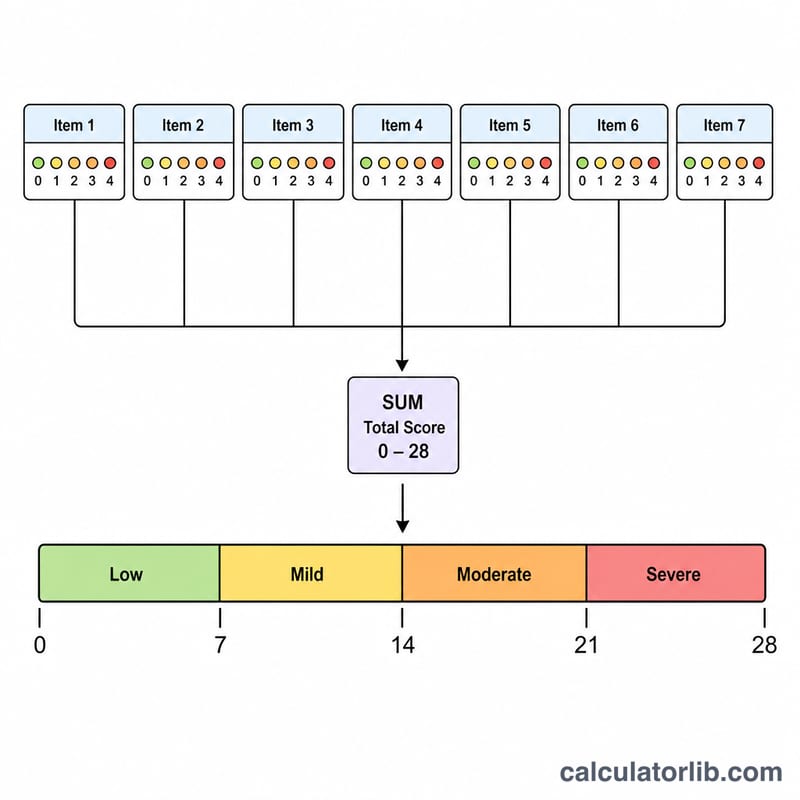
The Insomnia Severity Index (ISI) is a widely used 7-item self-report questionnaire that measures the nature, severity, and impact of insomnia. Each item is rated on a 0–4 scale, producing a total score from 0 to 28. It is used in research and clinical practice to screen for insomnia and to track treatment progress over time. This tool is an educational screening aid only and does not replace assessment by a qualified healthcare professional.
How to use this calculator
Answer each of the seven questions based on how you have been over the past two weeks. The first three items rate the severity of difficulty falling asleep, staying asleep, and waking too early. The remaining items rate satisfaction with sleep, how noticeable the problem is, your level of worry, and how much sleep difficulty interferes with daily functioning. Select the option that best fits, then submit to see your total score and its interpretation.
The formula explained
The ISI total is simply the arithmetic sum of all seven item scores: $$\text{ISI} = \text{Q1} + \text{Q2} + \text{Q3} + \text{Q4} + \text{Q5} + \text{Q6} + \text{Q7}$$ Since each item ranges from 0 to 4, the minimum total is 0 and the maximum is 28. Standard cut-offs are: 0–7 = no clinically significant insomnia; 8–14 = subthreshold insomnia; 15–21 = moderate clinical insomnia; 22–28 = severe clinical insomnia.
Worked example
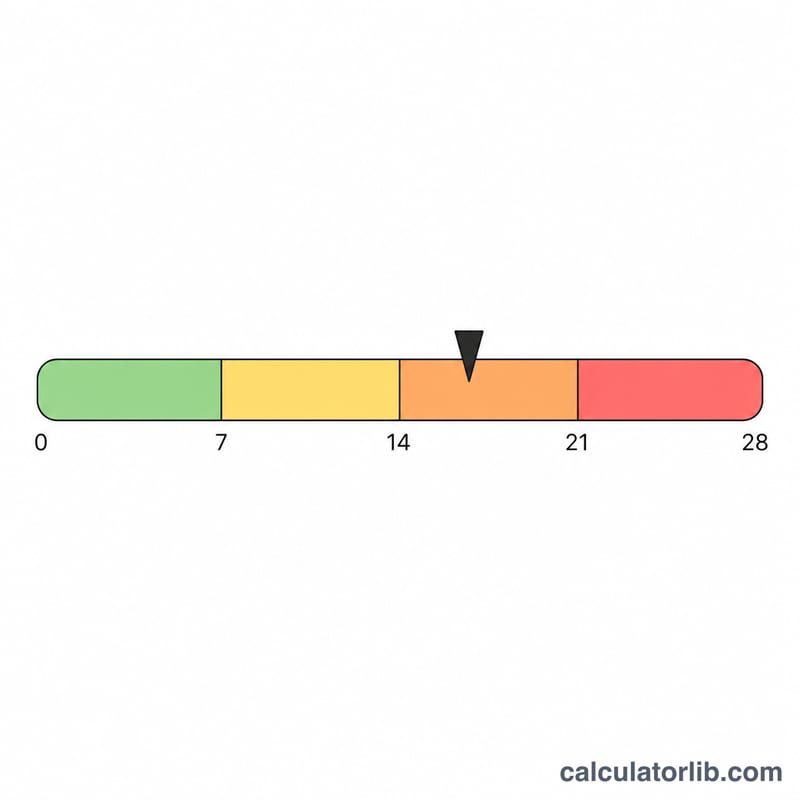
Suppose someone answers: 3, 2, 2, 3, 2, 3, 3. The sum is $$3 + 2 + 2 + 3 + 2 + 3 + 3 = 18.$$ A score of 18 falls in the 15–21 band, indicating clinical insomnia of moderate severity.
FAQ
Is a high score a diagnosis? No. The ISI is a screening instrument; only a clinician can diagnose insomnia disorder.
What time frame should I consider? The standard ISI asks about the last two weeks.
What change in score is meaningful? Research often considers a reduction of about 6 or more points to reflect clinically meaningful improvement.